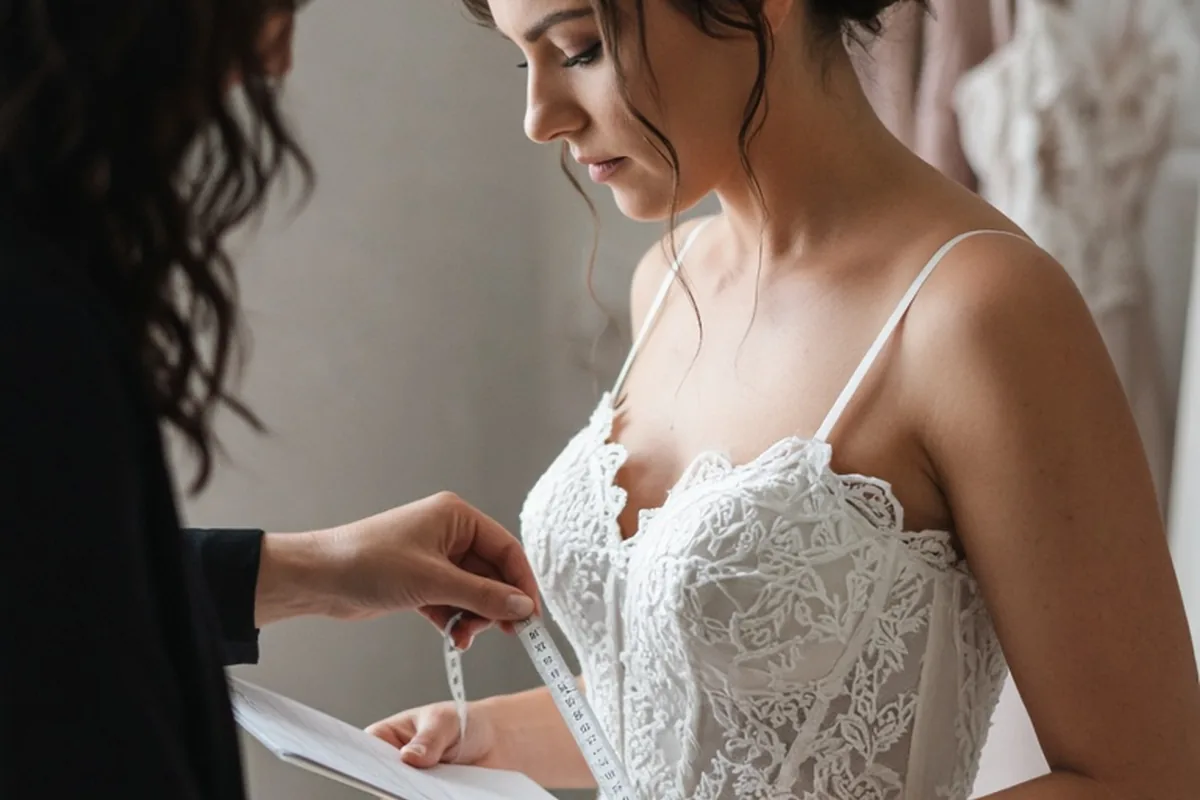
To budget for wedding dress sizing, separate the retail gown price from tailoring and sizing costs. Plan for three distinct expenses: custom or split-sizing production fees from the designer, labor for foundational alterations such as side seams, hemming, and bustles, and incidentals like foundation garments, rush fees, or multiple fittings. Because bridal size charts rarely match street clothing sizes, sizing expenses depend on dress construction, fabric layers, and local tailoring rates rather than retail price.
Purchasing a wedding gown involves more than selecting a design from a boutique rack; it requires planning for the complex tailoring necessary to achieve a secure, comfortable fit. Street clothing uses standardized industrial sizing, but bridal gowns are engineered with rigid internal structures, layered textiles, and traditional measurements that necessitate dedicated sizing budgets.
Bridal Size Charts Compared to Standard Everyday Sizing
Bridal sizing standards differ significantly from contemporary ready-to-wear fashion. Most bridal manufacturers base their patterns on European sizing conventions from decades past, which means a bridal gown label often reflects a numerical size larger than an individual's everyday street size. When a salon takes your bust, waist, and hip measurements, they compare those numbers to a designer-specific chart. If your bust aligns with one size, your waist with another, and your hips with a third, standard practice dictates ordering the size that accommodates your largest individual measurement.
Ordering to your largest measurement ensures the gown contains enough raw seam allowance to close comfortably around the body, but it also guarantees that the other areas will require tailoring. Budgeting for sizing begins at this initial ordering stage. If you purchase a gown tailored for your hips, the bodice, armholes, and straps may require substantial reduction. Understanding that bridal sizing charts prioritize the widest measurement allows you to anticipate where fabric will need to be taken in, preventing unexpected tailoring bills later in the planning process.
Essential Labor Line Items in Wedding Dress Sizing
A complete sizing budget breaks down into several technical tailoring tasks rather than a single flat fee. The most common sizing adjustment is bodice contouring, which involves opening the side seams, reshaping princess seams, taking in the back zipper or button placket, and resetting internal boning channels. Bodices with integrated bra cups or complex illusion mesh require delicate hand-stitching to resize without distorting the symmetry of the neckline or armholes.
The skirt hem and the train bustle form the second major labor category. Hemming a bridal gown is rarely a simple trim; it frequently requires lifting layers of crinoline, horsehair braid, lining, and delicate lace borders. When lace appliqués run along the hemline, seamstresses must unpick each motif by hand, shorten the foundational tulle, and hand-sew the lace back into place. Additionally, the bustle—which lifts the train off the floor for the reception—is constructed from scratch using an intricate network of loops, buttons, or ribbons matched to the specific weight and drape of the gown.
Designer Made-to-Measure Options Versus Local Tailoring
When purchasing your gown, salons may offer split-sizing or made-to-measure services directly from the manufacturer for an additional fee. Split-sizing allows the factory to cut the bodice in one standard size and the skirt in another, which reduces the amount of reduction needed later. Made-to-measure orders go a step further, cutting the gown panels according to a full set of your personal body measurements rather than a standard chart.
While these manufacturer upgrades reduce major structural modifications, they rarely eliminate the need for local alterations. Factory-produced custom sizing builds a general silhouette based on static numbers, but it cannot account for your posture, shoulder slope, or subtle asymmetries. You must decide whether to invest part of your sizing budget into factory customization upfront or allocate the entire fund toward an independent local bridal seamstress who can sculpt the standard dress directly onto your body during in-person fittings.
Fabric Mechanics, Appliqués, and Hidden Labor Drivers
The architectural complexity of your wedding dress directly dictates the time a seamstress must spend resizing it. Clean, minimalist gowns made of crepe, silk faille, or satin require high precision because every stitch line is visible, yet they are generally less labor-intensive to open and resew than heavily embellished styles. Intricate dresses featuring allover beadwork, sequins, or multi-layered French lace require hours of manual preparation before a machine stitch can even be placed.
To resize a beaded seam, a tailor must carefully remove individual beads and sequins along the seam line to prevent sewing machine needle breakage and puckered fabric. Once the seam is resized and pressed, those beads must be individually hand-sewn back over the altered area to maintain visual continuity. Intricate boning structures, horsehair-edged hems, and delicate illusion panels similarly increase labor hours. Evaluating these textile details before finalizing your dress purchase helps you forecast whether your sizing budget will fall on the moderate or complex end of the scale.
Fitting Schedules, Weight Fluctuations, and Rush Surcharges
A typical sizing timeline consists of three to four fittings spread over several months. The initial fitting generally occurs two to three months before the wedding date, focusing on pinning the core silhouette, adjusting the side seams, and setting the baseline for the hem. The second fitting refines the bodice fit, tests the undergarments, and builds the bustle system. A final fitting, scheduled two to four weeks prior to the event, verifies that the fit remains secure and comfortable under normal movement.
Altering a gown too early risks fit discrepancies caused by natural weight fluctuations, while starting too late incurs premium rush fees. If your weight changes between the second and final fitting, your seamstress may need to perform emergency adjustments, adding labor costs to the final invoice. To protect your budget, maintain consistent physical habits once alterations begin and verify your tailor’s policy regarding late adjustments, overtime fees, and short-turnaround deadlines.
Undergarments, Footwear, and Foundation Alignment
A gown cannot be accurately sized without the exact shoes and undergarments you plan to wear on the wedding day. The height of your shoe heel determines where the seamstress pins the hemline; changing from a two-inch heel to a flat sandal after the hem is pinned requires the entire skirt to be re-measured and re-sewn, duplicating the labor cost. Even a subtle change in heel thickness alters your pelvic tilt, which can throw off the skirt balance and train drape.
Similarly, foundation garments fundamentally reshape the torso. Whether you plan to wear a specialized bustier, seamless shapewear, sewn-in bra cups, or no bra at all, that foundation must be worn at every single fitting. Sizing a bodice over one bra style and subsequently switching to another alters the bust apex, neckline tension, and back closure alignment. Budgeting for your foundation pieces and shoes before your first alteration appointment prevents the costly expense of redoing previously completed tailoring work.
How to Obtain and Compare Professional Sizing Quotes
Before committing to a gown purchase, ask your bridal salon for a transparent breakdown of expected alterations. Inquire whether their in-house alteration department charges a flat-rate package or bills on an à la carte basis. Flat-rate packages often bundle common tasks like side-seam adjustments, hems, and basic bustles into a single fee, which offers budget predictability. However, they may exclude complex modifications such as reshaping necklines or adding custom sleeves.
À la carte billing charges independently for each specific seam, stitch, and modification. This approach can be cost-effective for minor adjustments but escalates quickly on complex gowns. Request written estimates from both boutique specialists and independent local bridal tailors. Provide clear photos of the gown’s interior construction, exterior lace placement, and hem edge, and ask specifically about bustle pricing, cup insertion fees, and potential steam-and-press charges included in the final delivery.
Frequently asked questions
Can a wedding dress be altered if it is ordered two sizes too large?
Most wedding dresses can be safely taken in by up to two full sizes without compromising the structural integrity or silhouette of the design. Reducing a gown beyond two sizes often requires deconstructing the entire bodice, moving armholes, and repositioning interior boning, which significantly increases labor expenses.
Is it cheaper to use an in-house boutique tailor or an independent bridal seamstress?
Costs vary based on billing structure rather than venue type. In-house boutique departments frequently offer flat-fee packages that provide cost certainty for standard hems and seams, whereas independent bridal tailors often charge itemized or hourly rates that may be more economical for simple gowns requiring minimal adjustments.
Why do seamstresses recommend ordering a size up instead of a size down?
Taking in excess fabric is a standard, predictable tailoring procedure, whereas letting out a tight dress depends entirely on the hidden seam allowances left by the manufacturer. If a gown lacks sufficient internal seam allowance, expanding it may be impossible without inserting visible gussets or matching custom fabric panels.
Are steaming and pressing typically included in wedding dress sizing costs?
Some alteration packages include professional steaming, pressing, and packaging as part of the final fitting service, while others bill it as an optional add-on fee. Always confirm in your written estimate whether final wrinkle removal and garment bag preparation are included before pickup.
Your next step
Request a complete line-item estimate from a qualified bridal tailor before finalizing your gown order, and bring your exact wedding shoes and foundation garments to your initial fitting appointment.