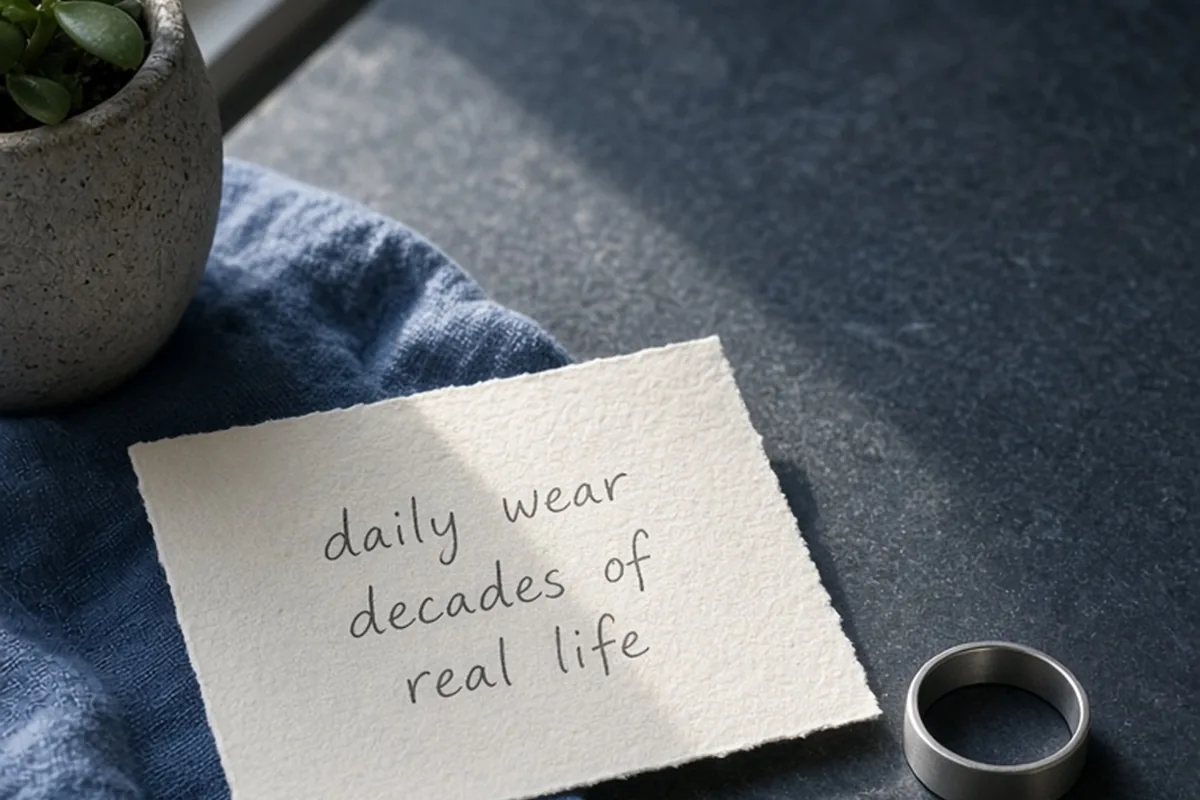
To compare wedding band metals effectively, evaluate five core criteria against your daily lifestyle: long-term durability and scratch resistance, whether the ring can be resized over decades, allergic reactivity to base alloys, physical weight on your finger, and ongoing maintenance requirements. Precious metals like platinum and gold offer lifetime resizability and heirloom value, while alternative contemporary metals like titanium, tungsten carbide, and tantalum provide superior scratch resistance or light weight at lower purchase points but cannot be resized.
A wedding band is one of the few items of personal jewelry designed to stay on your hand through decades of physical work, handwashing, gym sessions, and shifting knuckle sizes. Choosing between traditional precious metals and modern industrial alternatives requires looking past showroom lighting to understand how each alloy actually behaves when worn against everyday surfaces.
Daily Wear Durability and How Surface Scratching Actually Works
Durability in jewelry means two very different things: resistance to scratching and resistance to deformation or breaking. People often assume that a heavier or more expensive metal will remain mirror-smooth forever, but precious metals are comparatively soft. Platinum, yellow gold, white gold, and rose gold all develop micro-abrasions within weeks of continuous contact with door handles, gym weights, steering wheels, and desk edges. However, the way precious metals scratch is distinct from industrial metals. When gold is scratched, microscopic bits of metal are scraped away over time. When platinum receives an abrasion, the metal shifts rather than flakes off, creating a soft, velvety texture known as a patina. Many wearers appreciate this antique look, but those who want a perpetual high-gloss polish must have their platinum ring professionally buffed on a regular basis.
Alternative modern metals approach durability from the opposite extreme. Tungsten carbide is exceptionally hard, sitting near diamond on hardness charts, which makes it practically impervious to common desk abrasions and daily scuffs. However, extreme hardness introduces brittleness. If a tungsten carbide band is dropped on ceramic tile or struck with significant force against a hard angle, it will not bend or dent; it will fracture or shatter completely. Titanium and tantalum occupy a middle ground between gold and tungsten. Titanium is tough, highly resistant to bending, and structurally indestructible under ordinary human force, yet its surface will still acquire a fine web of hairline scratches over years of wear. Tantalum offers high density and remarkable shatter resistance with a dark, slate-gray tone that resists surface gouging better than gold while remaining ductile enough not to fracture on hard impact.
Choosing the right durability profile depends entirely on your daily physical routine. If your hands spend all day handling rough building materials, power tools, or metal equipment, a brittle or easily scratched precious metal may look heavily worn very quickly, whereas an unyielding alternative metal could present safety trade-offs or resist scuffing altogether. If your routine is mostly digital or office-based, any fine metal will hold its form indefinitely, making personal aesthetic preference and feel far more important than raw hardness numbers.
Platinum, Gold, and Palladium in Long-Term Resizing Realities
Human fingers change size across an adult lifetime. Joint arthritis, weight fluctuations, pregnancy, seasonal fluid retention, and natural aging all alter knuckle and finger circumferences over thirty or forty years of marriage. One of the sharpest distinctions among wedding band metals is whether a bench jeweler can easily cut the band, insert or remove metal, and solder it seamlessly back together. Platinum, yellow gold, rose gold, and white gold are fully resizable by almost every local bench jeweler in the world. A traditional precious metal ring can comfortably transition through multiple size adjustments over several decades without compromising structural integrity, provided the ring does not have continuous gemstones set all the way around the circumference.
By contrast, modern industrial metals including titanium, tungsten carbide, cobalt chrome, and stainless steel cannot be resized using standard jeweler torches and bench tools. The extreme melting points and crystalline structures of these metals make traditional cutting, stretching, and soldering impossible in a standard repair shop. If you choose an industrial metal band and your finger size shifts by a full size a decade from now, the original ring cannot simply be expanded or taken down. You must purchase a replacement ring or rely on a jeweler exchange program to receive a newly manufactured band in your revised size. For couples who attach strong sentimental meaning to keeping the exact physical piece of metal blessed or exchanged during their ceremony, this limitation makes alternative metals an impractical choice.
White Gold Rhodium Plating Cycles and Upkeep Requirements
White gold remains one of the most popular wedding band choices, but many buyers enter the showroom unaware that white gold is naturally not bright white. Pure gold is naturally yellow. To create white gold, refiners melt pure gold together with naturally white or silvery metals such as nickel, silver, or palladium. The resulting raw alloy has a warm, pale champagne or grayish-yellow undertone. To achieve the mirror-bright, icy white finish displayed in jewelry cases, manufacturers coat the finished ring in an ultra-thin electroplated layer of rhodium, a rare and reflective member of the platinum metal family.
Because rhodium is applied only as an exterior surface plate, it naturally rubs off over time as the ring encounters friction against your palm, pockets, soap, and countertops. As the rhodium wears thin, the warmer base metal begins to show through, usually starting along the bottom of the shank where contact is highest. Maintaining that crisp white appearance requires having the ring chemically stripped, cleaned, and replated with fresh rhodium periodically. The frequency of replating varies widely based on individual sweat chemistry, hand-washing habits, and mechanical friction. Platinum, by contrast, is naturally white throughout its entire mass and never requires plating of any kind. When evaluating white gold, factor in both the recurring cost and the inconvenience of leaving your ring with a jeweler every couple of years for replating.
Ring Weight Profiles and How Different Metals Feel on the Finger
The physical weight of a wedding band creates an immediate tactile difference that people either love or dislike. Platinum is one of the densest elements used in commercial consumer goods. A solid platinum band feels distinctly heavy and grounded on the hand, providing a substantial, premium heft that serves as a constant physical reminder of the ring. Tungsten carbide shares a similarly high density, delivering a reassuring weight that feels solid and indestructible. Wearers who prefer a ring with physical presence consistently gravitate toward platinum, tungsten, and tantalum.
On the opposite end of the spectrum sits titanium. Titanium is famous in aerospace engineering specifically because it delivers structural strength comparable to steel at a fraction of the mass. A titanium wedding band feels almost weightless on the finger. For someone who has never worn rings, watches, or bracelets, this featherlight quality is often a significant relief, preventing the feeling of hand fatigue or distraction during typing, athletic training, and sleep. Yellow and white gold sit comfortably in the middle, offering a balanced, noticeable weight without the dense mass of platinum. Before settling on a metal based purely on internet photos, visiting a jeweler to place a platinum band on one hand and a titanium band on the other is critical, as sensory reaction to weight is intensely subjective.
Skin Chemistry and Nickel Allergies Across Alloy Blends
Skin sensitivity is an essential consideration for any piece of jewelry worn twenty-four hours a day. Allergic contact dermatitis from rings is overwhelmingly triggered by nickel, a common hardening agent blended into standard commercial white gold alloys. When a person with nickel sensitivity wears a nickel-rich alloy against warm, sweating skin, the body reacts with redness, intense itching, peeling, or fluid-filled blisters beneath the band. While a fresh rhodium plating acts as a protective barrier, the allergic symptoms will flare the moment that micron-thin plating wears away and raw white gold contacts the epidermis.
Wearers with sensitive skin or known metal allergies should prioritize inherently hypoallergenic metals. Platinum is virtually always alloyed at ninety or ninety-five percent purity using other hypoallergenic platinum-group metals like ruthenium or iridium, making genuine allergic reactions extraordinarily rare. Titanium, niobium, and medical-grade tantalum are widely used for surgical bone implants precisely because human tissue does not react to them, making them safe choices for hyper-reactive skin. High-karat yellow gold and palladium-alloyed white gold are also generally safe, though anyone with severe reactive skin should always verify the specific alloy recipe with the manufacturer before ordering.
Emergency Cut-Off Safety and Demanding Manual Work Environments
For healthcare professionals, electricians, mechanics, and anyone operating heavy machinery, ring safety is a genuine consideration. In trauma situations where a hand suffers blunt injury, rapid swelling can cut off blood flow to the finger unless medical personnel can quickly remove the ring. Traditional precious metals like gold, platinum, and silver are soft and ductile enough to be severed in seconds using standard manual or battery-operated ring cutters found in every hospital emergency department, fire station, and jewelry bench.
A common myth claims that alternative industrial metals cannot be removed in an emergency, but the reality depends entirely on the specific metal and the tools at hand. Titanium and cobalt chrome are tough enough that standard manual brass-blade cutters cannot pierce them; they require high-speed diamond-grit cutting wheels or specialized heavy-duty electric cutters to slice through. Tungsten carbide cannot be cut by blades at all due to its extreme hardness, but emergency responders use standard locking pliers or vice-grips adjusted across the ring's diameter to apply gradual pressure until the brittle band cleanly snaps and falls away. Tantalum, being ductile rather than brittle, cuts similarly to titanium. If you work in an environment with high crush or snag hazards, verify your workplace safety policies, as some industries mandate non-conductive silicone rings or quick-release bands during work shifts regardless of the metal chosen.
Total Lifetime Cost Across Precious and Contemporary Metal Types
Comparing the cost of wedding band metals requires looking beyond the initial checkout price to consider total lifetime ownership expenses. Traditional precious metals carry significantly higher initial price tags because raw gold and platinum are traded on global commodities exchanges, have intrinsic market scrap value, and require skilled hand fabrication. Platinum generally commands a higher price than gold not only due to metal purity requirements but also because its high density requires more raw gram weight per ring, and its high melting point demands specialized jeweler equipment and labor.
Industrial metals like titanium, tungsten carbide, and stainless steel are abundant base materials, making their raw production costs remarkably low. However, total cost calculations must account for long-term upkeep and life events. A white gold ring requires ongoing rhodium dipping fees across a lifetime, which accumulate over decades. Conversely, while an unresizable tungsten or titanium band is inexpensive initially, an unexpected change in ring size means buying an entirely new band. Furthermore, industrial metals have virtually zero secondary scrap value if you ever choose to melt, redesign, or trade in the piece. Couples should weigh whether they prefer an initial heirloom investment that retains trade-in value and can be physically adapted for generations, or an affordable contemporary band that is cost-effective to replace outright if damaged or outgrown.
Frequently asked questions
Can platinum and white gold wedding bands be worn next to each other?
Wearing a platinum band directly against a white gold band is generally discouraged. Because platinum is significantly denser and harder than white gold alloys, the platinum ring will act like a slow abrasive file, gradually wearing away the thinner white gold metal over years of friction.
Does rose gold require special maintenance compared to yellow gold?
Rose gold does not require rhodium plating because its warm pink tone comes from copper blended permanently throughout the alloy. Its maintenance is identical to yellow gold, requiring only periodic cleaning and occasional professional polishing if you wish to remove surface scratches.
What happens if a tungsten carbide ring drops on a hard floor?
Because tungsten carbide is an extremely hard ceramic-metal composite with very low ductility, it does not bend or dent under sudden shock. If dropped from hand height onto a hard surface like porcelain tile, slate, or concrete, there is a realistic chance the ring will crack or fracture into pieces.
Which wedding band metal is the easiest to clean at home?
Platinum and unplated yellow gold are the simplest to maintain at home because they have no surface coatings that can be stripped. Soaking the band in warm water mixed with mild dish soap and brushing gently with a soft-bristled baby toothbrush restores shine safely without special chemical baths.
Your next step
Visit a local independent jeweler to try on bands made from at least three contrasting densities, such as platinum, gold, and titanium, to test how their physical weight and profile feel against your natural grip before purchasing.