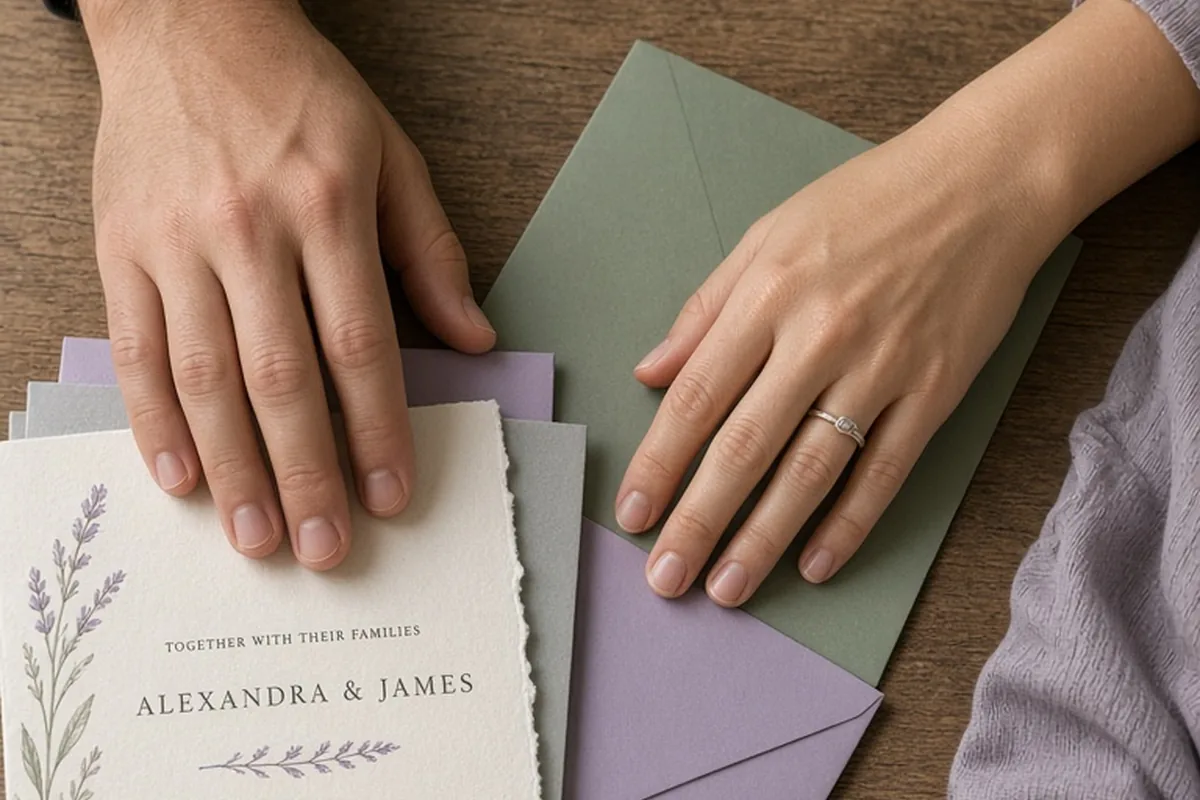
To save money on wedding invitations, order based on household count rather than total guest count, choose standard digital flat printing over labor-intensive methods like letterpress, and replace multi-card inserts with a single details card directing guests to a wedding website. Opt for standard rectangular envelopes to avoid extra postal surcharges, eliminate heavy embellishments like wax seals, and always weigh a fully assembled sample at your local post office before purchasing postage.
Stationery sets the initial tone for your wedding day, but standard invitation suites can quickly consume a disproportionate share of your overall event budget. Between specialty paper stocks, custom print techniques, individual insert cards, and tiered postage rates, small design upgrades compound rapidly across a large guest list.
Trimming your stationery budget does not mean settling for flimsy cards or sloppy presentation. By understanding the mechanical drivers of production pricing—such as plate creation, paper weight classifications, finishing labor, and postal sorting regulations—you can create an elegant, cohesive invitation suite while keeping production and delivery expenses firmly under control.
Base Your Order Quantity on Households Instead of Guest Count
The most common mistake couples make when ordering wedding invitations is purchasing a suite for every individual on their guest list. Couples, families, and shared households only require one physical invitation per residence. If your guest list contains two hundred attendees, you will likely need somewhere between one hundred and one hundred twenty individual suites, depending on how many single guests and multi-person families are attending. Calculating your quantity based on addresses rather than individual heads immediately lowers the required volume of paper, printing impressions, and envelopes.
When finalizing your order count, add a small buffer of roughly ten to fifteen extra suites beyond your verified address total. This safety margin covers last-minute additions to your guest list, addressing errors during handwriting, and keepsakes for parents and personal memory boxes. Ordering an additional batch later requires print shops to set up a new production run, which incurs separate minimum order fees, setup charges, and shipping costs that far exceed the price of including a few extra suites in your initial print run.
Select Digital Flat Printing Over Traditional Artisanal Techniques
The printing method you choose represents one of the largest variables in stationery pricing. Artisanal techniques such as letterpress, foil stamping, engraving, and thermography require custom physical metal or photopolymer plates, manual press setup, and individual ink mixing. Because these processes demand skilled manual labor and significant machine calibration time, printers charge substantial setup and plate fees regardless of how small your order might be.
Digital flat printing uses commercial-grade digital presses to apply ink directly onto paper fibers without requiring custom physical plates. Modern digital presses produce sharp typography, rich color saturation, and crisp graphic details that rival traditional printing methods at a fraction of the labor cost. If you want the visual aesthetic of metallic sheen or tactile texture, consider pairing a flat-printed main invitation card with a subtle metallic ink effect or choosing a naturally textured paper stock rather than paying for custom hot-foil stamping or physical blind debossing.
Choose Standard Paper Weights and Readily Available Finishes
Paper stock pricing varies dramatically based on fiber source, manufacturing process, and thickness. Premium materials like handmade cotton rag with raw deckled edges, thick acrylic sheets, genuine wood veneer, and double-thick bonded cardstock carry premium material surcharges. Furthermore, unusually thick or rigid cards require specialized cutting, manual packaging, and elevated postage rates because automated postal sorting machines cannot process stiff or heavy materials.
Standard commercial cardstock in a matte, smooth, or subtle eggshell finish delivers a sturdy, luxurious handfeel without the specialty markup. Cardstock weights commonly designated in standard cover weights provide substantial rigidity for a single-card presentation while remaining compatible with digital presses and automated mail equipment. If you prefer tactile depth, an eggshell, felt, or linen texture achieves an upscale, tactile impression while remaining within standard paper pricing tiers.
Consolidate Enclosure Pieces and Move RSVPs to Your Wedding Website
Traditional multi-piece invitation suites include a main invitation card, a reception card, an accommodations insert, a travel or directions card, a formal response card, and a pre-stamped return envelope. Every supplementary card adds individual design fees, paper costs, cutting charges, and assembly complexity. Additionally, supplying a dedicated return envelope for response cards requires purchasing twice as many stamps—one for the outer mailing and one for the return transit.
Streamlining your suite into a two-piece presentation eliminates redundant materials and streamlines guest responses. Produce one primary invitation card accompanied by a single compact details card that lists your wedding website address or features a clean scannable quick-response code. Guests can access your event schedule, driving directions, registry details, and digital RSVP form directly from their smartphones. Online RSVP collection not only reduces printing and return postage expenses to zero for the response workflow, but it also prevents lost return mail and automatically compiles dietary restrictions into an exportable spreadsheet.
Skip Costly Embellishments and Manual Suite Assembly Upgrades
Stationery embellishments such as custom wax seals, hand-torn silk ribbons, vellum wrap jackets, envelope liners, and laser-cut pockets add significant expense to your overall stationery budget. Beyond the raw cost of purchasing these accessories, hiring a stationer to fold, wrap, seal, and assemble multi-layer suites incurs substantial manual finishing labor fees. If you assemble them yourself, the time investment can become overwhelming during the busy final months of wedding preparation.
A minimalist, well-designed layout relies on strong typography, intentional whitespace, and balanced hierarchy rather than physical layers to convey elegance. If you desire a cohesive accent, opt for printed decorative motifs directly on the card or select a colored outer envelope that coordinates with your wedding palette. Colored envelopes provide a distinct visual pop in your guests' mailboxes without requiring the extra material and adhesive costs associated with custom paper envelope liners.
Avoid Postage Surcharges by Adhering to Postal Regulations
Postage is frequently overlooked during the initial budgeting phase, yet mailing costs can easily equal a significant portion of your total printing bill if your suite violates standard postal parameters. Postal services enforce strict automated machine sorting standards. Envelopes that are square, non-machinable, rigid, unusually thick, or secured with protruding wax seals cannot pass through standard sorting rollers. Consequently, these envelopes are subject to non-machinable surcharges, rigid packaging rates, or elevated weight tier pricing.
To keep mailing costs at standard letter rates, select standard rectangular envelopes such as standard commercial announcement sizes. Avoid lumpy closures, bulky ribbon knots, or stiff acrylic inserts that push your envelope past standard thickness limits. Once you receive your printed stationery, assemble one complete suite with all planned contents, seal the envelope, and take it directly to a clerk at your local post office. Request an exact physical weight check, a thickness slot test, and a machine-readability assessment before buying any postage stamps.
Evaluate Digital Templates, Online Print Vendors, and Local Commercial Shops
Couples have three primary avenues for purchasing wedding invitations: fully custom boutique stationers, online semi-custom print platforms, and independent digital design templates paired with local commercial print shops. While bespoke stationers offer high-touch design assistance, their pricing reflects custom illustration time and project management fees that may not fit a conservative budget.
Purchasing an editable digital template from an independent graphic designer allows you to customize your typography and wording using browser-based layout software. Once finalized, you can export a print-ready PDF with appropriate bleed margins and take the file to a local commercial copy shop or independent print provider. Local printers frequently offer competitive paper options, zero shipping transit fees, and physical on-site proof prints that let you verify color accuracy and legibility before committing to a full production run. Alternatively, established online stationery printers regularly run seasonal promotions and bundle matching envelopes, making them a streamlined, reliable option for pre-designed suites.
Frequently asked questions
How far in advance should I order wedding invitations to avoid rush fees?
Order your invitations roughly four to six months before your wedding date. This timeline provides adequate buffer for design proofs, printing, packaging transit, addressing, and post office delivery, allowing you to mail suites eight to ten weeks prior to the event without paying expedited rush fees.
Can I print wedding invitations on a home desktop printer to save money?
While home printing is possible for basic paper, heavy cardstocks often jam desktop paper feeds or cause ink smudging. Furthermore, replacement ink cartridges and specialty paper packs can quickly approach the cost of a commercial digital print run without matching commercial-grade sharpness and color consistency.
Are electronic wedding invitations acceptable for formal weddings?
Digital invitations have gained widespread acceptance across modern wedding styles, particularly for casual gatherings, engagement parties, and save-the-dates. For formal events, a hybrid approach—pairing a single printed main invitation with an online RSVP and digital information hub—balances traditional etiquette with cost efficiency.
What is the best way to address envelopes without hiring a calligrapher?
You can use your home printer to print guest addresses directly onto light-colored envelopes using elegant serif or script digital fonts. Many online printing services also provide complimentary or low-cost recipient address printing when you order your envelope and stationery suite together.
Your next step
Assemble one complete invitation suite containing your planned cards, enclosures, and envelope, then take it to your local post office counter for precise weighing and machineability verification before purchasing your stamps or printing your full batch.