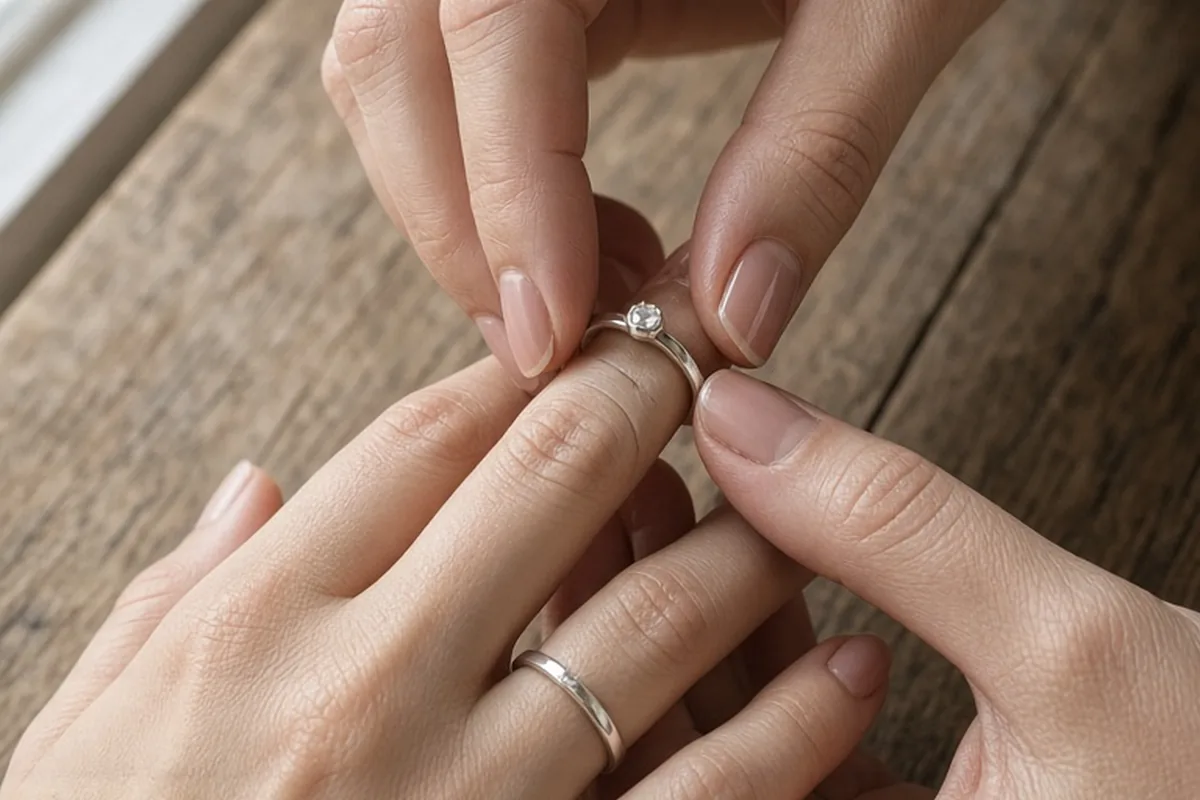
A promise ring is most commonly worn on the ring finger of either the left or right hand. Choosing the left ring finger usually signals a pre-engagement commitment, while wearing it on the right ring finger highlights personal devotion, fidelity, or mutual commitment without being mistaken for an upcoming marriage. You can also wear it on a middle finger, index finger, or chain necklace based on comfort, work requirements, and personal preference.
Promise rings carry deeply personal significance, yet unlike traditional wedding bands, they come with no rigid social rulebook. Understanding how different finger placements communicate your shared intentions helps you wear your piece comfortably, protect your jewelry, and avoid unwanted social confusion.
Deciding Between the Left Ring Finger and the Right Ring Finger
The two most frequent locations for a promise ring are the ring fingers on the left and right hands, and each carries distinct social signals. Placing the ring on the left ring finger directly mirrors traditional Western engagement customs. Couples who choose this placement often view the piece as a formal precursor to an engagement, indicating that while a wedding may not be planned in the immediate future, marriage remains the intended long-term goal. The historic association of the left ring finger with the vena amoris, a symbolic vein believed to connect directly to the heart, makes it an emotionally resonant choice for partners who want their commitment openly visible to the public.
Conversely, selecting the right ring finger establishes commitment while maintaining clear separation from marital vows. This placement is ideal for couples who are intentionally dating exclusively, navigating long-distance arrangements, or focusing on personal milestones like completing school before discussing marriage timelines. Wearing the band on the right hand prevents strangers, colleagues, and acquaintances from assuming you are actively planning a wedding, which saves you from fielding questions about venue deposits and guest lists. The right hand also works well for promise rings exchanged between close friends or rings purchased for oneself as symbols of personal milestones, sobriety, or self-love.
Choosing the Middle Finger, Index Finger, or a Pendant Chain
Not every promise ring needs to rest on a traditional ring finger. Wearing the band on your middle finger represents balance, personal agency, and grounded devotion. Because the middle finger sits at the center of the hand, rings worn here draw visual attention to design details without mimicking engagement or wedding jewelry in any way. Keep in mind that a middle finger is wider than a ring finger, so a ring sized for one will rarely fit the other comfortably without professional resizing. Ensure you test how adjacent fingers touch the ring during daily tasks like writing, typing, or gripping steering wheels to confirm the setting does not cause friction.
For people who work with their hands, index finger placement or wearing the piece around the neck provides functional alternatives. Placing a band on the index finger symbolizes direction and personal integrity, offering a bold fashion statement alongside romantic meaning. If your daily environment makes hand jewelry impractical or unsafe, stringing the promise ring on a durable sterling silver, gold, or platinum chain keeps the token close to your heart without exposing it to hazards. This necklace method is particularly valuable for nurses, culinary workers, mechanics, machinists, and athletes who cannot wear metal rings safely during their shifts.
Aligning on What Your Promise Ring Means Before You Wear It
Because promise rings lack a universally mandated definition, confusion only arises when two partners hold mismatched assumptions about what the piece represents. For one partner, the ring might be a tangible promise to save money for an engagement ring over the next three years; for the other, it might simply mean romantic exclusivity with no implied timeline for marriage. The healthiest approach is having a candid, warm conversation before the ring ever touches a finger. Being clear about what the ring does and does not promise protects both individuals from unspoken pressure or unexpressed disappointment.
You can facilitate this clarity by naming the specific intent out loud without turning the moment into a solemn interrogation. A statement such as, 'To me, this ring means I am completely devoted to our relationship and building our future together, without rushing a timeline,' provides safety and shared understanding. Clarifying whether the ring implies future cohabitation, exclusive dating, or eventual marriage gives the object its true weight. When both partners explicitly agree on the scope of the promise, wearing the ring becomes a source of daily comfort rather than quiet ambiguity.
Selecting Metals and Stone Profiles That Handle Daily Wear
A promise ring is typically worn continuously, meaning its physical construction must withstand everyday friction, household chemicals, and incidental bumps. Choosing durable precious metals like 14-karat gold, 10-karat gold, or platinum ensures the band will maintain its shape over years of use. Sterling silver is a classic and affordable option, but it is a softer metal that bends more easily under pressure and naturally tarnishes when exposed to moisture, sweat, and household sulfur. If you opt for silver, anticipate needing routine polishing and occasional maintenance to preserve its initial luster.
Stone choice and setting geometry matter just as much as metal purity. Delicate stones like opals, pearls, and emeralds are softer on the mineral hardness scale and can chip, crack, or lose their polish under daily hand-washing and desk work. Harder gems like diamonds, moissanite, and sapphires offer significantly better longevity. Furthermore, low-profile settings such as bezels, flush mounts, or modest four-prong baskets are far less likely to snag on clothing, knit sweaters, or car doors compared to high-set solitaire prongs. A low-profile design ensures you can wear your ring from the gym to the office without constantly worrying about damaging the prongs.
Managing Ring Sizing Differences Across Dominant and Non-Dominant Hands
A common mistake when buying or exchanging promise rings is assuming that the ring fingers on your left and right hands are the same size. For the vast majority of people, the ring finger on the dominant hand is anywhere from a quarter to a full size larger than the corresponding finger on the non-dominant hand due to muscle development and frequent blood flow. If you purchase a ring sized specifically for your left hand, it may feel constricting, leave indentations, or prove difficult to slide over the knuckle on your right hand.
Environmental factors also alter finger diameter throughout the day. Hands swell during warm summer afternoons, intense cardio workouts, and after consuming high-sodium meals, while cold weather causes blood vessels to constrict and makes rings slide loosely. When sizing a promise ring, aim for a fit that offers slight resistance as it passes over the knuckle but rotates smoothly without pinching once seated at the base of the finger. If the ring features an unbroken pattern or eternity gemstones wrapped entirely around the band, resizing later can be technically impossible, making accurate initial sizing critical.
Transitioning the Promise Ring When an Engagement Ring Arrives
When a relationship moves toward marriage and an engagement ring is presented, many people wonder what to do with their original promise ring. One of the most popular and practical paths is simply transferring the promise ring from the left ring finger to the right ring finger. This simple shift frees up the left hand for the engagement ring and eventual wedding band while preserving the promise ring as a treasured, active piece of your daily jewelry rotation.
Another elegant choice is stacking the promise ring alongside your engagement ring, provided the metal colors, band widths, and setting heights complement one another. A slim promise band can sit comfortably flush beneath a high-set engagement ring, creating an evolving visual story of your relationship milestones. If the rings feature conflicting designs that rub against one another and risk scratching the metals, retiring the promise ring into a dedicated jewelry keepsake box or stringing it onto a necklace chain allows you to honor its sentimental chapter without cluttering your fingers.
Responding to Outside Inquiries and Navigating Workplace Etiquette
Wearing a ring on either hand frequently invites well-meaning questions from relatives, friends, and coworkers. If you wear your promise ring on your left hand, people may spot the shimmer and immediately ask if you got engaged over the weekend. You are under no obligation to provide a lengthy explanation of your relationship dynamics or justify your choices to casual acquaintances. A brief, cheerful response like, 'It is a promise ring celebrating our relationship, not an engagement ring,' immediately satisfies polite curiosity and shifts the topic naturally.
In professional and workplace settings, you may prefer an even simpler framing. If a client or supervisor notices the piece, acknowledging it simply as a meaningful personal ring keeps the boundary firm between your personal life and professional obligations. For hands-on jobs where loose jewelry poses safety or hygiene issues, consider keeping a secure silicone ring dish at your desk or home entryway. Storing the ring in the same dedicated spot during workouts, heavy yard work, or sanitizing rounds prevents tragic accidental losses and protects fine metals from harsh surface abrasion.
Frequently asked questions
Can a man wear a promise ring, and on which finger does it go?
Yes, men frequently wear promise rings. Just like women, men most commonly wear them on either the left or right ring finger depending on whether the ring represents pre-engagement or a broader personal commitment. Plain metal bands made of titanium, tungsten, or gold are popular choices that wear comfortably across both hands.
Does wearing a promise ring on your left hand mean you are officially engaged?
No, a promise ring does not mean you are legally or formally engaged unless both partners explicitly agree it is serving that function. While strangers might initially assume it is an engagement ring, the meaning is determined entirely by the private commitment you and your partner choose to give it.
Is it okay to wear a promise ring on a chain around your neck?
Wearing a promise ring on a necklace chain is a widely accepted and practical alternative. It is especially beneficial for people working in healthcare, food service, or manual trades where hand jewelry creates hygiene or safety risks, as well as for those whose fingers swell frequently.
Can I resize my promise ring if I decide to switch hands later?
Most plain metal bands and rings with simple prong settings can easily be resized up or down by one to two sizes by a local bench jeweler. However, bands made of alternative metals like tungsten or titanium, as well as eternity bands with stones wrapping the entire circumference, cannot be resized.
Your next step
Take five minutes with your partner to confirm what your ring symbolizes, then check your knuckle and base-finger fit on both hands before finalizing where you will wear it.