A great maid of honor speech for your sister combines shared childhood history, a genuine tribute to her character, warmth toward her new spouse, and a heartfelt toast. To write one, structure your remarks into four parts: an engaging introduction stating your relationship, one or two brief personal anecdotes illustrating who she is, observations on how her partner complements her, and a celebratory wish for their future together. Keep the total length between three and five minutes.
Giving a maid of honor speech for a sister carries a unique emotional weight. You hold decades of shared memories, family context, and private milestones that friends and casual acquaintances simply do not share. The challenge lies in translating a lifetime of closeness into a clear, engaging, four-minute tribute that resonates with every guest in the room.
The Core Framework for a Sister Maid of Honor Speech
A successful maid of honor speech follows an intentional narrative arc rather than a random collection of memories. Aim for a total length of 400 to 650 words, which translates to roughly three to four and a half minutes of spoken delivery at a conversational pace. Speaking slower than your normal conversational speed ensures guests across the venue can follow your words, especially in reverberant event spaces.
Begin with a clear opening that welcomes guests, states your name, and establishes your relationship to the bride. While most attendees know who you are, acknowledging the room immediately breaks the ice. Follow this with one or two concise stories from childhood or early adulthood that reveal your sister's core qualities—her loyalty, tenacity, kindness, or quick wit. From there, pivot smoothly to the moment she met her partner or the visible positive shift you witnessed in her life once they began dating. Conclude by addressing the couple directly with your well wishes and inviting the room to raise a glass.
- Introduction: Warm greeting, your name, and acknowledging your role as her sister (30–45 seconds).
- The Sister Tribute: One or two focused stories highlighting her character rather than just a chronological resume (60–90 seconds).
- The Partner Integration: How her spouse brings out her best qualities and what you observed as their relationship grew (45–60 seconds).
- The Toast: Direct blessing, advice, or celebration followed by raising a glass (30 seconds).
Example 1: The Nostalgic and Sentimental Sister Speech
This template suits sisters who share a deep, emotional connection and want to focus on mutual support, personal growth, and gratitude. It balances early memories with mature reflection.
"Good evening, everyone. For those I haven't had the pleasure of meeting yet, I am Maya, Sarah's sister and proud maid of honor. Growing up together in a house with one shared bathroom and entirely different wardrobes taught us early on how to negotiate, how to compromise, and above all, how to have each other's backs. Sarah has been my confidante, my fiercest defender, and the person whose opinion matters most to me since we were young girls building blanket forts in our living room.
Watching Sarah grow into the incredible, generous woman she is today has been one of the great privileges of my life. She approaches everything with steady devotion—whether it is her career, our family, or her friendships. For a long time, I wondered who could possibly match that level of loyalty and care. Then she introduced me to David. From our very first dinner together, I noticed the quiet ease Sarah felt around him. David, you bring a calm joy to her life, and seeing how deeply you respect and protect her heart means everything to me and our family. Please raise your glasses with me to Sarah and David: may your years together be filled with unwavering partnership, endless laughter, and a love that only deepens with time. Cheers!"
To adapt this example, replace the blanket fort reference with a genuine, low-stakes childhood memory that reflects your specific upbringing. Ensure your remarks about her partner focus on observable actions or feelings rather than vague platitudes.
Example 2: The Lighthearted and Humorous Sister Speech
If you and your sister have a playful, witty dynamic, humor can make the room feel warm and relaxed. The key is using self-deprecating or gentle sisterly teasing rather than embarrassing exposés.
"Hello, everyone! I'm Chloe, Jessica's younger sister. As the younger sibling, my primary childhood responsibility was annoying Jessica as thoroughly as possible. I borrowed her clothes without asking, eavesdropped on her landline phone calls, and memorized her diary entries. Through all of that, she somehow chose not to disown me, which tells you everything you need to know about her extraordinary patience.
In all seriousness, Jessica has always set the standard for what it means to be driven, passionate, and hilariously direct. She knows exactly what she wants, and she does not settle. So when she called me three years ago after her second date with Alex and said, 'Chloe, I think he might actually be normal,' I knew we had reached a monumental turning point. Alex, you have passed every sibling test with flying colors, including surviving our loud family game nights. You complement Jessica's fiery drive with your thoughtful steadiness, and you make her happier than I have ever seen her. Everyone, please lift your glasses to Jessica and Alex. May your love be modern enough to survive the times, and old-fashioned enough to last forever. To the newlyweds!"
When delivering a humorous speech, pause for laughter after your punchlines. Rushing into the next sentence can cause guests to miss your best lines or talk over the crowd's reaction.
Example 3: The Younger Sister Looking Up to Her Older Sister
When you are the younger sister, your perspective naturally centers on mentorship, inspiration, and welcoming a new family member who honors the sister you have looked up to your entire life.
"Good evening. I'm Elena, Rachel's little sister. For as long as I can remember, I have wanted to do everything Rachel did. When she took up soccer, I demanded a pair of cleats. When she started reading big novels, I carried them around to look smart. Rachel was my blueprint for how to be brave, how to work hard, and how to treat people with grace.
As we became adults, our dynamic evolved from older and younger sister into true best friends. Seeing her navigate life's challenges with such poise has always inspired me. But seeing her fall in love with Marcus showed me a side of Rachel that was completely new—a sense of relaxed contentment and pure joy. Marcus, thank you for loving my sister with the dedication she deserves and for seamlessly stepping into our family rhythm. You are the brother I always wanted. Let's raise a toast to Rachel and Marcus. May your home be filled with peace, your days with adventure, and your hearts with enduring love. Cheers!"
This style works best when you clearly distinguish the past from the present. Grounding the speech in your adult bond prevents the tribute from feeling like a one-sided childhood memory log.
Balancing Inside Jokes, Sisterly Teasing, and Family History
Sisters often share a private language made up of code words, inside jokes, and decades of family lore. While these references feel meaningful to you, a wedding speech is delivered to a diverse audience containing coworkers, grandparents, college friends, and in-laws. If an anecdote requires two minutes of background explanation to make sense, it belongs in a private letter, not the reception speech.
Apply the 'Rule of Three Audiences' to every story you include. Ask yourself: Will this make sense to someone who met the bride last year? Will it make the bride feel honored rather than exposed? Would you feel comfortable saying it in front of the groom's extended family? If the answer to any of these is no, replace the story. Avoid mentioning ex-partners, past college wild nights, family inheritance disputes, or bitter childhood rivalries, even in jest.
- Green light topics: Shared childhood quirks, mutual support through school or career moves, how her personality shone during ordinary moments, her positive influence on your life.
- Red light topics: Past relationships, drinking or partying misadventures, financial stressors, unresolved family tension, jokes that question marriage as an institution.
How to Meaningfully Include and Welcome Your New In-Law
A common pitfall in sister maid of honor speeches is focusing exclusively on the bride and treating the new spouse as an afterthought in the final thirty seconds. A wedding is a celebration of a union, and welcoming your sister's partner into the family elevates your remarks from a personal tribute into a true wedding speech.
You do not need to pretend you have known the spouse your entire life if the relationship is relatively new. Instead, speak about the tangible, positive impact they have had on your sister. Describe the phone call where she first mentioned their name, the way her shoulders drop when they enter the room, or a specific instance where the spouse showed kindness to your family. Acknowledge them directly by looking them in the eye during this portion of your delivery.
Delivery Techniques for Managing Nerves and Emotion on the Day
Delivering a speech for your sister is uniquely emotional. It is completely normal to feel your throat tighten or eyes water, particularly when reflecting on your upbringing. The best way to manage emotional overwhelm is practical physical preparation well before the reception begins.
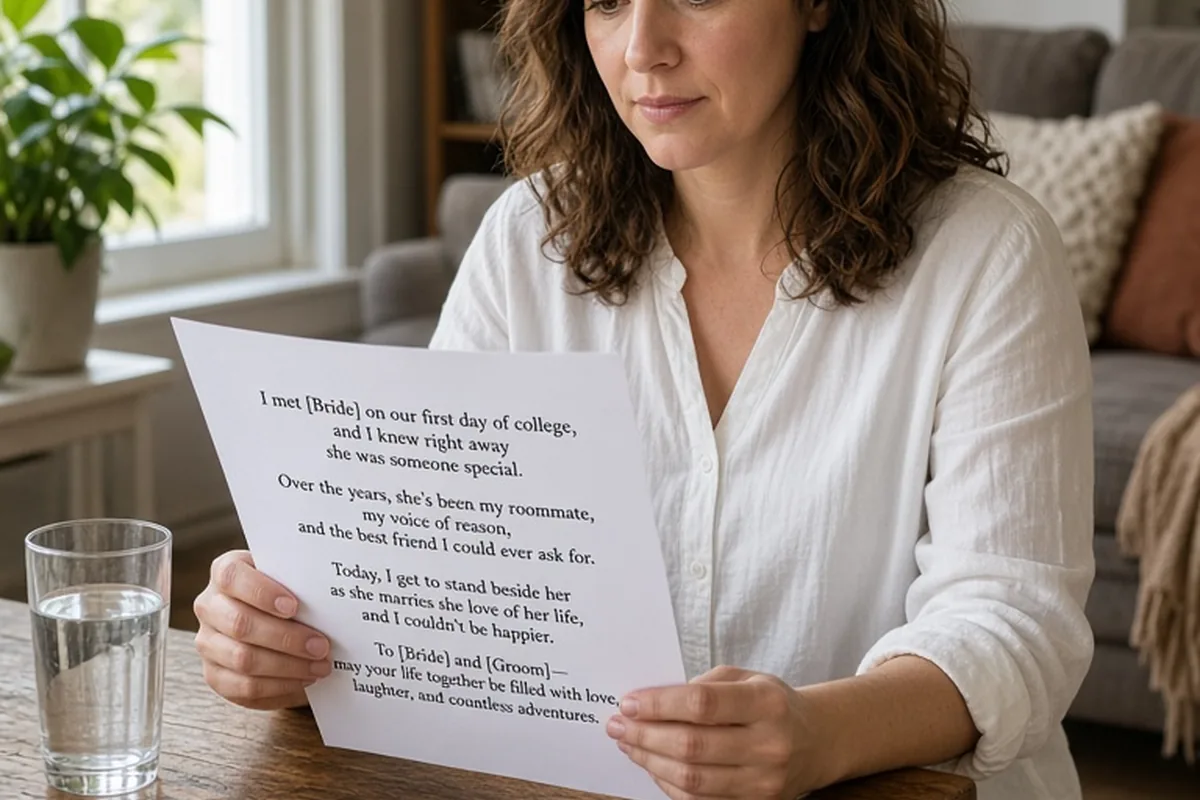
Print your speech on clean, heavy paper or write it neatly on index cards using a large, legible font with 1.5 line spacing. Avoid reading directly from your phone; screen glare, incoming notifications, and auto-lock screens create unnecessary friction. If you begin to choke up during delivery, stop, take a slow sip of water, take one deep breath, and continue. The audience is entirely on your side and will happily wait while you compose yourself. Distribute your eye contact in a triangle: look at your sister, look at her partner, and sweep your gaze across the guests.
- Format your notes: Use bullet points or bold key transition phrases so you never lose your place if you look up.
- Hydration: Keep a glass of still water nearby to clear your throat before picking up the microphone.
- Microphone posture: Hold the microphone about two inches from your chin at a steady 45-degree angle; do not drop your hand as you speak.
Frequently asked questions
How long should a maid of honor speech for a sister be?
Aim for three to five minutes, which translates to roughly 400 to 650 written words. This provides enough time to share meaningful stories and toast the couple without losing the audience's attention.
What if I start crying during my sister's wedding speech?
Pause completely, take a breath, and take a sip of water. Guests understand that a sisterly bond is deeply emotional, so do not apologize profusely; simply give yourself a moment to reset and read your next line.
Should I write the speech with another sister or co-maid of honor?
If you share maid of honor duties with another sister or friend, a joint speech can work wonderfully if you divide speaking parts clearly. Split the speech into alternating sections or themes rather than trying to speak simultaneously in unison.
Is it okay to bring up childhood arguments in a sister speech?
Brief, playful mentions of typical sibling bickering are fine if they illustrate how you grew closer. However, avoid genuine grievances or deep family conflicts that could make guests or your sister feel uncomfortable.
Your next step
Choose one specific story that best captures your sister's character, write out a 500-word draft following the four-part framework, and practice reading it aloud with a timer twice this week.