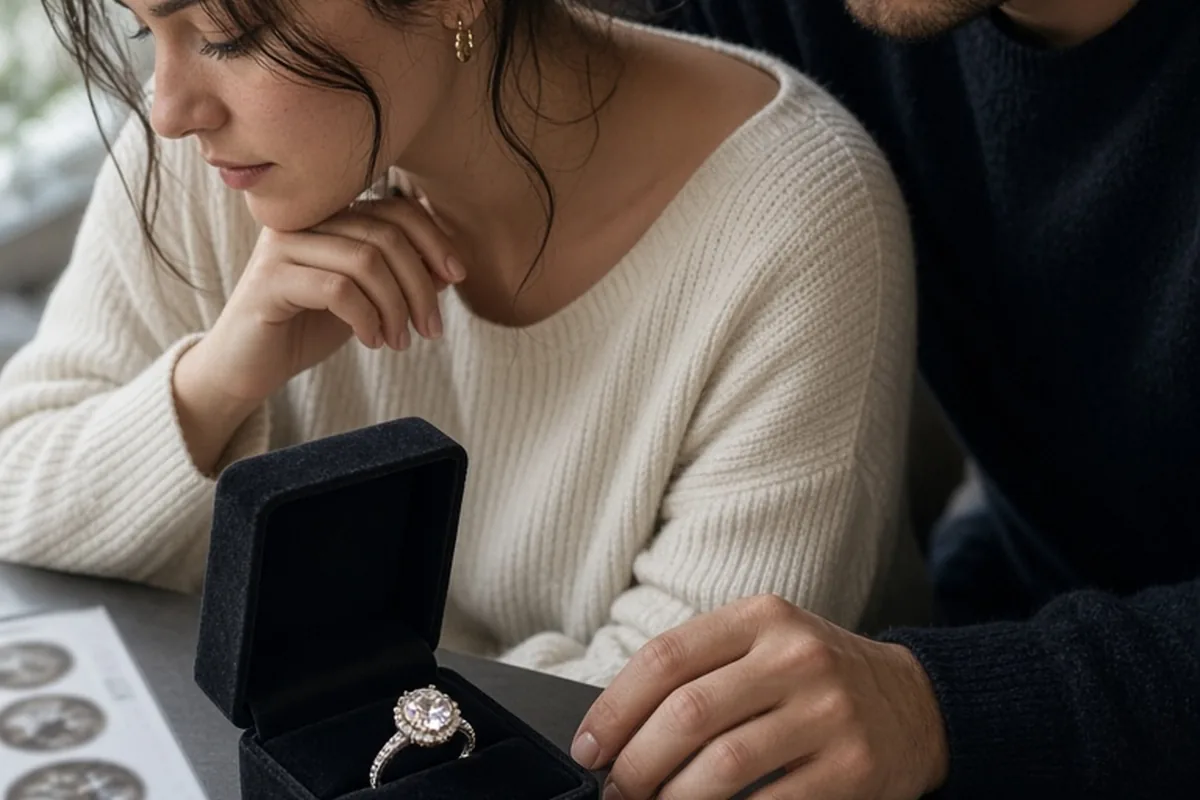
When evaluating moissanite engagement rings, couples should discuss visual preferences, optical fire, daily durability, shared financial priorities, and social comfort. Key questions center on whether you prefer vibrant rainbow sparkle over subtle white light return, how stone hardness fits your daily lifestyle, how ring savings might fund other goals, and whether both partners feel confident and unified in choosing a distinctive gemstone.
Choosing an engagement ring is both a deeply personal milestone and a practical investment in a piece of fine jewelry meant for everyday wear. While natural and lab diamonds remain traditional centerpieces, moissanite has emerged as a distinct, highly durable gemstone with its own unique optical properties and ethical appeal. Having intentional conversations early in the shopping process ensures that both partners feel heard, respected, and fully aligned on the aesthetic, financial, and emotional value of the ring.
Comparing Visual Brilliance, Fire, and Gemstone Appearance
One of the first conversations couples should have centers on the distinct visual characteristics of moissanite compared to other white gemstones. Moissanite is composed of silicon carbide, a mineral originally discovered in trace amounts inside meteorites and now grown in controlled laboratories for fine jewelry. Because of its physical structure, moissanite has a higher refractive index and dispersion rate than diamond, producing what gemologists refer to as double refraction and intense optical fire. Under bright sunlight, spot lighting, or candlelit environments, moissanite emits noticeable flashes of spectral, rainbow-colored light rather than predominantly white and gray flashes. Couples should discuss whether they appreciate this vibrant, energetic scintillation or if they prefer a more understated, traditional monochrome sparkle.
It is equally helpful to discuss how stone size and cut shape influence these optical differences. In smaller carats or step-cut shapes such as emerald and Asscher cuts, moissanite displays clean, crisp geometric planes with subtle light return. In larger dimensions and brilliant cuts—such as round, oval, or pear shapes—the rainbow fire becomes significantly more pronounced. Couples who view loose stones or sample rings side-by-side in natural daylight often find it much easier to determine their preference. Asking whether you want your center stone to be appreciated specifically for its fiery, lively character helps eliminate unrealistic comparisons and ensures both partners genuinely love the look of the ring on the hand.
Assessing Hardness, Daily Durability, and Long-Term Wear
Because an engagement ring is intended for continuous daily wear across decades, understanding durability is critical for active couples. Moissanite ranks at 9.25 on the Mohs hardness scale, making it second only to diamond among commonly worn fine jewelry gemstones. This high level of surface hardness means moissanite resists scratches, abrasions, chips, and surface dulling from incidental contact with hard surfaces, metal door handles, and kitchen countertops. Discussing your daily routines, hobbies, career environments, and hands-on activities will help clarify whether a durable center stone meets your practical needs without demanding constant worry or restrictive maintenance routines.
In addition to scratch resistance, couples should consider how moissanite reacts to everyday exposure to oils, lotions, soaps, and heat. Like most fine gemstones, moissanite can attract surface buildup over time, sometimes creating a temporary hazy film that requires gentle cleaning with warm water, mild dish soap, and a soft-bristled toothbrush. Unlike softer alternatives such as morganite, opal, or cubic zirconia, moissanite will not permanently cloud, fracture under moderate heat, or lose its structural luster over time. Clarifying these maintenance expectations together ensures that both partners feel confident the chosen piece will withstand ordinary life milestones, travel, and household routines without fragile handling.
Aligning on Financial Goals and Shared Budget Values
Discussing the financial side of an engagement ring offers a valuable opportunity to practice open communication about broader financial goals. Moissanite typically costs a fraction of an equivalent-sized mined or lab-created diamond, creating substantial room within a couple's bridal budget. Rather than viewing the ring purchase in isolation, couples can ask how the financial difference impacts other joint priorities, such as saving for a home down payment, funding a memorable wedding celebration, investing in retirement accounts, paying down debt, or taking an extended honeymoon trip.
It is also important to discuss how each partner interprets value and sentimentality. Some individuals find immense satisfaction in maximizing stone quality, scale, and custom metalwork without straining their finances, while others may hold sentimental or cultural beliefs tied to traditional pricing customs. Openly discussing whether you view the ring primarily as a symbol of your commitment, a personal design statement, or a financial milestone prevents misunderstandings. Agreeing on a clear spending comfort zone allows you to design or select a custom piece free from financial stress or unspoken expectations.
Navigating Social Perceptions and Open Communication
While non-diamond engagement rings have gained widespread mainstream acceptance, couples may still encounter questions, curiosity, or traditional assumptions from family members, friends, or coworkers. A meaningful question to explore is how both of you feel about sharing the details of your ring choice with others. Some couples take great pride in openly sharing the science, sustainability, and value of moissanite, viewing it as an intentional and modern choice. Other couples prefer keeping their personal jewelry choices private, considering the ring simply as their personal symbol of commitment without feeling obligated to explain its mineral makeup to casual observers.
Mutual alignment on this topic prevents awkwardness in social settings. If one partner feels excited to talk about moissanite while the other feels hesitant or self-conscious, exploring those feelings before making the purchase helps build unity. Asking whether either partner feels any lingering pressure from social expectations or peer comparisons ensures that the decision is rooted in your shared preferences rather than external opinions. A confident, mutually agreed-upon approach allows both individuals to wear and celebrate the ring with complete joy and security.
Selecting Moissanite Settings, Metal Pairings, and Proportions
The design of the setting plays a major role in how moissanite interacts with light and how securely the center stone is held. Because moissanite possesses exceptional brilliance, pairing it with different precious metals can alter its overall visual warmth and contrast. Platinum and white gold emphasize the crisp, ice-white facets of modern colorless moissanite grades, while yellow gold and rose gold provide a warm, vintage contrast that can soften the stone's vivid fire. Couples should discuss which metal color best complements existing everyday jewelry, personal skin tones, and aesthetic preferences.
Proportions and setting security are equally vital practical considerations. Higher prong settings elevate the gemstone to allow maximum light entry, which amplifies dispersion, but they can also catch on clothing or gloves during physical tasks. Lower-profile settings, bezel designs, or semi-bezel mountings offer streamlined protection and a modern silhouette that sits close to the finger. Furthermore, couples should determine whether they plan to pair the engagement ring with a flush-fitting wedding band or a curved contour band, ensuring that the entire bridal stack functions comfortably as a cohesive set.
Evaluating Warranties, Certification, and Jeweler Policies
Before finalizing a moissanite ring purchase, couples should thoroughly evaluate the jeweler's craftsmanship standards, certifications, and post-purchase support policies. Unlike diamonds, which are graded by laboratories on standardized 4C scales for natural imperfections, premium moissanite is produced in laboratory settings to exacting clarity and color grades, often categorized as colorless (equivalent to D-E-F range) or near-colorless (G-H range). Couples should verify whether the jeweler provides an authenticity certificate or a manufacturer warranty covering optical clarity and optical performance over the lifespan of the gemstone.
Equally important are the retail policies regarding resizing, routine prong inspections, cleaning services, and return windows. Many engagement rings require slight size adjustments after the initial proposal, so checking whether the jeweler offers complimentary resizing within a specific timeframe is essential. Inquire about the turnaround time for repairs, coverage for accidental side-stone loss, and options for specialized jewelry insurance policies. Clarifying these logistical details in advance ensures that both partners have reliable support for routine upkeep and long-term care.
Frequently asked questions
Can an untrained eye tell the difference between moissanite and diamond?
In casual settings, many people cannot tell them apart because colorless moissanite looks very similar to high-grade diamond. However, under bright direct light, moissanite displays stronger rainbow dispersion and double refraction, whereas diamonds show more balanced white flashes and contrast patterns.
Does moissanite lose its sparkle, discolor, or become cloudy over time?
No, moissanite does not permanently cloud, change color, or lose its internal optical qualities over time. Any temporary dullness is typically caused by surface buildup of hand lotion, cosmetics, or skin oils, which easily washes away with gentle soap and water.
Can moissanite engagement rings be insured like diamond rings?
Yes, fine jewelry insurance providers and standard homeowners or renters policies allow you to insure moissanite rings against loss, theft, and damage. You will typically need to provide an itemized sales receipt and an appraisal document detailing the setting metal and stone specifications.
Which color grade of moissanite looks best in yellow or rose gold rings?
Both colorless (D-F range) and near-colorless (G-H range) moissanite look stunning in yellow or rose gold. Near-colorless stones offer a subtle warmth that blends seamlessly with warm metal prongs, while colorless stones provide a striking, crisp contrast.
Your next step
Schedule an in-person or virtual consultation with a reputable jeweler to view loose moissanite stones in varied lighting conditions before choosing your final setting.