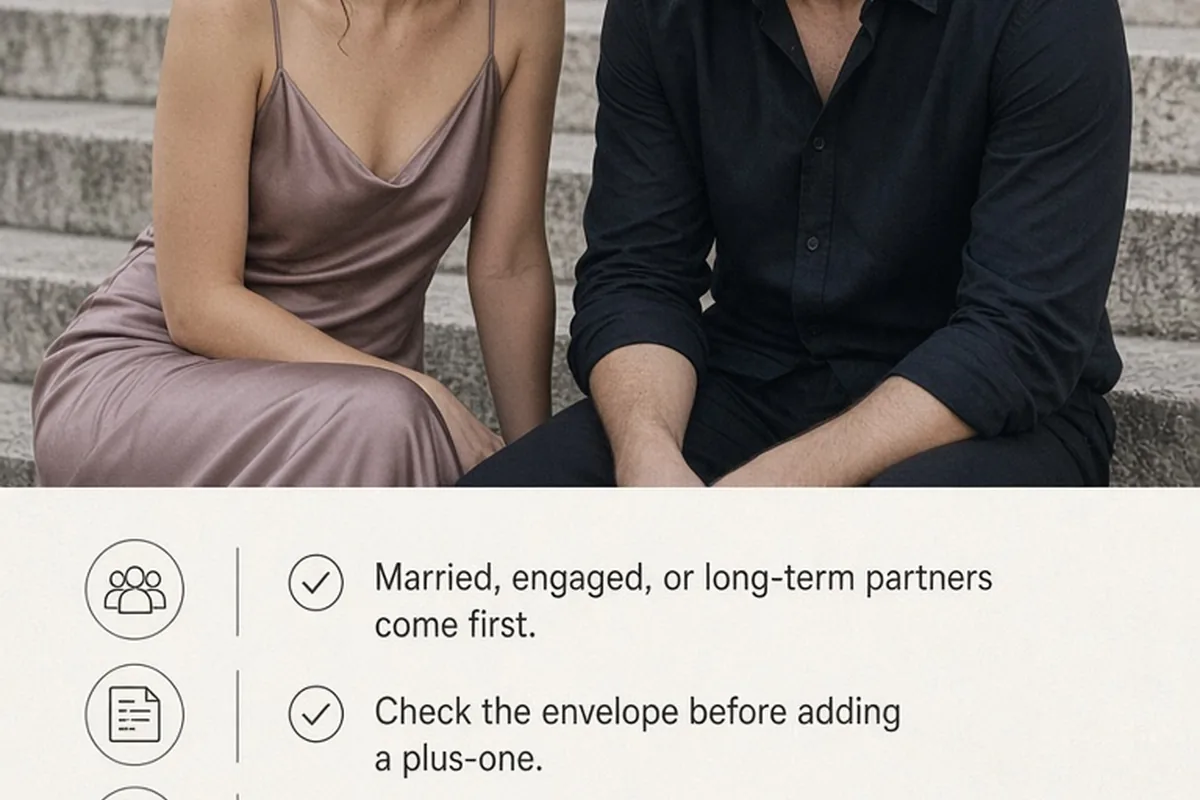
A plus-one wedding etiquette checklist establishes clear rules for extending and accepting extra invitations. Couples should offer plus-ones to married, engaged, cohabiting, or long-term partners, as well as the wedding party and guests who will not know anyone else. Guests must check the invitation envelope before bringing a date, RSVP with the full name of their guest, never substitute dates without asking, and ensure their companion observes the event dress code and schedule.
Navigating plus-one invitations requires balancing venue capacity, catering expenses, and personal relationships without creating unnecessary tension or budget strain.
Core Rules for Determining Who Receives a Named Guest or Open Plus-One
A clear distinction exists between a named guest and a general plus-one. A named guest is someone you invite specifically by their first and last name, such as a close friend's spouse, fiancé, or cohabiting partner. An open plus-one is an invitation extended to an individual with permission to bring an unnamed guest of their choice. Drawing this boundary early in the planning process prevents confusion and ensures you treat social circles fairly.
As a standard rule, couples should extend invitations to both halves of an established couple. This includes spouses, engaged partners, and couples who live together, regardless of how well the hosts know the partner. Leaving out a live-in partner or spouse is widely considered a major social faux pas because it asks an adult guest to celebrate your union while ignoring their own committed relationship.
Members of the wedding party usually receive a plus-one as a courtesy for their investment of time, energy, and money in your wedding events. If your bridal party member is single, granting them an open plus-one allows them to bring a companion to celebrate after fulfilling their ceremonial duties. Similarly, solo guests who do not know anyone else attending the wedding should receive a plus-one so they have someone to converse with during cocktail hour and dinner.
Casual daters, coworkers, and distant relatives who will already be seated with a large network of mutual friends or family members do not automatically require a plus-one. Applying these criteria consistently across your entire guest list prevents accusations of favoritism and keeps your headcount predictable.
Budget, Venue Capacity, and Per-Person Catering Trade-Offs
Every additional person added to a wedding guest list carries a direct financial and logistical cost that extends far beyond the price of an extra dinner plate. Adding a plus-one increases catering fees, beverage packages, bar stock calculations, chair rentals, linen counts, tableware sets, and physical space at assigned tables. In many metropolitan areas and full-service venues, the fully loaded cost of hosting a single additional guest can substantially alter your overall reception budget.
Physical venue limitations often dictate your plus-one policy more strictly than your catering budget. Fire codes and floor plan configurations establish hard maximums on total room capacity. For example, if a reception hall holds a maximum of 150 people and you have 140 primary guests on your must-invite list, you can only distribute 10 plus-ones before exceeding the legal capacity of the building. Forcing extra tables into a room also compromises dance floor space, buffet accessibility, and the flow of service staff.
Couples managing strict budgets must evaluate the trade-off between inviting casual acquaintances as plus-ones versus including meaningful first-tier friends and extended family members. Creating a tiered guest list with a defined cutoff for plus-ones allows you to allocate your resources toward people who have a lasting, personal connection to your life together.
Addressing Invitations and RSVP Cards to Prevent Uninvited Plus-Ones
Ambiguous invitation wording is the most common cause of uninvited guests appearing on your RSVP list. The outer envelope, inner envelope, and response card must leave no room for interpretation regarding who is invited. When inviting an established couple, write both full names on the outer envelope. Avoid addressing an envelope to an individual and assuming they will know their partner is included, as this creates uncertainty.
If you are offering an open plus-one to an unattached guest, specify this explicitly on the envelope and RSVP card. Writing your friend's name followed by and Guest on the inner envelope signals that they are welcome to bring a date. On the response card, include a dedicated line for the guest to print their companion's first and last name so that you can create an accurate seating chart and escort cards.
Digital RSVP platforms offer built-in safeguards that limit the number of attendees per household. When setting up an online response form, lock the submission fields so that a recipient can only select accept or decline for the exact number of seats assigned to their unique profile. Printing a pre-filled response line on physical RSVP cards reading We have reserved 1 seat in your honor or We have reserved 2 seats in your honor eliminates guesswork before the card is mailed back.
Handling Awkward Inquiries and Declining Plus-One Requests Gracefully
Even with precise invitation wording, some guests will reach out to ask if they can bring a date, a new romantic partner, or a friend. The key to handling these inquiries is responding promptly with a warm, firm, and consistent message that references concrete constraints such as venue capacity or budget limits without sounding defensive.
When an invited guest texts or calls to request an extra seat, you can say that due to strict venue capacity and budget limits, you are unfortunately unable to accommodate additional guests beyond those listed on the invitation. Express that you are eager to celebrate with them personally and appreciate their understanding. Blaming physical venue limits or strict catering maximums depersonalizes the refusal and reduces hurt feelings.
Never grant a plus-one to one single friend while denying it to another in the same social group, as word travels quickly. If a guest attempts to RSVP with an uninvited date without asking first, call them directly rather than sending a text. Explain the situation kindly, clarify that only the named individual can be seated, and ask whether they will still be able to attend solo so you can finalize your catering headcount.
Plus-One Etiquette Checklist for Wedding Guests and Companions
Receiving an invitation to a wedding requires careful attention to etiquette, especially when a plus-one is involved. The first step for any recipient is examining the envelope carefully. If your invitation is addressed only to your name and does not state and Guest or include your partner's name, you are invited solo. Assuming an invitation extends to a date without explicit confirmation is a serious breach of wedding etiquette.
If you are granted a plus-one, select a companion who will respect the solemnity and atmosphere of the celebration. A wedding is not an appropriate venue for a first date or someone who tends to drink excessively, cause public scenes, or disregard formal dress codes. Your guest is a reflection of you, and their behavior directly impacts the hosts' experience.
Always provide your companion's legal first and last name on your RSVP card instead of writing Guest. This allows the couple to produce personalized place cards, account for specific dietary restrictions, and inform security or venue staff. Furthermore, once you submit an RSVP naming a specific person, you should not swap companions at the last minute without clearing the change with the couple first.
As an invited plus-one who is not personally acquainted with the couple, your primary duty is supporting your date and being a gracious, low-maintenance attendee. Arrive on time, adhere strictly to the specified dress code, avoid dominating conversations with the hosts during brief greeting moments, and participate positively in the reception without calling unnecessary attention to yourself.
Special Circumstances: Destination Weddings, Coworkers, and Single-Guest Tables
Destination weddings introduce distinct financial and social dynamics that require adjustments to standard plus-one rules. Because destination weddings demand significant travel expenses, lodging commitments, and personal time off from work, couples should be more generous with plus-one invitations. Expecting a guest to travel across the country or fly overseas alone to attend a weekend of events can feel isolating, particularly during non-wedding downtime.
Workplace invitations require thoughtful boundaries. If you invite coworkers, you are not obligated to offer plus-ones to everyone unless they are married or in long-term cohabiting partnerships. If a group of colleagues attends together, they already form a natural social unit, which eliminates the risk of anyone feeling stranded during the cocktail hour or dinner.
Thoughtful seating arrangements help mitigate the discomfort of guests attending without a date. Avoid creating an isolated singles table, which can make unattached guests feel self-conscious. Instead, group solo attendees by common interests, age brackets, or shared history, ensuring that every table has a lively mix of conversational partners so no individual feels left out of the celebration.
Frequently asked questions
Can I bring a date if my wedding invitation only had my name on it?
No. Unless your invitation specifically includes your partner's name or states and Guest, you are invited alone. Adding an uninvited date places unexpected financial and spatial strain on the hosts.
Is it rude to give some single guests a plus-one but not others?
It is acceptable if based on clear, consistent criteria, such as offering plus-ones only to the wedding party or solo guests who know no other attendees. Inconsistency within the same close friend group, however, can cause hurt feelings.
What should I do if a guest RSVPs for two people when only one was invited?
Contact the guest directly by phone as soon as you receive the RSVP. Politely explain that due to strict venue capacity constraints, you can only accommodate the person named on the envelope, and ask if they plan to attend solo.
Can a guest substitute a new date if the original plus-one cannot attend?
The guest must ask the couple before substituting another person. Last-minute name changes affect place cards, seating charts, security lists, and dietary accommodations submitted to the caterer.
Your next step
Review your venue capacity and catering budget, establish written plus-one criteria based on relationship stages, and format your RSVP cards with explicit guest counts before mailing invitations.