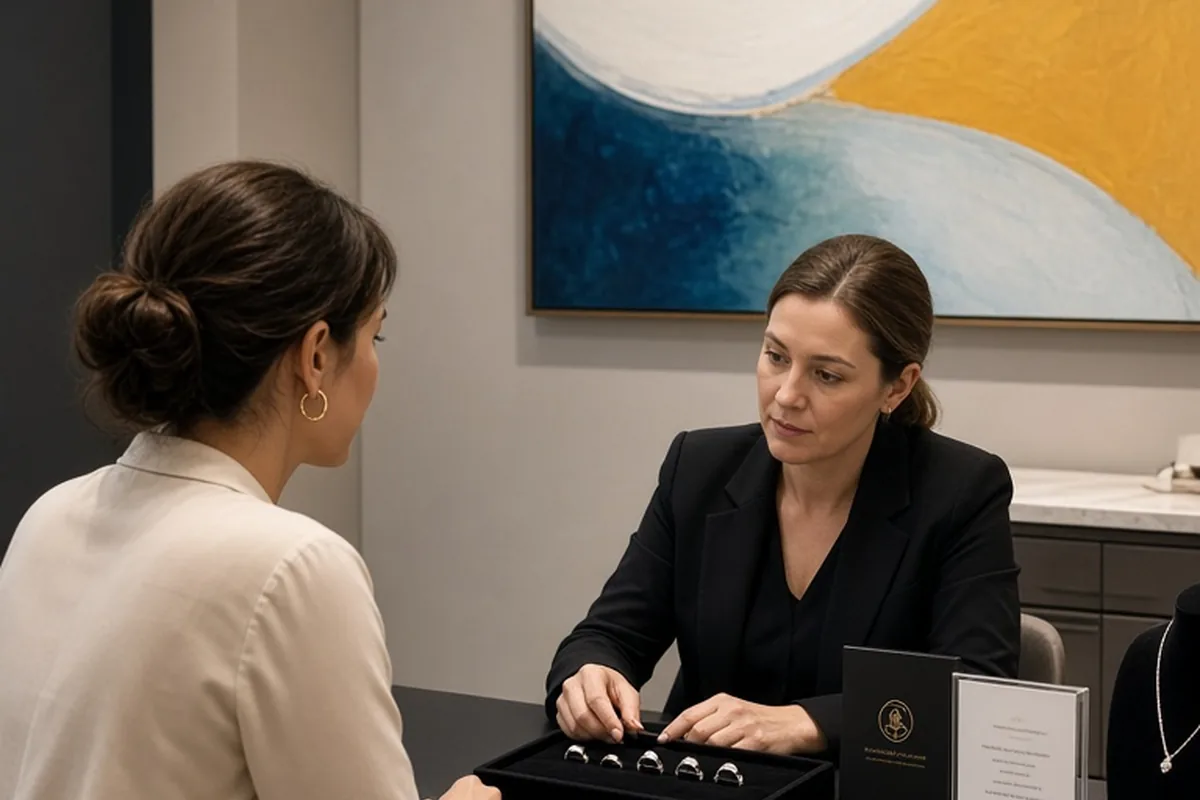
Before booking an engagement ring consultation or placing a custom order, ask the jeweler about their gemstone certification standards, custom design timelines, metal sourcing, and warranty coverage. Confirm whether routine maintenance, resizing, and cleaning are included, and clarify deposit structures, appraisal documentation, and return or exchange windows in writing. Asking these questions upfront protects your budget, ensures structural durability, and prevents unexpected delivery delays or surprise modification fees.
Scheduling an engagement ring appointment is often the first tangible step toward a proposal, but stepping into a showroom without a clear evaluation plan can quickly lead to decision fatigue. Because an engagement ring represents both significant emotional value and a major financial commitment, vetting a jeweler's production practices, stone sourcing, and service policies in advance ensures you invest in a piece built for everyday, lifelong wear.
Vetting the Jeweler: Studio Experience, Sourcing, and Craftsmanship
Before scheduling an appointment or committing to a consultation fee, clarify how the jeweler operates their business and produces their inventory. Ask whether their pieces are designed and fabricated in-house by dedicated bench jewelers, cast from mass-market prefabricated mountings, or outsourced to third-party manufacturers. Studios with on-site master jewelers often provide higher accountability for structural integrity, easier direct communication for custom modifications, and faster turnaround times for future adjustments.
Inquire about their typical design aesthetic and portfolio of past work to ensure their technical specialties align with your vision. If you want an intricate vintage-inspired filigree, delicate pavé bands, or a modern bezel setting, verify that they regularly execute those styles successfully. Asking to see physical samples or high-resolution macro photographs of finished rings from their bench gives you an accurate sense of their finishing quality, symmetrical prong placement, and metal polish.
Evaluating Engagement Ring Center Stones: Certification and Inspection
When discussing diamonds or alternative gemstones, ask the jeweler which independent gemological laboratories grade their stones. For diamonds, reputable reports from independent institutions like the Gemological Institute of America (GIA) or the International Gemological Institute (IGI) offer consistent, objective grading for cut, color, clarity, and carat weight. Ask whether the jeweler provides the physical grading report and whether the stone carries a laser inscription on its girdle that matches the certificate dossier.
Inquire if you will be able to inspect the loose stone under standard 10x magnification (a jeweler's loupe or gemological microscope) and across multiple lighting environments during your consultation. Direct showroom spotlights can mask color tints and internal inclusions, so asking to view stones near diffused daylight helps you accurately evaluate light performance, fire, and eye-clean clarity before the gem is permanently mounted into a setting.
Setting Durability and Metal Integrity for Daily Wear
Engagement rings endure continuous friction, exposure to chemicals, and accidental impacts. Ask the jeweler about the structural durability of your preferred setting style in relation to your partner's lifestyle and occupation. For example, inquire whether delicate micro-pavé bands have sufficient metal thickness to hold accent stones securely over time, or whether a six-prong setting is recommended over a four-prong head to prevent stone loss in active daily routines.
Ask detailed questions regarding their precious metal options, including the exact alloys used in their 14k gold, 18k gold, and platinum pieces. Inquire whether their white gold contains nickel—a common allergen—or if they use palladium white gold or platinum for hypoallergenic wear. Additionally, ask how frequently white gold pieces will require rhodium replating to maintain a bright white finish, helping you anticipate long-term aesthetic maintenance.
Custom Design Milestones, CAD Models, and Approval Timelines
If you are designing a bespoke ring, ask the jeweler to walk you through their standard design milestones from the initial concept to the finished piece. Clarify whether they provide Computer-Aided Design (CAD) renderings, physical wax models, or resin 3D prints for you to try on before metal casting begins. Understanding these review stages allows you to make proportional adjustments to band width, stone height, and prong orientation before irreversible metalwork starts.
Establish an exact production timeline and ask what buffer they build in for unexpected casting flaws, stone sourcing delays, or holiday rushes. A clear schedule detailing when design iterations close, when casting begins, and when final quality control checks occur ensures that your ring is securely in hand well ahead of your planned proposal date.
Transparent Pricing, Deposits, and Potential Surcharges
Ask the jeweler for an itemized breakdown of costs rather than a single lump-sum quote. A transparent quote should delineate the price of the center stone, the setting metal and labor, accent gemstones, custom design or CAD modeling fees, and any specialized details like hand engraving or milgrain borders. Understanding each cost driver allows you to adjust individual elements intelligently to stay comfortably within your designated budget.
Ask about payment schedules, deposit requirements, and potential hidden fees before initiating work. Clarify what percentage of the total price is required as an upfront deposit, whether that deposit is refundable if initial CAD sketches do not meet your expectations, and what payment methods they accept. Inquire whether the final quote includes local sales tax, secure shipping and transit insurance if you live out of area, and formal appraisal documentation for insurance purposes.
Post-Purchase Care: Resizing Boundaries, Maintenance, and Warranties
Ring sizing can be imprecise prior to a surprise proposal, making post-purchase adjustment policies vital. Ask the jeweler whether they offer complimentary initial resizing, the allowable size range adjustments without compromising structural integrity, and how long resizing typically takes. Certain styles, such as full eternity bands with continuous diamonds or tension settings, cannot be resized traditionally, so clarifying these limitations beforehand prevents costly setting remakes.
Ask for a written copy of their warranty policy and clarify the conditions necessary to keep it active. Many jewelers require complimentary biannual inspections to maintain coverage on accent diamond loss, prong tightening, and structural repairs. Confirm whether routine cleaning, ultrasonic polishing, and prong re-tipping are covered under their standard warranty or require an add-on service plan.
Return Policies, Cancellation Windows, and Future Upgrade Options
Even with meticulous planning, circumstances may require an exchange, return, or alteration. Ask the jeweler directly about their return and exchange window for both catalog pieces and custom-commissioned settings. While ready-to-wear settings often carry standard 14-day to 30-day return windows, bespoke designs frequently entail non-refundable labor or metal fees; knowing these boundaries in writing protects you financially.
Inquire about their long-term trade-in and upgrade programs. Many fine jewelers allow clients to trade in certified natural diamonds toward larger stones in the future, crediting a significant portion or the full original purchase price provided the new stone meets specific value thresholds. Knowing these policies helps you assess whether the studio is an appropriate partner for future anniversary or milestone jewelry investments.
Frequently asked questions
How far in advance should I book an engagement ring consultation before my planned proposal?
You should book an initial consultation at least two to three months before your target proposal date. Ready-to-wear settings with an in-stock stone can often be completed in one to two weeks, but custom designs, stone sourcing, and final fabrication generally require four to eight weeks, plus time for potential resizing.
What documentation should I receive when picking up the finished engagement ring?
You should receive an independent gemological grading report (such as GIA or IGI) for the center stone, an itemized sales receipt, a written manufacturer warranty, and an independent or in-house retail replacement appraisal. The appraisal document is necessary to bind jewelry insurance coverage against loss, theft, or damage.
Can all engagement ring setting styles be resized if the fit is incorrect?
Most standard solitaire, three-stone, and partial-pavé rings can be resized up or down by one to two full sizes. However, full eternity bands, intricate filigree designs, and certain alternative metals like titanium or tungsten cannot be resized and require an entirely new setting if the size is wrong.
Are consultation fees standard when meeting with a custom engagement ring jeweler?
Most retail showroom consultations and preliminary design discussions are free of charge. Some high-end custom jewelers charge a modest design or CAD deposit before creating 3D renderings, which is typically credited toward the final purchase price if you proceed with the build.
Your next step
Compile a short list of three local or independent jewelers, write down your non-negotiable design parameters and stone preferences, and call to ask about their certification standards and appointment deposit policies before booking your first consultation.