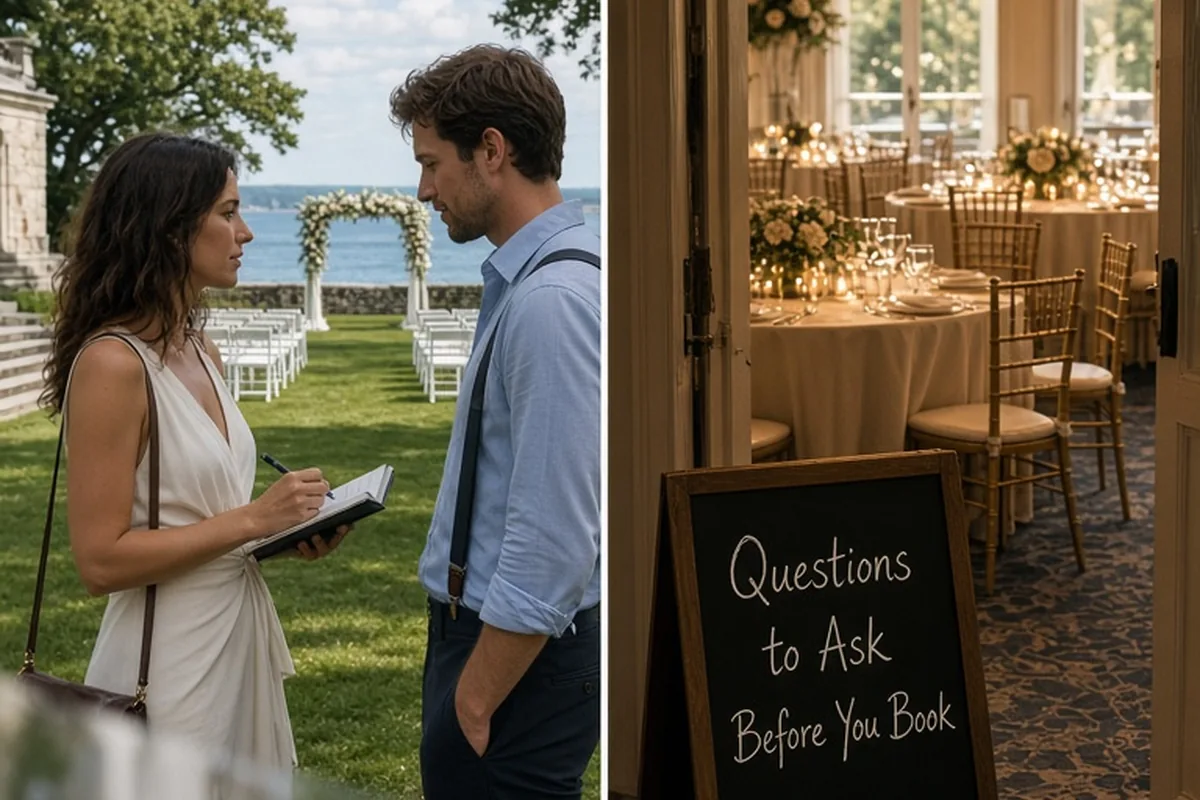
When evaluating a wedding venue, ask targeted questions covering true total costs, vendor restrictions, logistical timelines, and contingency plans. Inquire specifically about service fees, required in-house caterers, setup and teardown hours, sound curfews, liquor licensing, and exact indoor weather backups. Clarifying these operational details in writing before placing a deposit protects your budget and prevents day-of coordination conflicts.
Touring a wedding venue often brings an overwhelming mix of aesthetic excitement and sales presentations. While a space may look stunning during an afternoon walkthrough, understanding how it functions operationally ensures your wedding day runs smoothly without unexpected expenses or restrictive surprises.
Total Pricing, Payment Schedules, and Mandatory Fees
A venue's advertised rental rate rarely reflects the final amount due on your invoice. Many spaces publish baseline rates that exclude standard administrative charges, mandatory gratuities, cleaning fees, security costs, and local hospitality taxes. Failing to uncover these line items early can distort your overall wedding budget by thousands of dollars. To understand the true financial commitment, you need to ask for a line-item estimate that includes every operational fee required to host your event from start to finish.
Beyond the gross price, payment structures and liability terms directly affect your cash flow and financial risk. Inquire about the initial deposit amount, the subsequent milestone dates, and whether payment can be split across accessible intervals. You should also clarify cancellation terms, postponement allowances, and whether security deposits are fully refundable or subject to automatic deductions for wear and tear. For example, a venue offering an attractive eight-thousand-dollar base rate might require a mandatory twenty-four percent operational charge, five hundred dollars for post-event cleaning, and a one-thousand-dollar refundable damage deposit, turning an apparently affordable space into a significant stretch for your budget.
When comparing venues, ask whether package options bundle rental items like tables, chairs, and standard linens, or if the space is a raw shell that requires independent sourcing for basic infrastructure. An all-inclusive pricing model offers financial predictability, whereas dry-hire venues provide creative control but introduce separate delivery fees, damage waivers, and coordination responsibilities that must be tallied separately.
- What is the total estimated cost after adding service charges, local taxes, cleaning fees, and security deposits?
- What is the required deposit schedule, and what are the specific conditions for refunds or date transfers?
- What physical items are included in the base rental fee, such as tables, chairs, staging, or basic lighting?
Catering Options, Beverage Policies, and Kitchen Access
Food and beverage service represents one of the largest single line items in any wedding budget, and venue policies largely dictate your options. Some venues require couples to select from an exclusive in-house catering department, while others provide a curated list of approved vendors or allow entirely independent caterers. If in-house dining is mandatory, ask for current per-person menus, food and beverage minimum spend thresholds, and whether those minimums fluctuate depending on the day of the week or the season.
Alcohol policies require equal scrutiny, as service structures range from open bring-your-own models to mandatory tiered bar packages with high markups. Ask whether the venue allows you to supply your own alcohol, what corkage fees apply per bottle, and whether your bartenders must carry specific state licensing and commercial liability insurance. A venue that allows couple-sourced beverages can save substantial funds, but mandatory package upgrades or high corkage charges can quickly erase those savings.
For couples using an off-premise caterer, facility infrastructure becomes a primary concern. Caterers need adequate preparation space, reliable electrical circuits, running water, and refrigeration. If a venue only offers a basic staging area without heating equipment or dishwashing facilities, your caterer may charge extra rental fees to bring in portable ovens, warming towers, and prep tables.
- Are we required to use an in-house caterer or an exclusive vendor list, and what are the associated food and beverage minimums?
- What are your bar service rules, corkage fees, and licensing requirements for serving alcohol?
- What kitchen and staging facilities are available on-site for catering staff, and are there trash removal fees?
Rental Windows, Setup Schedules, and Teardown Rules
Event timelines are heavily dictated by the venue's contracted access hours. A standard eight-hour rental period sounds generous until it is divided among floral installation, sound checks, vendor deliveries, guest arrival, dining, dancing, and late-night cleanup. If your rental window begins only two hours before the ceremony, complex installations like custom arches, elaborate lighting, or extensive tabletop decor may be impossible to execute without paying for additional setup hours.
Equally important is the post-event breakdown process. Venues often enforce strict departure deadlines, requiring all personal decor, floral arrangements, and rental inventory to be cleared within one hour of the event's conclusion. If your vendors cannot complete breakdown within that timeframe, you could face steep penalty charges or be forced to hire dedicated breakdown crews. Clarify whether decor can be dropped off the day before or retrieved the following morning.
Consider a scenario where a couple plans a midnight departure but discovers the venue contract requires all guest music to end by ten in the evening to accommodate a mandatory two-hour teardown window before midnight. Asking detailed questions about rental spans helps you build a realistic schedule that balances your celebration goals with the property's operational boundaries.
- How many total hours are included in our contract, and how are they divided between setup, event time, and breakdown?
- What are the hourly rates for adding extra setup or breakdown time to our booking?
- Can decor, personal items, and rental deliveries arrive early or be picked up the following morning?
Weather Contingencies, Backup Layouts, and Climate Control
For open-air or partially outdoor venues, an actionable weather contingency plan is essential. Many spaces market sweeping garden lawns or scenic terraces, but their designated rain backup may be an uninspired conference room or an awkward flip of the primary reception hall. You need to physically view the secondary indoor space during your walkthrough and assess whether it comfortably accommodates your full guest count without sacrificing aesthetics.
Investigate the logistics and timing of making a weather call. Find out who makes the final decision to move indoors, how many hours in advance that call must be made, and what fees might apply if a tent must be installed. Some properties require couples to reserve a rain tent on hold months in advance, requiring non-refundable deposits with external tent rental suppliers regardless of whether it rains.
Indoor environmental comfort matters during every season. Ask how the venue manages temperature swings during hot summer afternoons or cold winter evenings, particularly in converted barns, historic buildings, or industrial lofts. Ensure the facility possesses adequate heating, ventilation, and air conditioning systems capable of handling a crowded room full of active guests.
- What is the exact indoor backup space for outdoor ceremonies and cocktail hours, and may we see its layout?
- What is the strict deadline for deciding to activate our weather backup plan on the wedding day?
- Are there added labor fees for flipping a room from ceremony seating to dinner tables during cocktail hour?
Sound Limits, Curfews, and Decor Restrictions
Municipal noise ordinances and private property rules can dramatically alter your evening entertainment plans. Many residential or historic venues are subject to strict sound thresholds measured at property boundary lines, which may prohibit outdoor amplified music, live brass instruments, or heavy subwoofers. In some locations, music must drop to acoustic levels or move indoors well before the overall event curfew.
Decor rules also vary widely depending on the venue's age, insurance policies, and building materials. Historic estates and art galleries frequently ban real open flames, wax candles, hanging overhead installations, glitter, confetti, sparkler exits, or tape on wall surfaces. If your vision relies on hundreds of glowing taper candles or suspended floral clouds, confirming these rules early prevents costly design redesigns later.
Trade-offs are common in this area. A historic mansion may offer unmatched architectural character but restrict your band to a lower volume limit and prohibit red wine on upper levels. Conversely, a modern loft might allow unrestricted sound and open flames but require you to rent every piece of furniture independently. Identifying your artistic priorities helps you choose the right balance.
- What are the exact music curfews, decibel limits, and restrictions on live bands versus digital DJ setups?
- What decor elements are strictly prohibited, such as real candles, hanging installations, sparklers, or confetti?
- Are there restrictions on where guests and photographers may access historical grounds or delicate landscaping?
Staffing Roles, Coordination, and Dressing Suite Amenities
Couples frequently confuse a venue's on-site event manager with an independent wedding coordinator. A venue manager represents the property, ensuring that building doors unlock on time, bathroom facilities remain functional, and house rules are respected. They do not manage your bridal party processional, cue your musicians, or pack up your gifts at the end of the night. Asking explicit questions about staffing clarifies whether you must hire an independent planner or day-of coordinator.
Examine the practical amenities of the getting-ready suites and guest facilities. If you plan to spend the morning on-site with your wedding party, verify how early you can enter the dressing suites, whether they feature climate control, dedicated restroom access, and sufficient electrical outlets and mirrors for professional hair and makeup teams. Inquire about secure locks so valuables remain safe while you take photos across the property.
Guest comfort infrastructure also deserves attention. Verify the ratio of available restrooms to your projected guest count to prevent long lines during intermission periods. Inquire about on-site parking capacity, valet requirements, shuttle bus accessibility on narrow access roads, and compliance with accessibility standards for elderly or mobility-impaired guests.
- What specific duties will the on-site venue representative handle during our ceremony and reception?
- What time can we access the dressing suites, and what amenities and security measures do they provide?
- How many guest restrooms and parking stalls are on-site, and is the entire venue ADA accessible?
Frequently asked questions
When is the best time to tour venues and finalize a contract?
Most couples begin touring venues 10 to 14 months before their desired wedding date, especially if they are targeting popular weekend dates during peak seasons. Starting early gives you access to a wider selection of dates and allows ample time to review contracts and compare itemized cost breakdowns before making a deposit.
Can we negotiate rental rates or contract terms with a wedding venue?
While baseline rental fees for prime Saturday dates are rarely discounted, venues are often willing to negotiate inclusions, such as waiving room flip charges, extending setup hours, or offering lower minimum spends for off-peak days and seasons. You can also negotiate contractual clauses regarding payment milestones and vendor selection flexibility.
What happens if our guest count changes after we sign the venue contract?
Most venues require an estimated guest count at booking and a locked minimum guest guarantee that protects their catering revenue. You can generally increase your guest count up to the building's maximum occupancy limit close to the event date, but dropping below your contracted minimum usually does not reduce your financial obligation.
Your next step
Compile a prioritized checklist of your non-negotiable logistical needs, and request a full sample contract along with an itemized mock invoice before committing to any venue tour deposit.