Wedding traditions are cultural, religious, or familial rituals passed down across generations to mark marriage. You do not have to include every custom; modern couples select meaningful rituals, adapt outdated ones, or replace them with personal alternatives. To choose effectively, evaluate each tradition by asking whether it honors your genuine values, respects both partners' backgrounds, and fits your wedding budget and timeline, rather than feeling pressured by external expectations or peer convention.
Every couple planning a wedding encounters an extensive catalog of customs, from traditional processionals and symbolic vows to tiered cakes and coordinated dances. While rituals provide a familiar sense of continuity and shared celebration, trying to incorporate every conventional practice can make your celebration feel rigid, costly, or disconnected from who you actually are.
Categorizing Wedding Customs Across Ceremony, Reception, and Attire
Wedding rituals generally fall into three distinct practical categories: ceremonial commitments, reception social customs, and aesthetic standards. Ceremonial traditions include elements such as the processional walk, the exchange of rings, formal vows, religious readings, and unity rituals like lighting a candle or pouring sand. These acts carry formal or spiritual significance, often framing the legal and emotional transition into marriage. When evaluating ceremony customs, the primary consideration is whether the symbolism accurately reflects what the two of you believe about partnership and mutual commitment.
Reception traditions focus on hospitality, entertainment, and communal celebration. These include the first dance, parent dances, toast sequences, cake cutting, bouquet and garter tosses, and exit send-offs. Because reception elements dictate the pacing of the evening, keeping too many of them can fragment the party and leave guests waiting through a rigid schedule. Attire customs, such as wearing white, wearing a veil, carrying something borrowed and blue, or outfitting a synchronized wedding party, carry aesthetic and historical expectations. Sorting traditions into these functional groups prevents couples from feeling overwhelmed by an undifferentiated checklist of expectations.
Recognizing the origins of common customs also clarifies whether they deserve a place in your celebration. Many traditions originated in ancient contract law, superstitions meant to ward off misfortune, or mid-twentieth-century retail promotions. A custom is not inherently sacred or mandatory simply because it is familiar. Taking inventory together allows you to separate customs that hold genuine personal resonance from those you might otherwise follow out of sheer momentum.
Evaluating the Bouquet Toss, Garter Removal, and Receiving Line
Certain reception activities frequently cause awkwardness or disruption, making them prime candidates for reassessment. The garter removal and bouquet toss, for example, originated as rowdy medieval customs where guests grabbed pieces of the bridal dress for good luck. In modern settings, singling out unmarried attendees on the dance floor can feel uncomfortable, patronizing, or exclusionary to single guests. Many couples choose to eliminate both rituals entirely, saving fifteen to twenty minutes of dance floor momentum.
If you want to preserve the playful spirit of floral gifting without singling out unmarried friends, you can present the bouquet directly to a guest of honor, an influential mentor, or the couple in attendance married the longest during an anniversary dance. Alternatively, some couples toss an item of humor or shared interest, like a plush mascot or a breakaway floral arrangement that disperses small bundles into the crowd. Modifying the activity keeps the lighthearted interaction while stripping away unwanted romantic pressure.
The traditional receiving line presents a different logistical trade-off. While standing in a formal line at the end of the ceremony guarantees that you greet every attendee, it can take forty-five minutes to an hour for a wedding of one hundred and fifty guests. This can leave elderly guests standing in discomfort, delay dinner service, or shorten your time for portraits. Couples often replace the formal receiving line by visiting tables between dinner courses or hosting an extended cocktail hour where they can circulate naturally among guests without holding up the event schedule.
Revisiting Processional Norms, Giving Away, and Family Roles
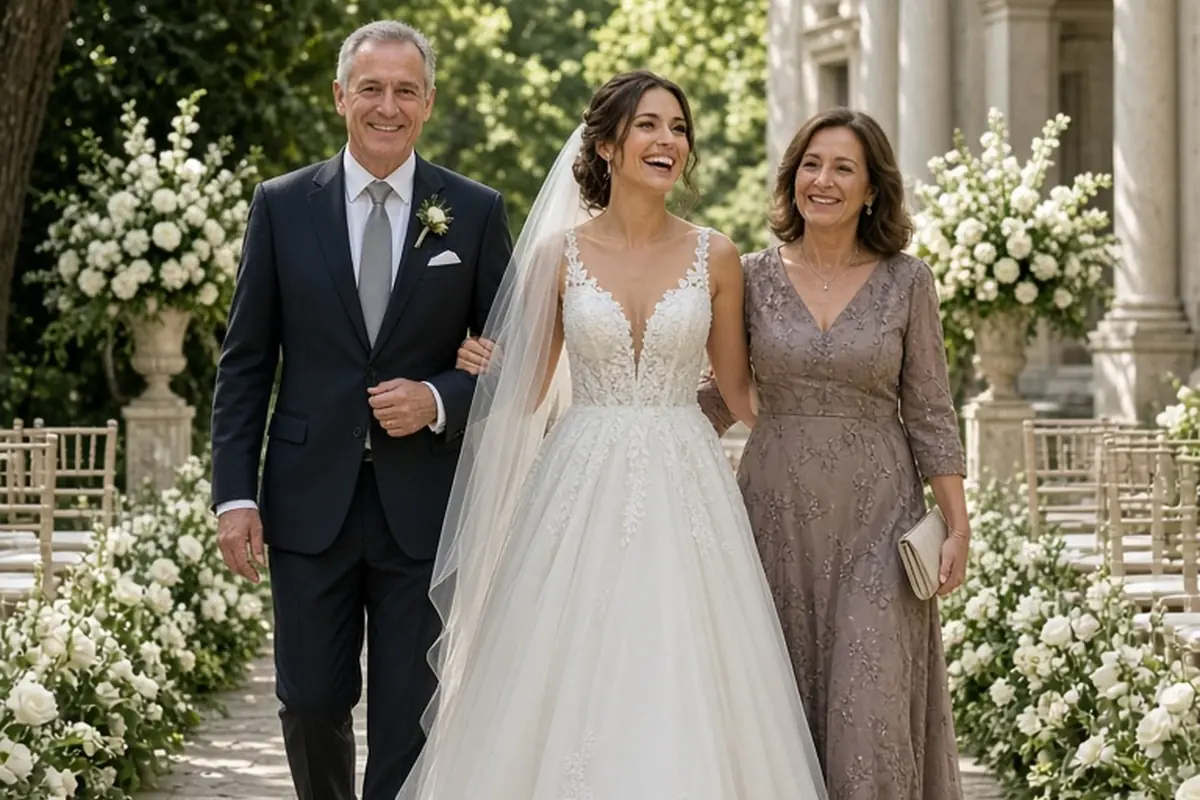
The ceremonial entrance is one of the most emotionally charged moments of a wedding, but traditional processional customs can conflict with modern sensibilities. The convention of a father escorting the bride down the aisle and formally giving her away stems from historical legal agreements where daughters transferred from one patriarchal household to another. While many families now view this as a loving gesture of parental support, others find the implied ownership outdated or feel that it minimizes the role of mothers, step-parents, or the bride's independent adulthood.
Couples can reshape this entrance in several thoughtful ways. Both parents can walk on either side of the bride, honoring maternal and paternal care equally. Alternatively, the bride can walk down the aisle alone to signify entering marriage as a self-sufficient adult, or both partners can walk into the ceremony space together side by side. If you want to include family members without the paternal handoff, the officiant can ask the entire assembly or both sets of parents to voice collective support for the marriage, reframing the moment as community blessing rather than transfer.
Gendered bridal party structures also warrant practical reconsideration. Demanding that attendants divide strictly by gender often excludes close lifelong relationships, such as a sister serving as a groom's attendant or a male friend supporting the bride. Eliminating rigid gender lines allows you to select attendants based on genuine personal closeness rather than superficial symmetry. You can also skip wedding parties altogether, which saves your closest friends substantial costs on specialized attire, travel, and pre-wedding events while keeping the ceremony focus entirely on the two of you.
Blending Multi-Cultural and Inter-Faith Wedding Rituals
When partners come from different religious, cultural, or ethnic backgrounds, weddings offer a rare opportunity to honor both heritages. However, combining multiple traditions requires careful curation to avoid an exhausting ceremony or unintended theological conflicts. For example, blending Jewish and Christian traditions might involve signing a ketubah and standing beneath a chuppah alongside readings from both traditions, or celebrating a Chinese tea ceremony with immediate family earlier in the day before an evening civil ceremony.
Effective blending depends on prioritizing rituals with complementary meanings rather than attempting to perform two complete liturgies back-to-back. If a ritual requires strict adherence to canonical language that excludes or diminishes one partner's heritage, seek out a progressive or interfaith officiant who can reframe the blessing with inclusive language. When traditions carry complex symbolic nuances, brief printed explanations in your ceremony program or a short sentence from the officiant can help uninitiated guests follow along respectfully and feel included in the significance of the moment.
Timing and separation can also resolve logistical tension. Holding cultural ceremonies on different days or in separate segments of the wedding weekend allows each tradition to receive dedicated attention without overwhelming the main gathering. A couple might host a traditional Indian sangeet or Nigerian traditional engagement the night before a Western ceremony, giving each family's heritage its own vibrant, unhurried space to shine.
Managing Family Pressure and Generational Expectations
Departing from established traditions often provokes emotional resistance from parents or grandparents. Family members frequently interpret a wedding not just as a couple's personal party, but as a generational milestone reflecting family identity and social standing. When a couple proposes eliminating a religious ceremony, a traditional formal meal, or specific dances, parents may feel rejected or worry about how extended relatives will perceive the decision.
The most constructive way to navigate this tension is to distinguish between genuine parental sentiment and control over personal aesthetics. Initiate early, calm conversations about your overall vision instead of delivering surprise announcements close to the wedding date. When declining a specific family tradition, acknowledge the sentiment behind it: 'We know how meaningful the traditional receiving line was at your wedding, but because our reception timeline is compact, we want to greet everyone during dinner so guests can enjoy cocktail hour.' Offering a sensible practical reason reduces the feeling that their values are being attacked.
Financial contributions introduce additional complexity. If parents are funding specific portions of the wedding, they may feel entitled to dictate the inclusion of certain customs. The healthiest path forward is absolute transparency regarding boundaries. If accepting family funds requires you to perform rituals that violate your core beliefs or comfort, the responsible choice is to decline that portion of the financial contribution and scale back the wedding scope to what you can fund independently.
Creating New Traditions That Reflect Your Shared Values
Replacing outdated customs does not leave your celebration empty; it creates room to establish new rituals that carry authentic personal resonance. Modern couples frequently replace standard unity candles with symbolic actions tied to their shared interests, such as planting a tree with soil gathered from both their hometowns, blending a custom barrel of wine, or contributing to an artistic canvas during the ceremony. The value of a ritual lies in its ability to anchor your attention on the commitment taking place.
You can also introduce community-focused customs that involve your guests directly. In a ring warming ritual, the wedding bands are passed quietly among close family and guests before vows, allowing attendees to offer silent well-wishes or prayers. Another option is a reciprocal vow exchange, where the couple makes promises to one another and then asks their assembled community to commit to supporting them through future trials. These participatory elements turn passive spectators into active witnesses.
Reception hospitality can similarly be reshaped around authentic hospitality rather than commercial scripts. Instead of a standard tiered cake cutting that interrupts dancing, you might serve a dessert bar highlighting family recipes, organize a group toast led by close friends, or begin the evening by personally greeting guests as they arrive with welcome drinks. Designing your own milestones ensures that every minute of your wedding reflects your intentional choices rather than unexamined routine.
Frequently asked questions
Is it rude to skip the traditional bouquet and garter toss?
No, it is entirely acceptable to skip both. Many modern couples omit these activities to avoid single-shaming guests or breaking reception dance momentum, and guests rarely notice or miss them.
How can we honor our parents if we do not want a traditional walk down the aisle?
You can have both parents walk you down the aisle, have parents meet you at the altar for a shared embrace, or ask the officiant to include a parental blessing in the ceremony script. You can also honor them through personal toasts, program dedications, or reserved front-row seating.
What should we do if our families disagree on which religious customs to include?
Hold an open conversation with your partner first to define your core comfort levels, independent of family pressure. Once aligned, consult an interfaith officiant to weave together neutral, universally meaningful blessings, or consider separating cultural ceremonies across different days of the celebration.
Your next step
List every conventional tradition on a single page, place each item into a 'keep,' 'adapt,' or 'skip' column with your partner, and write one sentence explaining why for each choice before discussing the list with outside family.