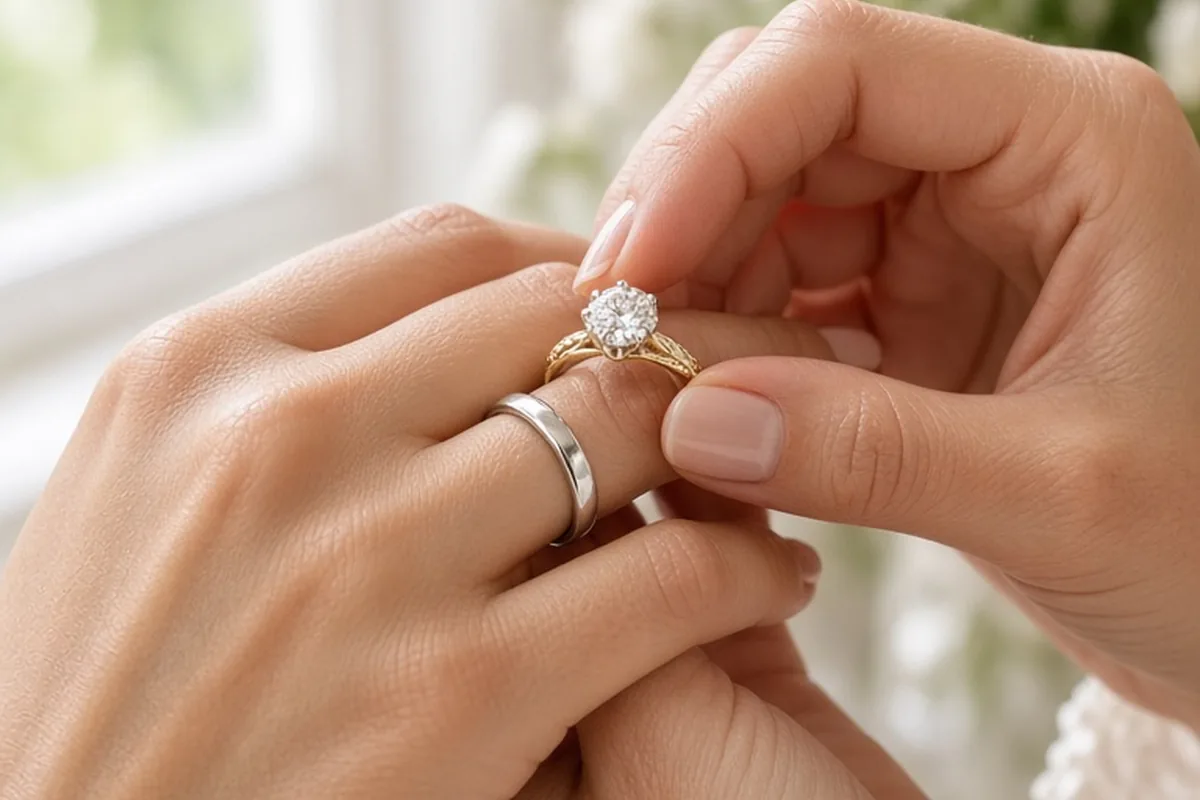
An engagement ring is traditionally presented during a marriage proposal and features a prominent center stone, such as a diamond or gemstone, set on an ornate band. A wedding ring, or wedding band, is exchanged during the marriage ceremony, featuring a simpler, low-profile design such as a plain metal band or a continuous row of smaller stones. While engagement rings signify the initial intent to marry, wedding rings symbolize the finalized union.
Navigating bridal jewelry can feel overwhelming when couples encounter unfamiliar terminology, varying traditions, and practical questions about daily wear. Deciding how to choose, budget for, and wear engagement rings and wedding rings comes down to personal lifestyle, aesthetic preferences, and comfort.
Comparing Engagement Rings and Wedding Rings by Design, Cost, and Wear
The primary distinction between an engagement ring and a wedding ring lies in its structural design and visual focal point. Engagement rings are built around a standout center stone, typically raised above the band using prong, bezel, tension, or halo mountings. This architecture is intended to highlight the brilliance, cut, and color of the primary gemstone. In contrast, wedding rings—often called wedding bands—are designed with a streamlined, low-profile silhouette. They may consist of solid precious metal, subtle surface textures, or smaller accent diamonds set flush into the channel, pavé, or micro-prong framework.
These structural variations create meaningful differences in daily wearability. Because an engagement ring has a raised center stone and delicate prongs, it is more susceptible to catching on fabrics, scratching delicate surfaces, or snagging on knitwear and gloves. A standard wedding band sits close against the finger, drastically minimizing contact with external objects. As a result, many people find wedding bands far more functional for continuous wear across active environments, household chores, manual professions, and athletic hobbies.
Cost distribution also varies significantly between the two styles. An engagement ring generally represents a larger portion of the total jewelry investment because the price of a certified center diamond or rare gemstone scales exponentially with carat weight, cut precision, clarity, and color purity. Wedding bands, by comparison, derive their value primarily from precious metal weight, manufacturing craftsmanship, and the total carat weight of uniform melee stones. This makes wedding band pricing much more predictable and straightforward to budget.
Tradition, Ceremony, and the Timing of Exchange
The timeline and social context of giving each ring reflect distinct milestones in a relationship. Historically and culturally in Western traditions, an engagement ring is presented during the proposal when one partner asks the other for their hand in marriage. From that moment onward through the duration of the engagement period, the ring is worn on the fourth finger of the left hand as a visible sign of an impending wedding.
The wedding band enters the picture during the marriage ceremony itself. During the exchange of vows, both partners present wedding bands to one another as reciprocal symbols of lifelong commitment and legal partnership. Traditional etiquette suggests moving the engagement ring to the right hand on the morning of the wedding ceremony. This leaves the left ring finger open so the wedding band can be placed on the finger first—symbolically closest to the heart—before the engagement ring is moved back on top to sit above it.
Modern practices have expanded beyond strict historical etiquette. Many couples today select engagement rings together or choose mutual engagement rings so that both partners wear a symbol of their upcoming marriage. Other couples bypass engagement rings entirely, choosing instead to focus their resources on bespoke wedding bands that reflect their shared values. Cultural variations also influence placement: in countries like Germany, Austria, and Greece, wedding bands are traditionally worn on the right hand rather than the left.
Choosing Between Separate Rings, a Bridal Set, or a Single Band
When planning long-term bridal jewelry, buyers generally select among three distinct paths: purchasing separate complementary rings over time, choosing a unified bridal set, or wearing a single versatile ring. The separate approach allows the engagement ring to be chosen first for the proposal, followed by an intentional search months later for a band that harmonizes with the engagement ring's shape, metal color, and stone arrangement.
A bridal set (or wedding set) involves purchasing both the engagement ring and the matching wedding band at the same time from the same jeweler. These rings are engineered to fit together seamlessly, with the wedding band contoured or notched to match the curvature of the engagement ring's center setting. This eliminates uneven gaps and prevents the two rings from rubbing against each other awkwardly. However, the trade-off is that a highly curved or notched wedding band may look incomplete or unusual if worn alone without the engagement ring.
The single-band alternative has gained popularity among those who prefer minimalism and practicality. Wearing only one ring eliminates the hassle of stacking two pieces of metal on a single knuckle, avoids ring spinning, and reduces cleaning requirements. A person might choose an intricate engagement ring that serves as their permanent wedding jewelry or select an eternity band with substantial diamond coverage that fulfills both roles without needing a raised center stone.
Metal Matching and Structural Compatibility to Prevent Ring Wear
Wearing two rings on the same finger introduces physical friction between the bands. Over time, metal-on-metal contact causes surface wear, micro-scratches, and metal thinning. Different precious metals possess varying levels of hardness. For instance, 14-karat gold contains a higher percentage of alloy metals than 18-karat gold, making 14-karat gold noticeably harder. Platinum is dense and malleable, meaning it displaces metal under pressure rather than flaking away, but it can still wear down softer gold alloys over decades.
To prevent premature wear, it is advisable to match the metal purity across both rings. Pairing an 18-karat white gold engagement ring with a platinum wedding band, for example, will cause the denser platinum ring to slowly erode the softer white gold ring where they touch. Similarly, pairing an unplated yellow gold ring with a rhodium-plated white gold ring can cause uneven scratching and faster plating degradation along the contact points.
Profile alignment is another structural factor that dictates how comfortably two rings sit together. Solitaires with high-set cathedral or peg-head mountings typically have enough vertical clearance for a straight wedding band to slide flush beneath the center stone. Low-profile basket settings, however, sit directly against the skin, forcing a straight wedding band to collide with the stone mounting. In those situations, couples must choose between accepting a small gap, commissioning a custom-contoured curved band, or soldering the two rings together into a single permanent unit.
Budget Allocation and Purchasing Timelines
Allocating financial resources between an engagement ring and wedding bands requires an honest assessment of priorities and lifestyle. Traditional marketing formulas that prescribe spending fixed percentages of annual salary do not reflect responsible personal financial planning. Instead, couples should establish a clear overall budget that covers the engagement ring and both partners' wedding bands without incurring unsustainable consumer debt.
Because wedding bands are required for the ceremony, shopping should begin three to four months before the wedding date. This timeline provides adequate buffer for custom metal casting, intricate hand-engravings, stone matching, and any necessary resizing adjustments. Rushing the process in the final weeks before the wedding limits design choices to in-stock inventory and increases the risk of receiving an ill-fitting band on the wedding day.
Long-term ownership costs should also be factored into the overall budget. These include professional appraisals for jewelry insurance riders, periodic rhodium plating for white gold jewelry every one to two years, and routine prong inspections to ensure accent stones do not work themselves loose. Understanding these upkeep considerations helps buyers choose low-maintenance metals like platinum or yellow gold if they wish to minimize recurring jeweler visits.
Daily Lifestyle Factors: Work, Hobbies, and Safety
Your daily occupation and physical routine play a major role in determining which ring you will wear most often. Healthcare practitioners, mechanics, laboratory technicians, and fitness enthusiasts frequently find raised engagement rings impractical or hazardous. Tall prong settings can puncture latex medical gloves, collect sanitizing residues, scratch sensitive equipment, or pose safety hazards around fast-moving machinery.
For hands-on lifestyles, a wedding band frequently serves as the primary everyday piece, while the engagement ring is reserved for social gatherings, formal occasions, and weekends. Many people also invest in low-cost silicone bands for the gym, outdoor hiking, swimming, and heavy manual labor. Silicone rings eliminate the risk of ring avulsion injuries and keep valuable diamond settings safe from impact damage or accidental loss in water.
Finger comfort is also influenced by band width and interior profile. Standard flat bands have sharp interior edges that can pinch the skin during heavy gripping, whereas comfort-fit bands feature a slightly rounded, convex interior that slides smoothly over the knuckle and reduces skin irritation. Individuals prone to finger swelling in warm weather or those with sensitive skin often find comfort-fit wedding bands substantially easier to wear throughout the day.
What to Verify Before Finalizing Your Ring Choices
Before completing a ring purchase, thorough verification of stone specifications and jeweler policies protects your investment. For diamond engagement rings, always request an independent grading report from established gemological laboratories, such as the Gemological Institute of America (GIA) or the International Gemological Institute (IGI). This report verifies the authenticity, carat weight, color, clarity, and cut proportions of the center stone independently of the seller's claims.
Review the jeweler's written warranty and service terms in detail. Confirm whether they provide complimentary lifetime cleaning, routine prong tightening, and initial resizing services. Resizing policies are particularly crucial for wedding bands: full eternity bands, which feature continuous stones wrapping all the way around the band, generally cannot be resized without rebuilding the entire ring. If weight fluctuations occur in the future, an eternity band may become unwearable, whereas a half-eternity or plain metal band can be resized up or down with relative ease.
Finally, ensure accurate sizing across varying band widths. A finger size measured with a narrow two-millimeter sizing tool will feel significantly tighter when wearing a combined engagement ring and wedding band stack measuring six or eight millimeters in total width. When testing band sizes at the jeweler, always try on wide sizing rings or wear sample bands together to confirm that the combined stack fits comfortably over your knuckle.
Frequently asked questions
Do I have to wear both an engagement ring and a wedding ring?
No. Wearing both rings is a personal preference rather than a requirement. Many individuals wear both stacked together, while others wear only the wedding band for daily tasks or wear the engagement ring alone as a standalone statement piece.
Which hand and finger do engagement and wedding rings go on?
In the United States and most Western cultures, both rings are traditionally worn on the fourth finger of the left hand, with the wedding band placed first beneath the engagement ring. However, several European and South American countries traditionally wear wedding bands on the right hand.
Can a wedding ring be more expensive than an engagement ring?
While engagement rings are usually more expensive due to prominent center stones, a wedding ring can cost more if it features substantial diamond eternity settings, intricate multi-stone designs, or rare heavy metals like high-weight platinum.
Should wedding bands match between partners?
Wedding bands do not need to match. While some couples select identical metals or complementary design motifs, many partners choose completely different metals, widths, and styles that suit their individual tastes, skin tones, and professions.
Your next step
Visit a local jeweler together three to four months before your wedding date to try on various band widths, profiles, and metal alloys alongside your engagement ring to ensure a comfortable and structurally compatible fit.