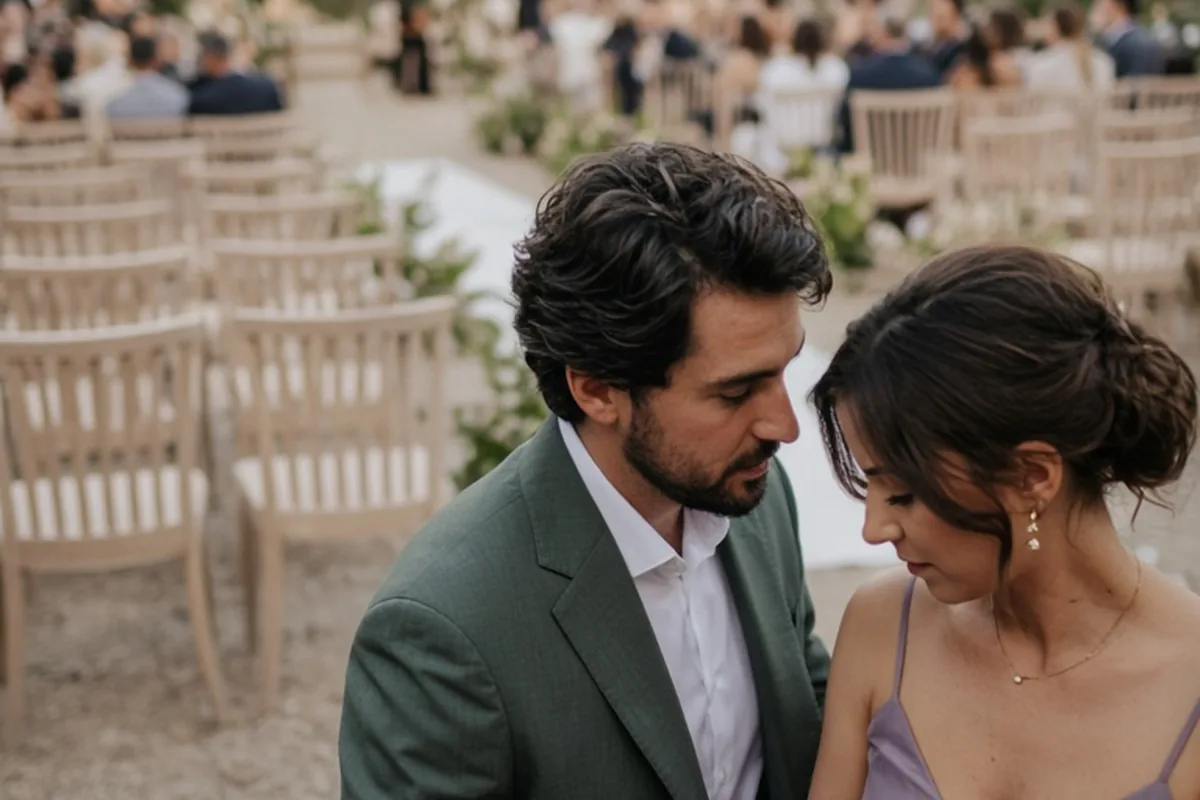
A standard wedding ceremony order for 200 guests begins with a 30-minute guest arrival and seating window, followed by a 5-minute formal processional, a 20-to-30-minute service, and a 10-minute structured recessional. Managing 200 attendees requires an aisle at least five feet wide, four dedicated ushers, sound amplification with clip-on lapel microphones, and a planned dismissal path that guides guests directly toward cocktail hour to prevent bottlenecks.
Coordinating a ceremony of 200 people requires balancing emotional intimacy with crowd-movement logistics. With roughly 20 to 25 rows of seating to organize, minor pacing delays or acoustic gaps quickly multiply across a crowd of this scale.
Arrival Timing and Seating Strategy for 200 Guests
A gathering of 200 guests requires a clear arrival structure that starts well before the opening processional note. Guests typically arrive in three distinct waves: early arrivals who appear 45 minutes prior, the main influx arriving between 15 and 20 minutes prior, and late stragglers who reach the venue within five minutes of the invitation start time. To manage this movement without gridlock, begin playing prelude music 30 minutes before the stated start time. This signals that the seating area is open and encourages early arrivals to take their places rather than congregating near the entrance doors or parking drop-offs.
Seating 200 people requires dedicated directional help. Assign four ushers rather than relying on guests to seat themselves. With two main seating banks of roughly 12 to 14 rows each, two ushers should work the center aisle while two work the outer perimeter. Ushers must seat attendees from the front center rows outward, leaving the first two rows on either side clearly marked with reserved ribbons or physical signage for parents, grandparents, and immediate wedding party members. Guiding guests toward the middle seats first prevents attendees from settling on outer aisle edges, which forces later guests to awkwardly climb over seated visitors and slows down the entire intake.
The 200-Guest Processional Sequence and Spacing
The processional for a 200-guest event is physically longer than that of an intimate wedding because the aisle usually spans 50 to 75 feet to accommodate the deep seating rows. The formal entrance starts with the officiant, the lead partner or groom, and the best man entering quietly from the side of the altar space to take their places. Next, grandparents are escorted down the center aisle, followed by the parents. Once immediate family is seated, the wedding party attendants walk in. Attendants can enter individually or in matched pairs; however, pairing attendants cuts the entry duration in half, which keeps a large crowd engaged and prevents the processional music from feeling drawn out.
Spacing between walkers is the most common operational failure in large processionals. When walking down an extended aisle with 200 guests leaning in, attendants naturally tend to rush or bunch together. Instruct each attendant or pair to wait until the preceding person reaches roughly halfway down the aisle before starting their walk. After the maid of honor reaches the front, the ring bearer and flower child enter. Finally, the main entrance occurs. Allow a full 20-second pause after the flower child enters so the crowd can settle, the music can transition smoothly to the primary processional theme, and the venue doors can fully close and reopen cleanly.
- Officiant and primary partner take position at the front via side entrance.
- Grandparents escorted down the main center aisle and seated in row two.
- Parents of the couple escorted to reserved front-row positions.
- Wedding party attendants walk either paired or spaced by half-aisle intervals.
- Flower child and ring bearer advance toward the altar.
- Brief pause for aisle clearance, doors reset, and processional musical cue shifts.
- Final partner or couple enters and advances toward the altar.
Structuring the Ceremony Service: Welcome to First Kiss
Once everyone is in place at the altar, the core service should run between 20 and 30 minutes. Shorter ceremonies can feel abrupt to guests who may have traveled long distances, while services running beyond 35 minutes often lead to restlessness, particularly in outdoor venues or environments without climate control. The officiant opens with welcoming words and an invitation for the crowd to be seated. Following the welcome, one or two short readings or musical interludes provide a natural buffer, allowing late-arriving guests to be quietly seated in the back perimeter without disrupting the couple.
The middle portion of the service centers on the couple's commitments. The officiant delivers an address on the significance of the marriage, followed by the exchange of vows and the presentation of wedding rings. In a room of 200 people, the physical handoffs must be practiced in advance: the maid of honor takes the partner's bouquet, the best man produces the rings without fumbling through deep pockets, and both partners turn slightly outward toward the audience so guests can observe the ring placement. After the vows and rings, the officiant delivers the closing blessing, officially pronounces the marriage, and invites the couple to share their first kiss.
Audio and Sightline Architecture for Deep Seating Layouts
A crowd of 200 seated adults creates substantial natural sound absorption, meaning unamplified speech will not carry past row four. A reliable sound setup is non-negotiable. The officiant should wear an omnidirectional wireless lapel microphone. In addition, place a secondary condenser or handheld wireless microphone on an adjustable stand between the couple, or equip the couple with low-profile lavaliers. Never rely on the officiant's microphone to capture the couple's vows; when the couple turns to face one another, their voices project away from the officiant, rendering their promises inaudible to the back ten rows.
Sightlines require equal attention during floor plan design. A straight-line layout with 200 chairs on a flat floor creates severe visual obstruction for everyone seated past row eight. To solve this, design the seating blocks with a slight chevron or semi-circular curve angled toward the central altar point. Maintain a center aisle width of at least five feet, expanding to six feet if dramatic dresses or dual escorts are planned. If the venue allows, place the altar platform on a low, six-to-twelve-inch riser. Raising the couple even half a foot ensures that guests seated in the back rows maintain a clear line of sight over the heads of the attendees in front of them.
Managing the Recessional and Immediate Guest Dismissal
The recessional begins the instant the officiant introduces the newly married couple. The couple exits briskly down the center aisle, followed immediately by the wedding party exiting in pairs, and then the parents and grandparents. The recessional sequence takes less than two minutes to walk out, but the subsequent dismissal of 200 guests is where severe event delays often happen. Do not attempt a traditional receiving line at the head of the center aisle. Shaking 200 hands, exchanging pleasantries, and coordinating personal hugs at an exit door takes roughly 45 to 60 minutes, which will derail your reception schedule and strand guests in hallway bottlenecks.
Instead, choose between two proven high-volume dismissal models. In the first model, the couple exits completely out of sight to a private holding room to sign the marriage license, while ushers direct the audience row-by-row toward the cocktail reception or outdoor patio. In the second model, the couple walks back down the center aisle row-by-row to dismiss each bench or row personally. If choosing row-by-row dismissal by the couple, enforce a strict visual pace: a brief five-second thank you per row keeps total dismissal time under 15 minutes. Regardless of method, venue staff should open double side doors or secondary perimeter paths to allow rear-row guests to exit immediately without waiting for the center aisle to clear.
Weather, Hydration, and Facility Logistics for 200 Guests
Outdoor ceremonies for 200 people introduce significant comfort and safety risks that do not exist in small backyard gatherings. Ambient temperature affects large groups dramatically. In hot weather, 200 bodies seated close together generate considerable heat. Provide a pre-ceremony water station staffed with infused cold water near the entrance, and consider printing ceremony programs on functional wooden hand fans. If outdoor temperatures are cool or windy, verify that outdoor patio heaters are positioned along the outer chair banks, keeping safety clearances in mind so walking paths remain completely unobstructed.
Restroom and parking capacities must also align with the 200-guest threshold before the ceremony starts. Because roughly one-third of your attendees will use the restroom during the 20-minute window directly preceding the processional, verify that your venue provides at least three to four dedicated stalls per gender, or arrange supplementary executive restroom trailers for open-lawn venues. For parking, 200 guests typically translate to 85 to 110 vehicles. If parking attendants are not guiding vehicles into designated spaces, parking delays will directly push back your ceremony start time by 15 to 20 minutes.
Rehearsing Pacing and Aisle Movements with the Full Group
A smooth 200-guest ceremony requires a structured 45-minute rehearsal the day before the event. Running a rehearsal for a wedding party of this size is about muscle memory, spatial awareness, and audio cues. Start the rehearsal by placing everyone in their final standing positions at the altar space. This clarifies where everyone will stand, how attendants will angle their shoulders inward toward the center, and how far apart each person must remain to maintain symmetry across the staging area before any walking is practiced.
Once the final altar picture is set, practice the recessional walk first, followed by the processional entrance. Run the processional at least three full times using the exact musical cues selected for the day. Have someone stand at the very back row of the planned seating area to observe pacing and confirm that attendants are honoring the required half-aisle gap. Conclude the rehearsal by practicing the transition of flowers, the ring handoff, and the immediate post-ceremony exit route so the wedding party knows exactly which door to exit through to avoid running directly into gathering guests.
Frequently asked questions
How long does a wedding ceremony for 200 guests usually take?
The ceremony itself generally runs 20 to 30 minutes from the opening processional to the recessional. However, when factoring in the 30-minute guest arrival window and the 10-to-15-minute crowd dismissal, the entire ceremony block spans approximately 65 to 75 minutes.
How wide should the center aisle be for 200 guests?
The center aisle should measure between five and six feet wide. This width provides adequate clearance for two people walking side-by-side without brushing against chairs, coat sleeves, or guest bags extending into the aisle path.
How many ushers are needed for a 200-person ceremony?
Plan for four ushers to handle 200 guests smoothly. Two ushers should escort attendees down the center aisle while the other two assist along outer perimeters and answer questions about seating, restrooms, or programs.
Should we do a traditional receiving line with 200 guests?
A traditional receiving line at the ceremony exit is not recommended for 200 guests because greeting that many people takes 45 to 60 minutes. Instead, release guests directly to the cocktail reception and visit tables together during dinner.
Your next step
Draft a master ceremony floor plan with your venue coordinator that specifies a five-to-six-foot aisle width, dedicated audio microphone placement, and an immediate post-recessional exit path toward the reception.