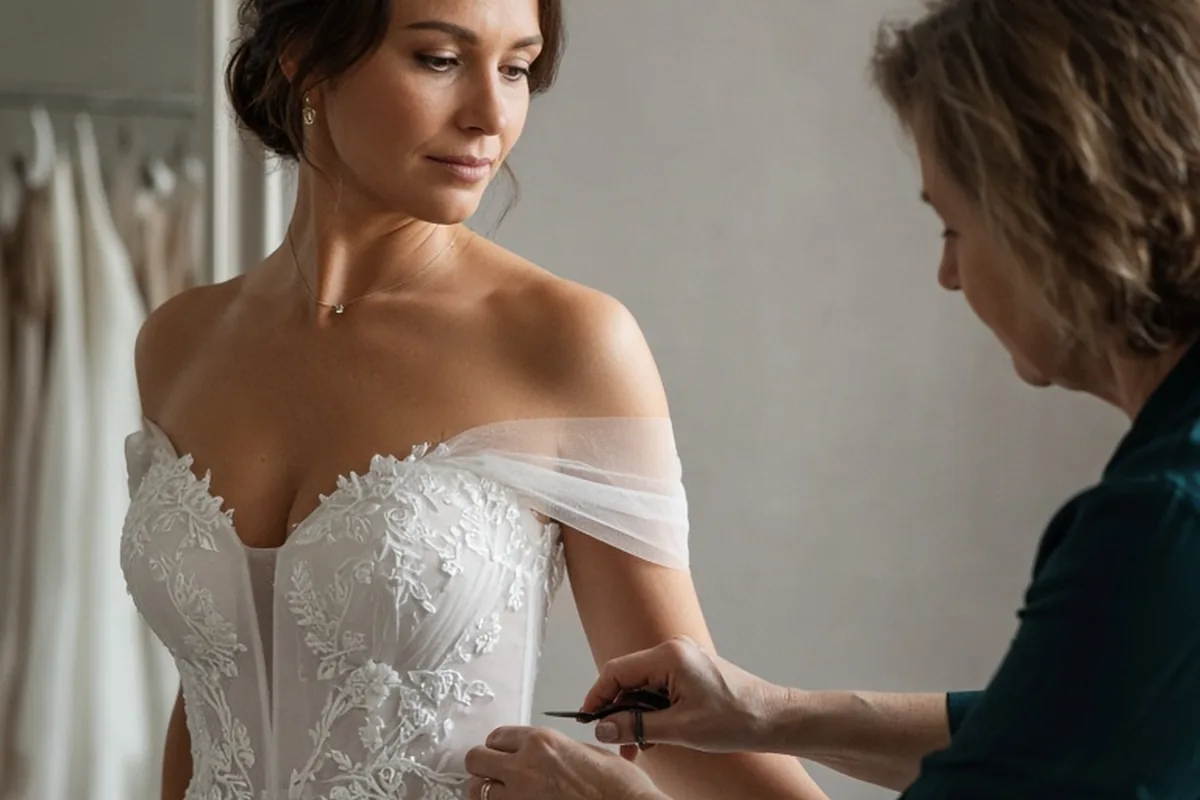
At your wedding dress fitting appointment, ask your seamstress about their specific bridal timeline, whether your shoes and undergarments provide the intended hemline and neckline fit, which bustle style best supports your train fabric, how alterations are priced and itemized, and what structural adjustments like sewn-in cups or boning are needed. Clarify their policy on mid-process body changes, the total number of fittings required, and the protocol for final pressing and pickup.
Bridal alterations transform a standard manufactured gown into a garment sculpted to your exact posture, height, and natural proportions. Entering your fitting appointments with targeted questions protects your investment, avoids miscommunications about turnaround times, and ensures your gown remains comfortable and secure through every phase of your wedding day.
Questions to Clarify Experience, Timeline Milestones, and Scheduling
Before any pins are placed into your gown, you need to understand how the seamstress or tailoring house manages project schedules. Bridal garments often require between two and four distinct fittings over a period of several months to account for progressive alterations, where foundational adjustments must be completed and tested before finishing touches like hem stitching or lace repositioning can begin. Inquiring about their standard operational calendar ensures your dress is not caught in a bottleneck during peak wedding seasons.
Ask how many fittings they anticipate for your specific silhouette and fabric weight, and confirm the specific deadline dates for each session. Inquire whether all tailoring work is performed in-house by the person conducting the fitting or if sections of the gown are delegated to other technicians. Knowing the firm cutoff date for final alterations gives you a realistic timeline and clarifies whether unforeseen body changes or accessory swaps will incur expedited labor fees.
- How many total fitting appointments do you anticipate needing for this specific dress style?
- Do you perform all alteration work on-site, or is handwork and beadwork delegated to external specialists?
- What is the final date by which all major structural adjustments must be locked in?
- What are your policies and fee schedules if unexpected schedule adjustments or rush timelines occur?
Foundation Garments, Footwear, and Silhouette Alignment Questions
The fit of a bridal gown is entirely dependent on the exact items worn underneath it and the exact footwear planned for the event. A shift in heel height of even a quarter-inch alters where the skirt falls against the floor, while changing from a plunge bra to adhesive silicone cups alters the bust apex and torso length. During your initial appointment, you must address how your intended undergarments interact with the dress interior.
Ask the tailor whether they recommend sewing bra cups, bust stays, or waist cinchers directly into the gown lining to eliminate the need for separate foundation garments. If you plan to switch from high heels during the ceremony to platform sneakers or flats for the reception, ask where the hemline should fall to accommodate both shoes without creating a tripping hazard or allowing the fabric to drag excessively across the floor.
- Would you recommend sewing contour cups or internal bust support directly into the lining of this bodice?
- How will my chosen shoe heel height influence the hem clearance across different types of flooring?
- If I switch to flat shoes for the reception, how will that affect the drape and safety of the skirt?
- Are the undergarments and shapewear I brought creating visible lines or tension along the side seams?
Wedding Dress Fitting Appointment Questions for Bustle Selection and Train Security
A train creates a striking entrance down the aisle, but it must be fastened securely out of the way once the reception, dinner, and dancing begin. Bustles are not built into dresses by designers; they must be custom-engineered by your seamstress based on the weight of the train, the number of fabric layers, and your movement preferences. Asking detailed questions about bustle mechanics prevents broken loops, torn lace, or drooping fabric mid-celebration.
Inquire about the different bustle types appropriate for your dress architecture, such as an American over-bustle, a French under-bustle, an Austrian ruched bustle, or a ballroom fold. Ask how many attachment points or reinforced clear buttons will be installed to distribute the fabric weight evenly. You should also ask the seamstress to demonstrate the fastening process during an appointment so a trusted friend, family member, or day-of coordinator can film the steps and practice securing it correctly.
- Which bustle style do you recommend for this specific train length and fabric weight?
- How many anchor points or hidden buttons will you use to distribute the weight across the back?
- What kind of reinforcement will you add to the underside to prevent delicate tulle or silk from tearing under stress?
- Can we record a video of you demonstrating how to connect and release the bustle for my bridal party?
Bodice Support, Seam Adjustments, and Delicate Fabric Modifications
The bodice of your gown must provide stability without restricting your breathing, pinching under the arms, or gaping when you lean forward. When pins are applied to the side seams, bust darts, or neckline, you need to understand how those reductions will alter the exterior visual design. Intricate embellishments such as dimensional lace appliques, hand-sewn beading, and horsehair hemlines require careful disassembly and manual reattachment rather than standard machine sewing.
Ask your seamstress how taking in the bodice or shortening the straps will affect the placement of lace motifs or zipper alignment. Inquire whether adding flexible spiral steel boning or plastic boning channels could prevent the waistline from collapsing or folding when you sit down. If your dress includes sleeves or off-the-shoulder straps, explicitly ask how the armhole tailoring will accommodate raising your arms to embrace guests or dance without ripping the interior mesh.
- How will altering the side seams affect the symmetry of the lace motifs and beading patterns?
- Can you add internal boning or waist stay tape to keep the bodice upright without sliding down?
- Will adjusting the armholes and straps allow me to raise my arms comfortably without tearing the illusion fabric?
- How do you plan to handle the delicate hemline lace or horsehair braid when adjusting the skirt length?
Alteration Pricing, Itemized Estimates, and Payment Terms
Bridal alteration pricing can vary substantially based on the complexity of the gown construction, the number of layers, the presence of horsehair braiding, and the degree of hand-beading required. Tailoring businesses typically utilize one of two billing models: a flat-rate alteration package that includes standard adjustments, or an itemized à la carte structure where each modification carries a separate fee. Establishing financial clarity early avoids unexpected expenses late in the process.
Request a detailed, written itemization of every planned adjustment, including specific line items for the hem, side seams, shoulder lift, cup installation, and bustle construction. Ask what happens if an adjustment requires minor fine-tuning at the second fitting, confirming whether revisions to previously pinned work are covered under the initial quote or billed as additional labor. Always verify accepted payment methods, deposit requirements, and whether post-alteration pressing is included in the stated total.
- Do you bill alterations as a comprehensive flat-rate package or as an itemized list of individual modifications?
- Are follow-up adjustments to previously altered seams included in this quote, or billed separately?
- What specific deposit is required to begin work, and when is the remaining balance due?
- Does this estimate include professional steaming, pressing, and an appropriate transport garment bag?
Managing Mid-Process Body Changes and Measurement Shifts
It is common for measurements to shift between your initial dress purchase, your first fitting, and your wedding date due to routine life changes, stress, or shifts in fitness routines. A professional bridal tailor knows how to sequence alterations strategically so that permanent cuts to fabric are made only when measurements are stable. Discussing potential body fluctuations openly allows the tailor to time specific cuts and seam adjustments appropriately.
Ask how much seam allowance remains inside the gown lining and exterior panels if the dress needs to be let out at the ribcage or hips closer to the date. Find out at which appointment the side seams and zipper will be permanently stitched down, and ask what emergency procedures exist if your measurements fluctuate during the final two weeks prior to the event. A proactive seamstress will leave minor safety margins until the penultimate fitting to accommodate minor shifts without compromising structural integrity.
- How much internal seam allowance is available if the dress needs to be expanded slightly at a later fitting?
- At which specific appointment will the final waist and hip seams be permanently trimmed and closed?
- What is your protocol if my measurements change during the final two weeks before the ceremony?
- Can we schedule a final check-in fitting close to the wedding date to confirm the bodice fit remains secure?
Final Fitting Walkthrough, Garment Care, and Pickup Protocols
The final fitting is your comprehensive quality-control check before bringing the gown home. Rather than simply standing on the pedestal in front of a mirror, you must put the gown through real-world physical tests. Walk around the studio floor, practice sitting in a standard chair, raise your arms, bend slightly to simulate greeting guests, and ensure the hem does not catch beneath the toe of your shoe.
Ask the tailor how the dress will be prepared for transport, including whether it will be professionally steamed and packed in a breathable, acid-free garment bag that accommodates the full train without crushing the fabric. Inquire about home storage protocols, such as hanging the dress by its interior ribbon loops rather than the delicate shoulder straps to prevent stretching, and ask what safe techniques should be used to remove minor travel wrinkles on the wedding morning.
- What specific care instructions should I follow for hanging and storing the gown between pickup and the wedding morning?
- Can you demonstrate how to use the interior hanging loops to take the weight off delicate straps?
- What is the safest method for touching up wrinkles or static on this specific fabric blend on the wedding day?
- What emergency repair supplies or matching threads do you recommend I keep in my day-of bridal kit?
Frequently asked questions
What items must I bring to every bridal fitting appointment?
You must bring the exact footwear you intend to wear on your wedding day, along with the precise undergarments, shapewear, and slip you plan to use. If you have chosen your veil, headpiece, or specialized jewelry, bring those as well so the tailor can verify proportion and ensure nothing snags on the dress fabric.
When should I schedule my first wedding dress fitting appointment?
Most bridal tailors recommend scheduling your first fitting roughly eight to twelve weeks before your wedding date, with your second fitting at four to six weeks and a final fitting one to two weeks before the event. If your gown requires extensive custom modifications, restructuring, or hand-beading, contacting your tailor three to four months in advance is advisable.
Can a wedding dress be altered if it is two sizes too large or too small?
Most wedding gowns can be successfully taken in by two to three sizes without distorting the design, provided the tailor repositions the seams and decorative appliques symmetrically. Letting a dress out is more constrained and depends entirely on the internal seam allowances built into the designer's construction, though a tailor can often insert subtle side gussets or convert a zipper back into a corset closure to add room.
How can I tell if my wedding dress hemline is pinned to the correct length?
When pinned correctly while you are standing naturally in your wedding shoes, the front hem of the gown should hover approximately one-half to one inch above the floor. This clearance allows your foot to move forward without stepping on the edge of the skirt, while maintaining the appearance of grazing the ground.
Your next step
Gather your exact wedding day shoes, planned foundation garments, and dress paperwork, then draft a written list of these fitting questions to bring to your initial seamstress consultation.