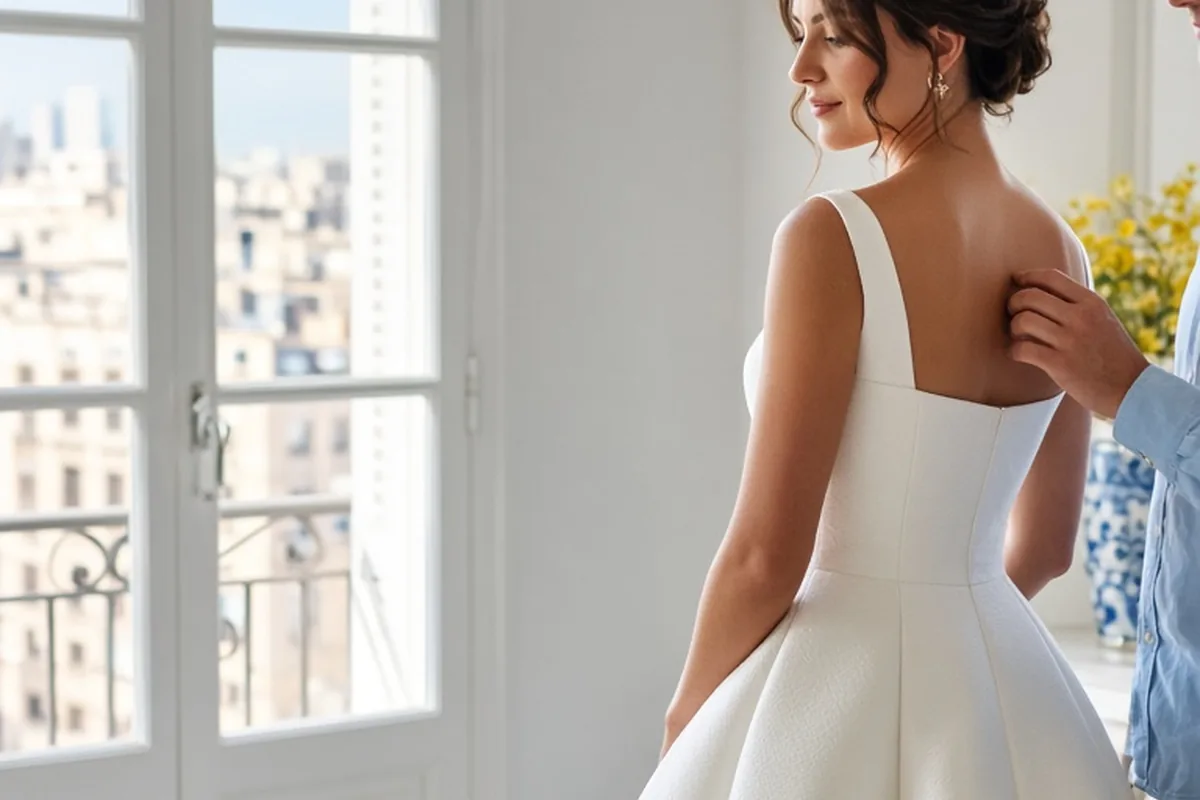
For a wedding with 150 guests, the ideal dress balances architectural visual presence with functional mobility. Choose a silhouette with defined structure, such as a tailored A-line, drop-waist, or soft ballgown, which stands out across a large ceremony space without overwhelming reception floor plans. Prioritize reinforced bustles, breathable linings, and snag-resistant fabrics like mikado, crepe, or structured jacquard to withstand hours of continuous greeting, dining, and dancing.
A guest count of 150 places an event squarely into the traditional full-scale category, requiring deliberate logistical planning for both venue spacing and attire. When you walk into a room of this size, your gown must hold its own against spacious floral installations and large seating layouts while remaining comfortable enough to navigate crowded table arrangements, endless hugs, and hours on your feet.
Visual Scale: Choosing Silhouettes That Register Across a 150-Person Room
A ceremony seating 150 people typically creates an aisle between 40 and 65 feet in length, with guests seated across 15 to 20 rows. At this distance, delicate surface details such as faint tone-on-tone embroidery, micro-sequins, and subtle lace borders disappear into the background. To create an impression that reaches the back rows, your gown needs clear perimeter lines and defined architectural volume. Traditional A-line silhouettes, modified fit-and-flare cuts, and drop-waist ballgowns define your frame cleanly against wide backdrops, ensuring you do not visually shrink under venue lighting.
While dramatic cathedral volume feels natural in grand settings, an oversized royal ballgown can become cumbersome once the ceremony concludes. If your skirt diameter exceeds four feet, standing between your partner and the officiant can feel cramped, and navigating the recessional through seated rows requires constant skirt management. Modified A-line cuts and paneled trumpet skirts offer a practical compromise by delivering strong horizontal proportions from the hips down while keeping the overall profile slender enough for effortless movement.
The Physical Demands of Greeting: Fabric Durability and Friction
Hosting 150 guests means spending substantial time receiving congratulations, whether during an organized receiving line, table visits, or cocktail hour. This translates into dozens of close embraces, arm contact, and continuous movement. Delicate fabrics like untreated silk chiffon, loosely woven gossamer tulle, and raised 3D floral appliques can snag on guest jewelry, sequined blazers, or wristwatches. Once a thread pulls or an applique tears early in the day, managing the skirt becomes an unwelcome distraction during photos.
Durable, tightly woven textiles provide resilience without sacrificing luxury. Heavyweight silk crepe, mikado, structured faille, and bonded satin resist friction wear and maintain their smooth finish throughout extended greeting periods. In addition, closely set bodices with smooth chest panels prevent makeup transfer from foundation and bronzer when guests lean in for hugs. Choosing a fabric with natural recovery also prevents permanent sitting creases across the lap after a multi-course dinner.
Navigating Floor Plans: Train Management and Banquet Table Clearance
A reception for 150 guests typically demands between 15 and 18 round banquet tables or several continuous long farm tables, resulting in dense room configurations. Standard catering floor plans leave approximately four to five feet of clearance between chair backs when guests are seated. A chapel-length or cathedral-length train that looks breathtaking during the processional will drag over chair legs, purse straps, and spilled beverages if it cannot be neatly and securely fastened after the ceremony.
Investing in a multi-point bustle tailored specifically to your gown's weight is critical for a reception of this scale. Single-button American over-bustles frequently tear under the weight of heavy satins when brushed against a chair or stepped on by a passing guest. Multi-point French under-bustles or Austrian tie bustles distribute fabric weight across three to five hidden anchor points inside the skirt. This keeps the hem clearing the floor by a uniform half-inch all the way around, allowing you to wind through narrow banquet rows without snagging table corners.
Crowd Photography: Coordinating Veils and Bold Textures for Long Shots
Event photography for mid-to-large guest counts relies heavily on medium and wide focal-length lenses to capture the scale of the gathering. In photographs framed to include rows of seated guests or broad room architecture, low-contrast gowns can blend into table linens, neutral drapery, or floral arrangements. Creating visual separation requires deliberate contrast, which you can achieve through rich fabric texture, dimensional jacquard patterns, or structured pleating that catches side-lighting.
Veil selection also plays a functional role in crowd framing. While a cathedral veil creates dramatic focal depth for aisle portraits, it requires careful handling during the post-ceremony portrait session when guests begin mingling nearby. If you choose an extended veil, designate a wedding attendant to carry the train during transitions, and plan to remove the veil before entering cocktail hour. A blusher or elbow-length veil can remain in place during mingling without catching on outdoor pavers or indoor flooring.
The Second Look Decision: Transitioning Attire at a 150-Guest Event
The decision to wear one gown throughout the entire celebration versus changing into a reception dress depends heavily on your timeline and hospitality priorities. Stepping away from 150 guests to change into a secondary outfit, touch up hair, and swap undergarments rarely takes less than 30 to 45 minutes. When you consider the finite duration of a standard four-to-five-hour reception, that departure represents a noticeable portion of the evening spent away from friends and family who traveled to celebrate with you.
If you want the visual grandeur of a formal ceremony gown alongside dance-floor comfort, consider convertible modular elements rather than a complete outfit change. Detachable overskirts, removable off-the-shoulder sleeves, or a dramatic lace capelet allow you to reveal a sleek, dance-ready silhouette in under two minutes right in the bridal suite. If you do opt for a dedicated reception dress, schedule the change to coincide directly with plate clearing between dinner courses to minimize your absence from the room.
Alterations and Movement Testing for Sustained Socializing
Fitting room appointments are traditionally static, with brides standing upright on an alterations pedestal to evaluate hem lines. For an event with 150 attendees, passive fitting is inadequate. You will spend eight to ten hours standing, walking, bending over to speak with seated elderly relatives, and dancing. During your final fittings, request that your tailor evaluate the dress through a complete range of motion to prevent mid-reception wardrobe failures.
Test your gown by walking at a brisk pace, sitting upright in an armless banquet chair, and raising both arms to shoulder height to simulate dancing and embracing. If your gown has boning or an internal corset, ensure it does not pinch your ribcage when your diaphragm expands while seated. The front hem should clear your dancing shoes by three-quarters of an inch so your toes never catch the hemline when stepping forward through a crowded room.
Matching Gown Weight and Construction to 150-Guest Venue Types
The venue setting required to host 150 people dictates how heavy and structured your gown can comfortably be. An indoor hotel ballroom or historic museum provides consistent climate control, allowing for multi-layered skirts, heavy silk dupioni, and structured corset bodices. These environments feature smooth hardwood or polished stone flooring that minimizes the risk of rough surface damage to wide skirts and long hems.
Conversely, hosting 150 guests under an outdoor sailcloth tent, at a vineyard, or on a private estate introduces natural variables like ambient heat, humidity, and irregular ground. Packed turf, gravel pathways, and wooden deck planks will grip onto delicate hem edges. For these expansive outdoor layouts, prioritize lightweight, breathable fabrics such as silk organza, linen-silk blends, or laser-cut cotton lace, paired with a hemline cut slightly higher off the ground to avoid collecting dirt, twigs, or moisture.
Frequently asked questions
Can I wear a dramatic ballgown for a 150-guest wedding?
Yes, ballgowns look balanced in venues designed for 150 guests because the room scale supports the skirt's volume. However, you must pair the gown with a sturdy multi-point bustle and ensure your reception floor plan maintains at least four feet of clearance between banquet tables so you can walk comfortably.
How do I keep my gown clean while greeting 150 people?
Choose smooth, dense textiles like mikado or bonded crepe that resist foundation makeup transfer during hugs. Ask your venue coordinator to ensure table walkways are swept clean before guest entry, and assign an attendant to hold your train off the floor until your bustle is fully secured.
Should I choose a veil based on my guest count?
Guest count impacts veil choice primarily because of aisle length and room congestion. Long cathedral veils look striking down an aisle accommodating 150 seated guests, but they should be removed before entering the cocktail hour or reception room to prevent people from accidentally stepping on the tulle.
How much should I budget for dress alterations on a formal gown?
Alterations costs vary widely depending on your local market, the number of fabric layers, and structural complexity. Expect to pay more for multi-point French bustles, intricate lace re-placement, and boning adjustments. Request an itemized estimate from an experienced bridal seamstress four to six months before your wedding date.
Your next step
Obtain a preliminary floor plan from your venue coordinator showing table spacing, and bring those walkway dimensions to your first bridal salon appointment to guide your silhouette choice.