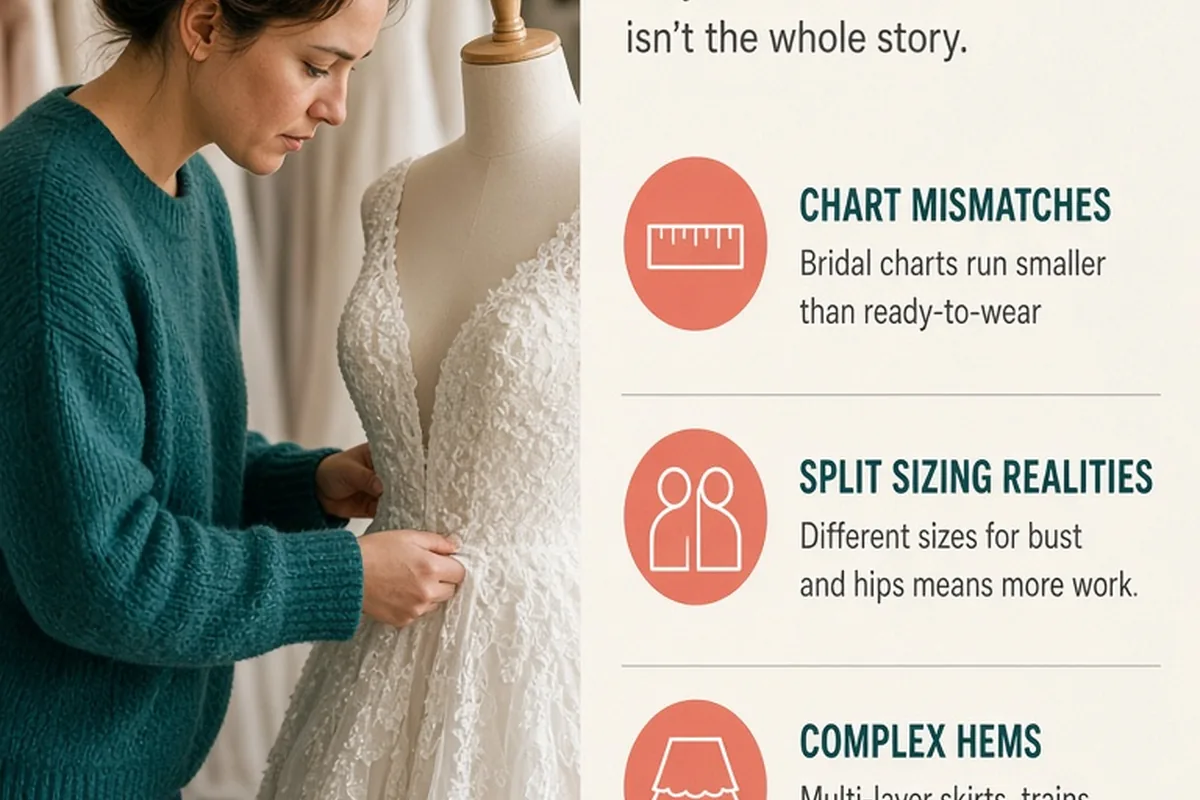
Wedding dress sizing hidden costs arise because bridal size charts run significantly smaller than standard clothing, prompting boutiques to order for your largest measurement. This practice frequently requires extensive downstream tailoring, such as rebuilding bodices, unpicking beadwork, re-hemming multi-layer skirts, adjusting hollow-to-hem lengths, and paying designer pattern surcharges or timeline rush fees.
Shopping for a wedding gown introduces many buyers to an unfamiliar sizing system based on historical couture proportions rather than modern ready-to-wear clothing. Understanding how boutique sizing practices and gown construction impact post-purchase tailoring expenses is essential for keeping your total bridal attire budget intact.
Bridal Sizing Charts Versus Everyday Clothing Fit
Bridal sizing charts are traditionally patterned on European couture specifications that have remained largely unchanged for decades. Unlike everyday ready-to-wear apparel, which utilizes vanity sizing and stretch fabrics to accommodate diverse body types, wedding dresses are constructed with rigid woven fabrics, structured linings, and internal stays. As a result, a bride who wears a standard size in regular street clothing often measures into a bridal gown size two to three numbers higher.
When boutique stylists measure a client, standard industry protocol dictates ordering the dress size that corresponds to the client's largest single measurement across the bust, waist, and hips. While this ensures that every part of the gown physically zips closed, it guarantees that the remaining sections will be disproportionately large. Purchasing a gown several sizes larger than your typical garment means that nearly every panel of the dress will require substantial alterations to fit your true contours, significantly driving up the overall cost of ownership.
Split Sizing Realities and Proportion Adjustments
Human bodies rarely conform to a single standardized size chart. It is common for a client to measure as one size in the bust, a different size through the natural waist, and an entirely different size across the hips. Because most commercial wedding dresses are manufactured as a single, uniform size from top to bottom, boutiques will almost universally order the gown to fit the widest dimension to avoid fabric shortages during final fitting stages.
Downsizing the smaller areas of a gown requires far more intensive tailoring than simply taking in side seams. If a dress is ordered to fit a fuller hip, the tailor must deconstruct the bust, reposition the armholes, shorten the shoulder straps, reshape the neckline, and reset internal bra cups. Each structural modification involves disassembling layered support fabrics, altering boning channels, and sewing the piece back together by hand, creating compounding labor charges that rarely appear on the initial purchase invoice.
Hemming Complex Skirts, Trains, and Hollow-to-Hem Limits
Standard bridal gowns are manufactured to fit an average height of roughly five feet nine inches to five feet eleven inches when wearing heels. For anyone shorter than this baseline, the skirt must be hemmed. Shortening a wedding skirt is rarely a straightforward cut-and-stitch job. Gowns typically feature multiple structural layers, including crinoline, dense tulle underskirts, lining fabrics, and external face fabrics, each requiring separate measured cutting and edge finishing.
The presence of decorative hems introduces substantial labor costs. Skirts finished with horsehair braid, scalloped lace, or intricate beading cannot simply be trimmed straight across. Tailors must painstakingly unpick feet of lace edging by hand, shorten the base fabric, and hand-sew the decorative trim back onto the raised hemline. Alternatively, tailors may have to lift the skirt from the waist seam, requiring complete detachment and reattachment of the skirt to the bodice, which represents one of the most labor-intensive alterations available.
Bodice Restructuring, Boning, and Embellishment Labor
Modern bridal bodices frequently incorporate illusion mesh, deep plunge necklines, low illusion backs, and integrated corsetry. When a dress size is ordered larger to accommodate the waist or hips, the upper bodice often gapes open, sits too wide on the shoulders, or provides insufficient bust support. Restructuring an embellished bodice requires specialized couture sewing skills to adjust internal architecture without leaving visible seams on sheer fabrics.
Embellished fabrics amplify tailoring expenses because seamstresses cannot run a sewing machine needle over glass beads, pearls, or metallic crystals without breaking needles and tearing fabric. Every seam alteration on a beaded or embroidered dress requires the seamstress to manually cut away beads along the alteration line, take in or let out the seam, secure loose threads, and hand-apply the beads back across the new seam to maintain continuity of the pattern. This meticulous process significantly increases the total billable hours required for a proper fit.
Plus Size Surcharges, Fabric Fees, and Custom Patterns
Many bridal manufacturers apply wholesale upcharges for gowns ordered above specific size thresholds. These designer surcharges are often passed directly to the consumer at the boutique register. Manufacturers justify these fees by citing the need for unique pattern grading, additional structural boning, reinforced support layers, and increased fabric yardage to maintain gown integrity across extended sizes.
Similarly, brides requesting custom modifications at the point of ordering—such as hollow-to-hem custom length adjustments, split-sizing patterns, raised necklines, or extra yardage for modesty panels—will encounter designer customization fees. While ordering a custom hollow-to-hem length can sometimes reduce local hemming labor, it requires precise initial measurements and rarely eliminates the need for final local tailoring adjustments once shoes and undergarments are chosen.
Weight Fluctuations and Expedited Fitting Timeline Fees
The standard manufacturing and shipping timeline for a special-order bridal gown spans several months, followed by a multi-fitting alteration schedule. During this extended window, natural body fluctuations due to stress, fitness routines, or lifestyle shifts can alter a client's measurements between the initial boutique ordering appointment and the first alteration fitting.
If a gown arrives significantly too large or uncomfortably tight, extensive structural reshaping becomes unavoidable. Letting out a gown is constrained by the remaining seam allowance provided by the designer and may require inserting side panels or converting a zip back into a lace-up corset. Furthermore, if dramatic resizing is identified late in the planning process, independent tailors and bridal salons will add substantial expedited rush fees to prioritize the gown ahead of standard seasonal work.
Auditing Sizing Contracts and Requesting Itemized Quotes
Before signing a bridal gown purchase agreement, carefully review the sizing policy and documentation. Boutiques typically require clients to sign a measurement waiver confirming that the chosen size was agreed upon, thereby releasing the salon from financial responsibility for post-delivery tailoring needs. It is critical to compare your physical bust, waist, and hip measurements directly against the manufacturer's specific chart rather than relying solely on verbal assurances.
Prior to purchasing, ask the salon whether they provide in-house alterations with a fixed price cap or if they refer clients to independent seamstresses who bill by the hour or by individual task. Once you receive your gown, obtain an itemized estimate from a professional bridal alterations specialist that breaks down distinct charges for hemming each skirt layer, taking in the bodice, setting cups, raising shoulders, and building a multi-point bustle. Transparent quotes allow you to make informed decisions about optional style changes versus essential structural adjustments.
Frequently asked questions
Can I save money on alterations by ordering my exact street size?
Ordering your street size instead of following the bridal chart risks receiving a gown that cannot zip closed. Bridal gowns lack stretch, and letting out tight seams is far more limited and structurally challenging than taking in excess fabric.
Why does a custom hollow-to-hem order not eliminate tailoring costs?
A custom hollow-to-hem adjustment shortens the skirt based on an early estimate, but final hem alignment still depends on your exact wedding shoes, chosen undergarments, and posture. Most gowns will still require fine-tuning at the final fitting.
How many fittings are typically required for wedding dress alterations?
Most bridal gowns require two to four separate fittings to achieve an exact fit. The initial session focuses on pinning the foundation and bodice, followed by hem and bustle adjustments, with a final fitting to verify clean lines.
Your next step
Request the designer's official measurement chart and secure a comprehensive, itemized alteration estimate from a bridal tailor before finalizing your gown size selection.