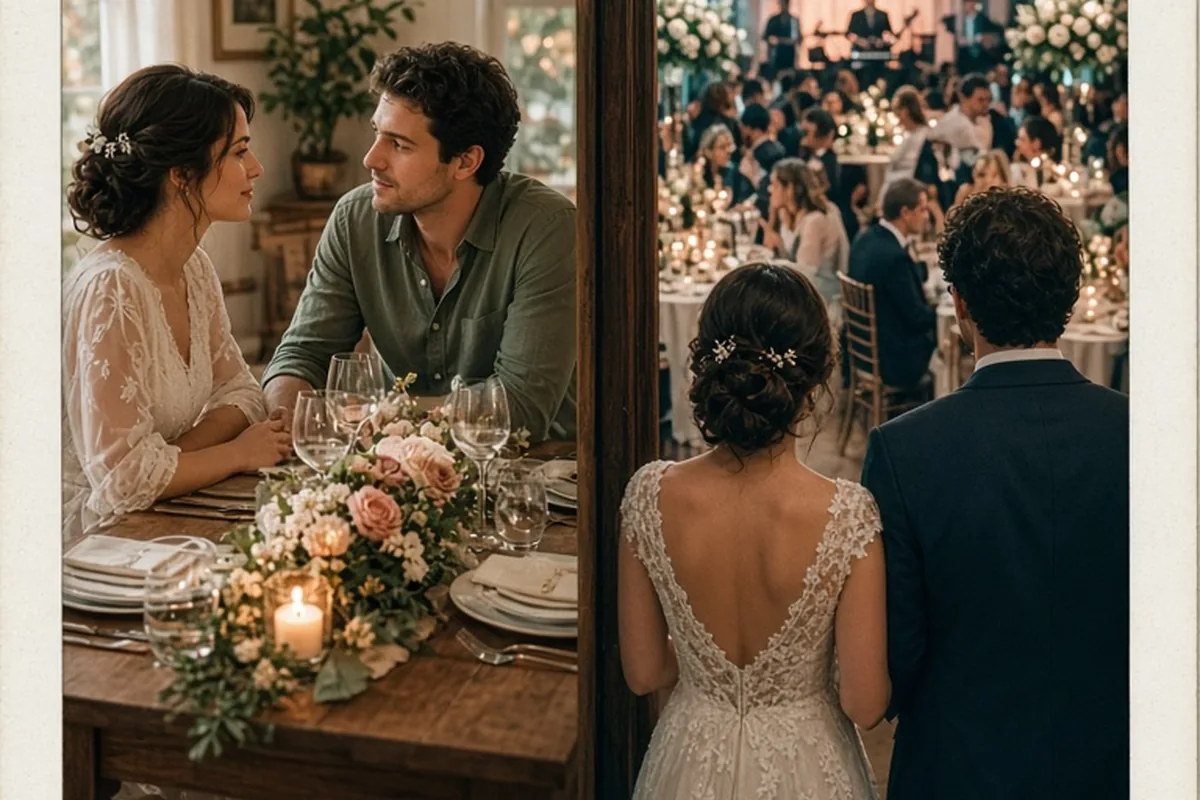
Choosing between a 20-guest wedding and a 150-guest celebration changes every operational layer of your day. A 20-guest micro-wedding focuses resources on fine dining, single long-table styling, personal conversations, and flexible boutique venues like private estates or restaurant dining rooms. A 150-guest wedding functions as a full-scale gala requiring ballroom or banquet infrastructure, professional crowd coordination, amplified entertainment, and strict per-person catering formulas. Your choice dictates whether your budget prioritizes high-touch intimacy or shared community celebration.
Couples weighing an intimate gathering against a traditional celebration often find that the difference is not merely a matter of scaling numbers up or down. A twenty-person ceremony and a one-hundred-and-fifty-person reception represent two fundamentally different event architectures, each demanding its own planning logic, vendor team, and host mindset.
Atmospheric Dynamics: Curated Intimacy Versus Collective Celebration
The social atmosphere of a twenty-guest wedding resembles an elegant private dinner party where every person in attendance shares a deep, personal history with the couple. At this size, there are no social pockets or disconnected groups. Everyone sits at a single imperial table or two close groupings, meaning conversations naturally cross generational lines and include the entire room. The couple can spend meaningful, unhurried time with every guest, listening to stories, sharing private jokes, and enjoying the meal without checking a clock. This structure eliminates the performative pressure felt by many couples, as there is no vast audience watching every entrance, dance, or speech.
A one-hundred-and-fifty-guest wedding, by contrast, generates the electric momentum of a true community festival. The energy comes from collective joy, crowded dance floors, and the feeling of two extended networks fusing into one room. However, this scale introduces social fragmentation. Guests naturally split into clusters based on familiarity, such as college friends, office colleagues, childhood neighbors, and extended family branches. For the couple, interacting with one hundred and fifty people within a standard four-to-six-hour event window allows only one or two minutes per attendee if they spend the entire reception greeting people. Couples choosing this size must embrace being the symbolic center of a large celebration rather than individual conversational hosts.
Venue Realities: Boutique Dining Rooms Versus Commercial Ballrooms
Finding a venue for twenty guests requires avoiding spaces that dwarf the gathering. Standard wedding venues with minimum capacities of one hundred people will feel hollow and cavernous with twenty attendees, deadening acoustic warmth and making the room look unfinished. Instead, twenty-person events thrive in non-traditional event spaces: private dining rooms in historic restaurants, architectural conservatories, residential estates, secluded wine cellars, or boutique inn courtyards. These venues typically feature built-in character, professional lighting, and quality furniture, which sharply reduces the need for supplemental structural decor, drapery, or rented architectural lighting.
Hosting one hundred and fifty guests moves your search into commercial event real estate, such as independent banquet halls, hotel ballrooms, country clubs, converted industrial warehouses, or modern barn structures. These venues solve the operational demands of large crowds: dedicated guest parking, commercial-grade electrical panels for live bands, ADA-compliant restrooms, commercial prep kitchens, and clear emergency egress pathways. However, these spaces often present aesthetic trade-offs. Raw industrial spaces or hotel ballrooms can feel utilitarian or generic without extensive investment in perimeter lighting, upgraded rental chairs, customized linens, and visual zoning to break up vast floor plates.
Catering Logistics: Fine Dining Service Versus Large-Scale Banquet Production
At twenty guests, food and beverage operations mirror high-end restaurant service. A kitchen can plate customized, multi-course tasting menus where steaks are cooked to individual temperature preferences and delicate seafood arrives hot at the table. Plating can feature intricate sauces, fresh herbs, and artistic garnishes that would wilt or cool during mass distribution. Beverage programs can include hand-crafted signature cocktails mixed individually to order, customized wine pairings poured tableside with educational tasting notes, and artisanal tableware sourced from specialty rental houses without running into inventory shortages.
Feeding one hundred and fifty guests requires an industrial production mindset focused on batch cooking and synchronized delivery. Caterers must utilize hot boxes, pre-plated sauces, and proteins that tolerate prolonged holding without drying out, such as braised short ribs or airline chicken breasts. Service styles must be selected for throughput efficiency. Plated service requires an army of servers moving in choreographed teams to deliver plates before food loses temperature. Buffet or family-style service demands wide circulation aisles and multiple double-sided stations to prevent guests from spending forty-five minutes waiting in line. Bar setups must prioritize speed, relying on batched cocktails, standardized beer and wine selections, and high-volume ice wells to prevent bottlenecking.
Design Strategy for 20 Guests vs. 150 Guests: Micro-Detailing Versus Macro-Impact
Visual design choices shift dramatically between these two group sizes. For a twenty-guest event, design capital is best spent on micro-details that guests interact with directly at eye level and arm length. Because everyone sits together, the table becomes the complete visual universe. Couples can invest in bespoke calligraphy on heavy cotton cardstock, personalized menus featuring handwritten personal notes to each guest, vintage silverware, hand-poured taper candles in antique holders, and dense, low floral runners made with fragile, rare blooms. The tactile quality of every linen napkin and stemware piece is noticed and appreciated.
For one hundred and fifty guests, micro-details are swallowed by the scale of the room. Investing heavily in hand-torn deckle paper or custom napkin rings yields minimal impact when spread across fifteen or twenty tables. Visual success at this scale requires macro-impact design: dramatic vertical floral centerpieces that draw the eye upward into the venue ceiling, professional perimeter uplighting to warm blank walls, suspended greenery installations over the dance floor, and cohesive color blocking that unifies a wide room. Designers must prioritize sightlines across twenty yards, ensuring that stage arrangements, table numbering, and sweetheart tables stand out clearly to guests seated in distant corners.
Operational Flow: Unstructured Evenings Versus Coordinated Timelines
The running order of a twenty-guest wedding allows for organic pacing and spontaneous flexibility. The couple does not need a loudspeaker or a master of ceremonies to herd attendees from one space to another; a simple verbal announcement by the host gently moves the room from cocktails to dinner. Speeches can happen spontaneously over dessert without strict time caps, and the dinner can stretch comfortably for three or four hours without anyone feeling restless. Dancing can happen around a living-room piano, through a high-end playlist connected to an ambient speaker system, or can be skipped entirely in favor of fireside conversation and board games.
A one-hundred-and-fifty-guest wedding relies on precise crowd control governed by a minute-by-minute timeline. Moving one hundred and fifty people from ceremony seating through a cocktail lounge and into a dining hall takes twenty to thirty minutes of coordinated transition time. Speeches must have rigid time boundaries to keep the kitchen on schedule, and an experienced master of ceremonies or disc jockey is necessary to project directions over crowd chatter, coordinate vendor cues, and maintain momentum. The timeline must balance dinner service, specialty dances, cake cutting, and open dance floor hours before the venue rental window closes and overtime charges begin.
Budget Mechanics: How Per-Person and Fixed Costs Diverge
Understanding your budget across these two sizes requires distinguishing fixed vendor costs from variable per-person expenses. Fixed costs—such as the photographer, the officiant, the wedding attire, ceremony musicians, and beauty artists—remain largely identical whether you host twenty people or one hundred and fifty people. A premier photographer spends the same eight hours shooting and brings the same camera equipment regardless of the room count. Consequently, a twenty-person wedding often has a higher total cost per guest, even if the gross bill is significantly lower, because those fixed baseline expenses are divided across only twenty people.
The radical cost divergence occurs in variable expenses: catering, beverage packages, table rentals, chair rentals, centerpieces, favors, invitation postage, and cake sizing. For one hundred and fifty guests, these variable line items multiply rapidly and constitute the dominant share of the budget. A small price change of twenty dollars per plate or five dollars per chair creates a thousands-of-dollars swing at one hundred and fifty people, whereas that same change produces a negligible shift for twenty guests. This allows couples hosting twenty people to choose ultra-luxury catering and top-shelf spirits without breaking their spending ceiling, while couples hosting one hundred and fifty must balance menu tier selections against sheer headcount.
Navigating Boundary Setting, Family Politics, and Guest Cutoffs
The social politics of curating a guest list differ drastically between these two numbers. A twenty-guest wedding requires brutal clarity and strict boundary definitions. At twenty people, the list is limited to immediate family—parents, siblings, living grandparents—and perhaps one or two lifelong friends. While cutting out aunts, uncles, and workplace peers can produce initial friction, the strictness of the cutoff often makes it easier to defend: couples can honestly explain that the wedding is an immediate-family-only gathering, which leaves little room for individual relatives to feel singled out or personally excluded.
A one-hundred-and-fifty-guest wedding, paradoxically, creates more interpersonal boundary challenges because there is room for extended circles. When aunts, uncles, and first cousins are invited, questions immediately arise regarding second cousins, coworkers, old college acquaintances, and plus-ones for single guests. Defining where the cutoff lies becomes subjective and visible. Furthermore, when parents contribute financially to a wedding of this size, they frequently expect proportional control over the guest list to invite personal friends and business associates. Navigating this scale requires clear upfront conversations regarding financial contributions, guest-count allocations, and an agreed-upon plus-one protocol before sending save-the-date cards.
Frequently asked questions
Can I hire a live band for a wedding with only 20 guests?
While technically possible, a full seven-to-ten-piece party band generally overpowers a twenty-guest gathering both acoustically and visually. For an intimate guest count, acoustic duos, jazz trios, solo harpists, or classical guitarists complement conversation without dominating the room. A full band requires physical stage depth and high decibel levels that fit best in spaces hosting seventy-five to one hundred and fifty guests.
How far in advance should I book vendors for 20 guests versus 150 guests?
A 150-guest wedding generally requires booking key vendors twelve to eighteen months ahead to secure prime weekend dates at large-capacity venues. A 20-guest micro-wedding can often be planned within four to six months because private dining rooms and boutique estates offer greater weekday and seasonal flexibility. However, high-demand solo vendors like elite photographers and hair artists still book out far in advance regardless of your party size.
Does a 20-person wedding always cost less than a 150-person wedding?
Overall bottom-line spend is almost always lower for twenty guests because catering, rentals, and bar tabs represent the largest total wedding expenditures. However, if a couple books a multi-day luxury villa rental, covers luxury guest lodging, and hires top-tier international photographers for twenty people, that total bill can exceed a budget-conscious one-hundred-and-fifty-guest banquet hall reception.
Do I still need a wedding planner for a 20-guest event?
You may not require a full-service production team, but hiring a day-of coordinator or event designer is still highly advantageous. Even with twenty guests, someone must cue the musicians, ensure dinner courses proceed smoothly, manage vendor load-ins, and troubleshoot unexpected issues so the couple and their immediate family can relax as hosts.
Your next step
Draft a preliminary twenty-person immediate circle list alongside a broader one-hundred-and-fifty-person community list, then obtain itemized food and beverage quotes from both a private dining venue and a full-scale banquet space to see which planning reality matches your values.