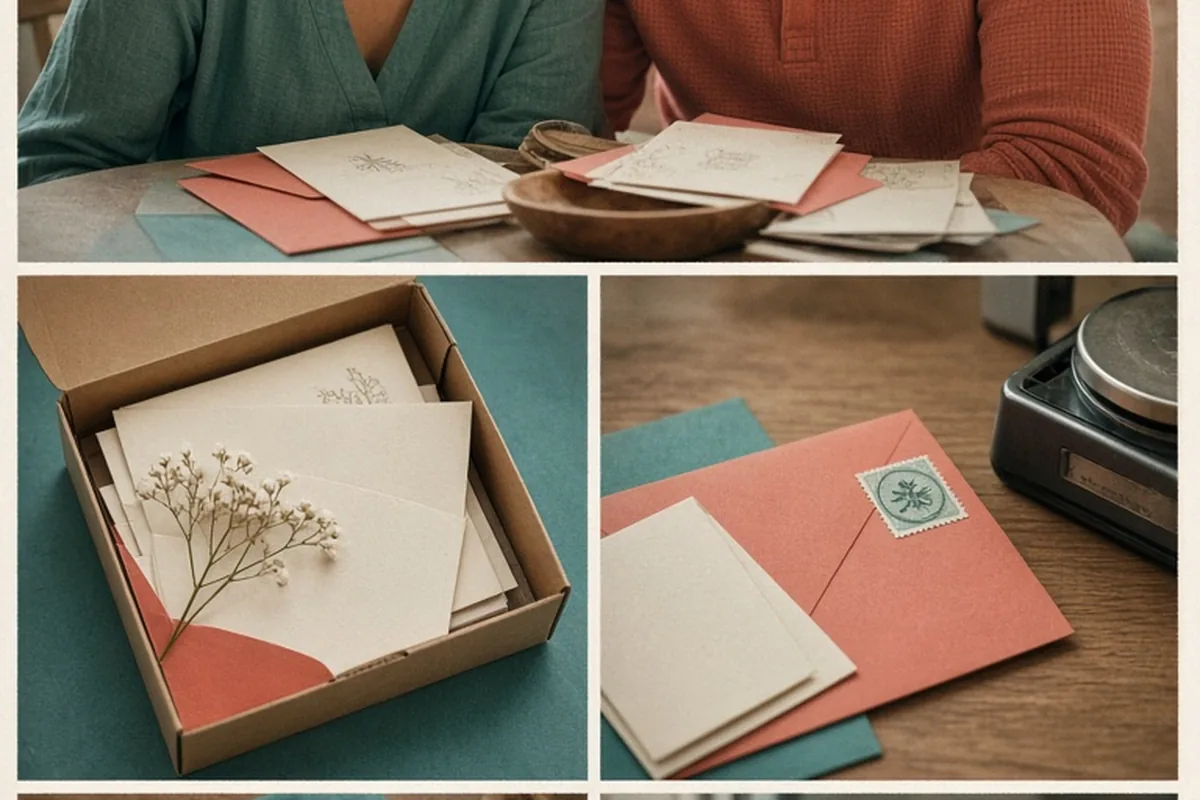
To manage wedding invitation postage on a budget, keep your invitation suite under one ounce in standard rectangular dimensions, avoid rigid embellishments like wax seals that trigger non-machinable surcharges, and replace traditional reply cards with digital RSVP options. Always assemble one complete test suite and have it weighed and measured by a postal clerk before purchasing postage in bulk.
Couples planning their stationery budgets often dedicate the majority of their funds to design, custom typography, and specialty printing, only to face an unexpected financial surprise when it comes time to mail the finished pieces. Postage costs can escalate quickly when an envelope exceeds standard weight tiers or incorporates structural design elements that prevent automated postal sorting.
Standard Sizing Versus Non-Machinable Postal Rates
Postal services sort mail using high-speed optical scanning and mechanical sorting equipment designed for standard rectangular envelopes. In the United States, a standard commercial letter must be rectangular, at least 3.5 inches high by 5 inches long, and no more than 6.125 inches high by 11.5 inches long, with a uniform thickness of no more than 0.25 inches. When an envelope falls within these parameters and weighs one ounce or less, it qualifies for the baseline letter rate. Any departure from these physical boundaries immediately changes how the piece is processed and priced.
Square envelopes are among the most common design choices that inadvertently inflate mailing budgets. Because square envelopes have an aspect ratio of 1:1, automated canceling machines cannot reliably determine the correct orientation for sorting. As a result, square envelopes carry a mandatory non-machinable surcharge regardless of whether they weigh less than one ounce. Choosing an A7 envelope (roughly 5.25 by 7.25 inches) or an A8 envelope instead of a 6-by-6-inch square allows you to achieve an elegant, formal aesthetic while maintaining a standard rectangular aspect ratio that qualifies for base mailing rates.
Beyond dimensions, envelope orientation and flexibility affect whether a piece is classified as machinable. Mail pieces that are too rigid to bend through automated sorting belts or envelopes addressed with vertical rather than horizontal alignment can also trigger non-machinable fees. By selecting standard rectangular formats early in the stationery design phase, couples avoid automatic surcharges on every single household invitation sent.
Lightening Paper Weight and Enclosure Cards to Stay Under One Ounce
Postage rates increase in stepped increments based on total weight. A typical wedding invitation suite contains multiple paper components: the outer mailing envelope, the main invitation card, an inner envelope, a reception card, an accommodations card, a weekend itinerary, a reply card, and a pre-addressed return envelope. When layered together on heavyweight cardstock, these separate pieces frequently push the total package weight just over the one-ounce cutoff, triggering the two-ounce postage rate across the entire guest list.
Controlling paper density is one of the most reliable ways to maintain single-stamp pricing without sacrificing presentation quality. Heavyweight cardstock options, such as 220-pound double-thick cotton or multi-ply duplexed boards, are substantial and luxurious, but they add noticeable mass. Using an ultra-thick stock for the primary invitation card while selecting a lighter 100-pound or 110-pound cover stock for supplementary inserts reduces aggregate weight while preserving a high-end tactile experience.
Consolidating information cards into a single double-sided insert provides immediate savings on both printing production and postal weight. Instead of creating distinct cards for hotel room blocks, rehearsal dinners, and travel logistics, a single elegantly formatted 'Details' card can present all logistical information cleanly. Reducing the sheer number of physical paper layers keeps the overall envelope slim, uniform, and light enough to clear postal scales within the initial weight tier.
Switching to Digital RSVPs to Eliminate Return Card Postage
Traditional wedding etiquette calls for a separate response card paired with a pre-addressed, pre-stamped return envelope. This convention essentially doubles the postage burden of your wedding mailing, as you must pay for both the outbound stamp and the inbound response stamp for every invited household. Furthermore, unused postage on reply envelopes sent to guests who decline or fail to mail the card back represents an unrecoverable expense.
Transitioning to digital RSVPs removes the return envelope and its associated postage cost entirely. Couples can direct guests to submit their attendance, meal preferences, and song requests through a dedicated wedding website URL or a neatly printed QR code on the details card. For older relatives or guests who may not be comfortable navigating online forms, you can print a small run of traditional reply cards and envelopes reserved specifically for that subset of your guest list, rather than purchasing physical return postage for the entire registry.
In addition to saving on outbound and inbound stamps, digital responses streamline guest tracking, eliminate delays caused by lost return mail, and simplify headcount reporting for catering vendors. By reserving physical reply cards strictly for guests who require offline options, couples can cut their total envelope and stamp expenditures nearly in half.
The Hidden Cost of Wax Seals, Ribbons, and Rigid Embellishments
Modern stationery trends frequently highlight tactile adornments such as wax seals, silk ribbon wraps, velvet belly bands, acrylic panels, and metallic envelope clasps. While these elements create a memorable unboxing experience, they introduce structural irregularities that frequently conflict with automated mail processing guidelines. When an envelope contains a raised wax seal or a bulky knot, it creates uneven thickness across the surface.
Envelopes with uneven thickness or rigid focal points cannot pass smoothly through postal processing belts. Automated rollers can crush wax seals, rip through outer envelopes, or jam mechanical sorting tracks. Consequently, postal clerks must divert these envelopes to manual hand-sorting, which incurs a non-machinable surcharge per piece. In some cases, envelopes that are mailed without proper non-machinable postage are returned to the sender with postage-due notices or arrive damaged at the recipient's address.
If you want to incorporate specialty textures without incurring additional postage fees, consider using flat embellishments. Blind embossing, foil stamping, custom envelope liners, and printed botanical motifs add depth and luxury without adding physical bulk. If you are determined to use wax seals, placing the seal on an internal card or inside an unsealed inner jacket—inside a protective, smooth outer envelope—can sometimes prevent mechanical snags, though the additional weight must still be accounted for.
Evaluating Vintage Stamps and Custom Postage Retailers
Vintage postage has gained popularity as an artistic way to coordinate postage colors and themes with wedding palettes. Collectors and stationery curators sell unused, valid vintage stamps issued in past decades that still hold face-value legal tender for postage. However, purchasing curated vintage stamp sets from boutique online sellers often carries a substantial markup, frequently costing three to five times the actual face value of the stamps.
If you love the aesthetic of vintage postage but need to manage costs, you can assemble your own sets by purchasing unused vintage stamp sheets in bulk from reputable philatelic dealers or online auction lots at or near face value. To use vintage stamps legally, the combined face value printed on the stamps must equal or exceed current postal rates for your envelope's weight class and machinability rating. Keep in mind that older stamps typically have lower denominations, such as 3 cents or 15 cents, requiring four to six stamps to reach current letter rates.
Arranging multiple stamps on a standard envelope also reduces the available surface area for recipient and return addresses. Postal regulations require clear margins around the delivery address and the barcode zone at the bottom of the envelope. If you choose a multi-stamp design, ensure that the arrangement leaves sufficient blank space for automated scanners and delivery carriers to read the address without obstruction.
Taking a Complete Prototype to the Post Office for Accurate Weighing
Estimating postage using a standard kitchen scale at home is a common source of costly mailing errors. Kitchen scales are generally calibrated for larger culinary weights and may lack the precision needed to distinguish between 0.95 ounces and 1.05 ounces. Crossing that tiny fraction of an ounce pushes the envelope into a higher postage tier, and underpaying by even a few cents can result in your entire batch of invitations being returned to sender with inked cancellation marks across the envelopes.
The most effective way to establish an accurate postage budget is to assemble one complete prototype suite before purchasing your stamps. This prototype must include every single component: the outer envelope, the inner envelope or pocket fold, all printed cards, belly bands, stickers, and liners. Take this fully assembled mock-up to your local postal counter and ask the clerk to weigh it on a calibrated postal scale and inspect its flexibility and thickness.
During this visit, confirm whether your suite qualifies for standard processing or requires non-machinable postage. If you are close to a weight boundary, the postal clerk can tell you exactly how much weight you need to shed to drop back down to the lower tier. This single verification step eliminates guesswork, prevents the embarrassment of postage-due notices delivered to guests, and ensures you buy the exact postage denomination needed.
Cleaning Your Guest List to Avoid Returned Mail and Repurchased Stamps
Wasted postage often stems from outdated addresses, missing apartment numbers, and formatting errors that prevent delivery. When an invitation is sent to an incorrect address, the postage stamp on that envelope is permanently used once the piece is canceled. If the envelope is returned weeks later, you must pay for a replacement envelope, re-print the outer envelope address, and purchase a brand-new stamp to mail it again.
Before addressing your envelopes, collect direct address confirmations from guests using a digital address-collection platform or direct messaging. Do not rely on old family address books or holiday card lists from previous years. Pay close attention to unit, suite, and apartment numbers, as automated sorting machines frequently reject or misroute mail lacking precise secondary unit indicators.
Address formatting and legibility also play a significant role in successful delivery. While elaborate calligraphy and light-colored metallic inks on dark envelopes can look striking, they frequently cause optical character recognition failures at sorting facilities. Ensure strong visual contrast between the ink color and the envelope paper, and maintain clear spacing between address lines to keep your mail moving smoothly through postal channels on the first attempt.
Frequently asked questions
Can I use regular Forever stamps for wedding invitations?
Yes, standard Forever stamps are valid for any standard rectangular wedding invitation weighing one ounce or less. If your invitation suite exceeds one ounce, is square, or requires non-machinable handling, you can purchase additional ounce stamps or dedicated non-machinable stamps to cover the difference.
What makes a wedding invitation require a non-machinable surcharge?
An invitation triggers a non-machinable surcharge if it is square, unusually rigid, more than one-quarter inch thick, or has an irregular surface caused by wax seals, buttons, or thick ribbons. Envelopes addressed vertically rather than horizontally may also be classified as non-machinable.
Does hand-canceling wedding invitations cost extra money?
Policies on hand-canceling vary by local post office branch. Some postal stations will hand-cancel a moderate batch of wedding invitations for free if you bring them during quiet hours, while others may apply a non-machinable surcharge or decline hand-canceling altogether. It is best to speak directly with your local branch supervisor beforehand.
How far in advance should I purchase my wedding postage?
You should purchase your postage after assembling and weighing a complete invitation mock-up at the post office, typically 6 to 8 weeks before your intended mailing date. Purchasing standard Forever stamps before announced postal rate increases can also lock in lower rates, as Forever stamps retain full mailing value indefinitely.
Your next step
Assemble one complete invitation prototype with all intended inserts and embellishments, then take it directly to your local post office counter to have it weighed and measured by a postal clerk before purchasing your stamps.