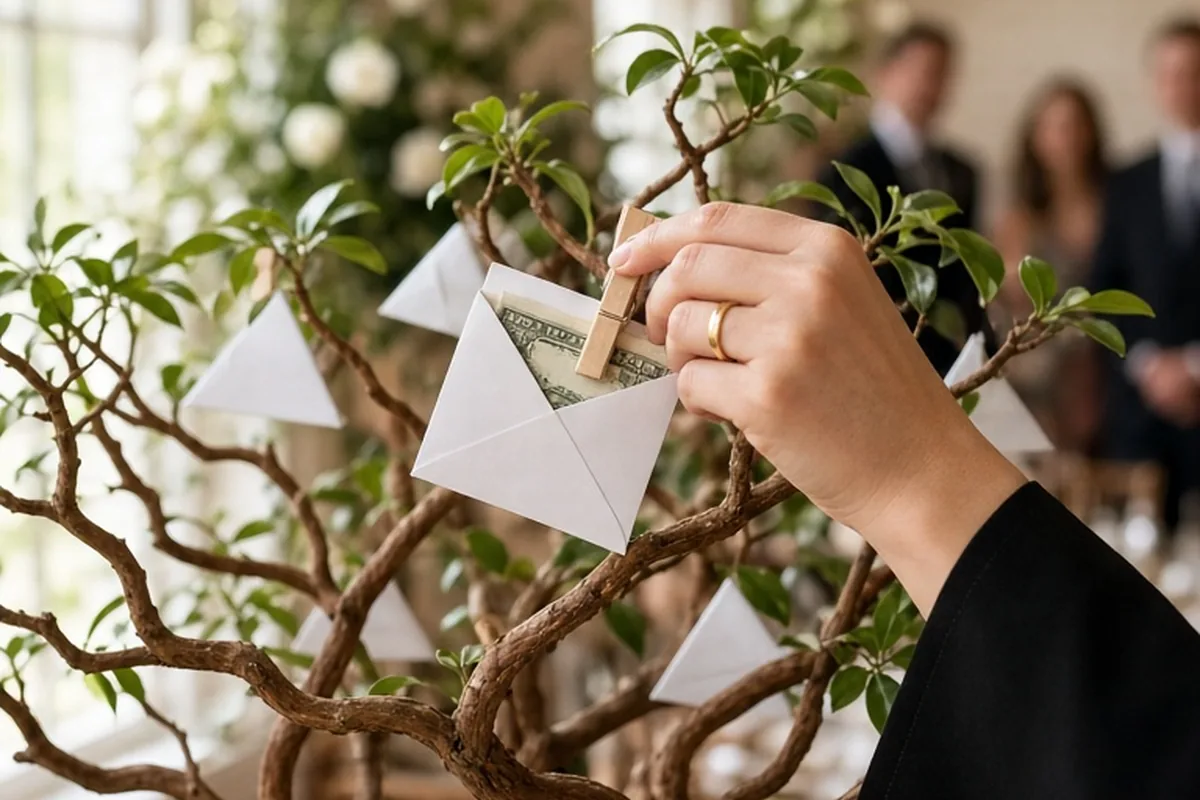
A wedding money tree is a decorative reception centerpiece or display where guests attach monetary gifts, envelopes, or written blessings to celebrate newlyweds. Depending on family traditions, it takes the form of a living potted plant, sculpted wire branches, or dried botanical boughs. It symbolizes shared prosperity, good fortune, and communal support, offering a visually engaging focal point that keeps envelopes and cards organized throughout the evening celebration.
Couples planning their reception often look for focal points that combine personal warmth with functional gift handling. While a traditional card box sits quietly on an entry table, an intentional money tree provides an interactive station where friends and family can leave blessings, well-wishes, and financial contributions to help launch the couple's shared life.
Cultural Traditions Behind Wedding Money Trees and Prosperity Symbols
The practice of offering monetary blessings through symbolic displays spans multiple continents and centuries. In several Eastern European traditions, particularly at Polish and Ukrainian weddings, money presentations have long been woven into the fabric of the celebration, sometimes linked to celebratory dances or folk rituals designed to secure a resilient economic foundation for the newlyweds. Guests historically pinned folded bills to bridal garments, tossed coins onto ceremonial cloths, or placed offerings onto decorated birch and evergreen branches representing continuous growth, seasonal renewal, and domestic stability.
Similar prosperity motifs appear prominently across East and Southeast Asian communities, where red envelopes containing crisp currency are presented to impart luck and ward off misfortune. In modern Western ceremonies, the money tree has evolved into a versatile hybrid that merges these diverse customs with contemporary decor trends. Instead of feeling purely transactional, the installation acts as a living metaphor for mutual support, showing that a community gathers not merely to witness vows, but to actively invest in the couple's long-term comfort, shelter, and security.
Choosing Between a Living Potted Plant and an Ornamental Branch Tree
Selecting the base structure of your installation depends largely on whether you want a permanent keepsake for your home or a purely architectural accent designed for a single night. A living potted specimen offers enduring emotional resonance. Varieties like Pachira aquatica, commonly known as the money tree, offer braided woody trunks and rich green foliage that easily blend with rustic, garden, or modern aesthetics. Sturdy indoor trees such as Ficus microcarpa, jade plants, dwarf olive trees, or potted citrus provide firm branches that carry lightweight cards without sagging, provided the root ball sits in a weighted, stable ceramic container.
Conversely, constructed or sculpted displays grant greater artistic control over scale, symmetry, and color palette. Kiln-dried manzanita branches, sand-blasted birch boughs, sculpted iron wire stands, or clear acrylic floral trees do not drop leaves or require hydration. They eliminate soil mess near banquet linens and easily handle heavier paper stationery or patterned envelopes. If your venue has low ambient lighting, an artificial branch tree also accommodates delicate micro-fairy lights or crystal droplets without generating heat that could wither live leaves. Balance your decision by considering venue setup rules, ease of end-of-night transport, and whether someone is prepared to care for a real botanic specimen after the honeymoon.
Wedding Money Tree Etiquette and Invitation Wording
Navigating financial gifts requires tact to avoid making attendees feel pressured or uncomfortable. Traditional etiquette universally advises against printing gift requests directly on the formal wedding invitation card. Instead, your wedding website, information insert, or digital RSVP portal serves as the proper venue for gentle guidance. Clear phrasing that highlights personal goals, such as buying a first home, financing a relocation, or contributing to an experiential honeymoon, frames cash requests as an optional shared celebration rather than an entrance fee.
When explaining your setup online, use warm, gracious phrasing such as: 'Your presence is our favorite gift. If you wish to help us plant roots for our new life, we will host a traditional money tree at the reception for envelopes, notes, and well-wishes.' Near the physical tree at the reception, place a small, elegant tabletop frame that reinforces inclusivity. A sign reading 'Leave a note, a blessing, or a token for our journey' ensures that guests who brought wrapped gifts to the shower, contributed through a registry, or simply wrote a heartfelt greeting card feel entirely welcome to participate without awkwardness.
Placement, Security, and Reception Logistics for Cash Displays
A collection point holding cash envelopes requires deliberate physical placement within your floor plan. The installation should occupy an easily visible, high-traffic zone where guests naturally pass upon arrival, such as adjacent to the guest book or welcome table, but well away from exit doors, catering service paths, and noisy dance floor perimeters. Placing the display under balanced lighting ensures guests can clearly read instructional signage and find stationery accessories while keeping the area in full view of event staff and venue coordinators throughout the evening.
Security demands discreet foresight so the couple can relax and enjoy their festivities. Because open envelopes hanging on boughs present an opportunistic temptation in busy hotel or public venue settings, never leave accumulated funds unmonitored late into the night. Assign a trustworthy wedding party member, family coordinator, or professional planner to discreetly clear the tree once dinner concludes. Provide them with a sturdy, lockable zippered satchel or deposit bag so they can transfer hung envelopes into a safe or locked venue suite before the bar opens for evening dancing.
Fastening Methods That Protect Both Currency and Delicate Branches
Securing notes and envelopes to branches calls for fasteners that look refined, operate easily for older relatives, and prevent accidental tears to paper money. Traditional adhesives like tape or rubber bands create unsightly residues, strip bark from natural limbs, and damage paper fibers. Instead, supply small natural wooden clothespeg clips, satin ribbon ties with alligator clasps, or ornamental metallic binder clips in brushed brass, rose gold, or matte black to match your table decor.
Consider providing a small basket of uniform mini-envelopes, pre-punched greeting cards, and gel pens on the surrounding tabletop. Encouraging guests to place cash or checks inside labeled envelopes rather than pinning exposed bills prevents awkward visual displays of differing gift amounts among guests. Pre-stringing ribbon loops onto stationery allows attendees to simply slip an envelope over a branch fork or clip it into place without struggling against delicate leaves, keeping the tree looking lush, balanced, and orderly from cocktail hour to the final send-off.
Managing Contributions and Caring for Living Trees After the Reception
The practical stewardship of your gifts continues once the celebration ends. When unboxing your envelopes, create an organized digital or handwritten ledger noting the sender, the monetary amount, and any specific personal sentiments or advice written on the card. This record prevents misattributions and serves as the baseline for your post-wedding thank-you notes, which should acknowledge how the gift will be used, such as funding a kitchen renovation or travel adventures.
If you chose a living botanical tree like Pachira aquatica, transition it gently into your household environment. Transport it away from drafty car trunks, and avoid placing it right next to indoor heating vents or freezing window panes. Give the root ball thorough hydration only when the top few inches of potting mix feel dry to the touch, and position the planter in bright, indirect sunlight. As the tree matures inside your home over the coming years, it stands as a daily, tangible reminder of the day your family and community gathered to help launch your marriage.
Illustrative Scenarios
Balancing Differing Family Traditions
Elena and Marcus faced a planning disagreement when Marcus's family, drawing on Mediterranean custom, wanted a conspicuous money dance, while Elena feared it might embarrass friends with limited discretionary budgets. Instead of abandoning the financial tradition entirely, they compromised on a sculpted manzanita branch money tree placed alongside their guest book. They provided small customized envelopes so guests could enclose monetary gifts, advice slips, or personal prayers with total privacy. Marcus's relatives appreciated the nod to prosperity rituals, while Elena's circle felt no uncomfortable pressure to display bills openly.
Key point: Providing uniform envelopes on an interactive money tree honors cultural traditions of financial blessings while preserving social comfort and financial privacy for all attendees.
Securing Reception Gifts at an Outdoor Venue
Jordan and Priya planned a barn wedding on a sprawling rural estate with multiple outdoor gathering spaces. Priya selected a potted dwarf olive tree for monetary gifts but worried about both gusty afternoon wind and unattended envelopes once guests migrated toward the bonfire pit. They stationed the tree on a heavy iron pedestal shielded from direct gusts during cocktail hour and pre-assigned Priya's brother to empty the tree into a lockbox right before speeches began. The tree remained on display as greenery, but all cash gifts rested securely in the bridal suite.
Key point: Pre-assigning a designated hand-off time and using weighted bases protects outdoor displays against both unexpected weather shifts and evening security vulnerabilities.
Frequently asked questions
Is it considered rude to have a money tree at a wedding?
A money tree is generally well-received when presented as an optional cultural or decorative station rather than an explicit demand for cash. Keeping instructions discreet on your wedding website and providing stationery for simple written notes alongside envelopes ensures that every guest feels respected regardless of whether they choose to give money.
Can guests leave non-monetary cards and notes on a money tree?
Yes, encouraging non-monetary messages makes the installation much more inviting and meaningful. Setting out pre-cut cards with prompts asking for marriage advice, bucket list ideas, or favorite memories allows every guest to contribute to the visual display.
What is the best way to anchor a money tree against tipping over?
Choose a heavy planter or pedestal with a low center of gravity, adding decorative pea gravel or river stones on top of the soil or base. If using artificial branches, secure their stems in a plaster-weighted vessel inside an exterior decorative container so that accidental bumps from guests will not knock the display over.
How should we mention a wedding money tree on our registry page?
Keep the note brief, humble, and focused on gratitude. You can write that while guest attendance is your greatest present, a celebration money tree will be available at the reception for anyone who wishes to contribute toward your honeymoon or savings fund.
Your next step
Choose whether a living plant or constructed branch display best matches your home and venue, then draft your website wording to emphasize gratitude and optional participation.