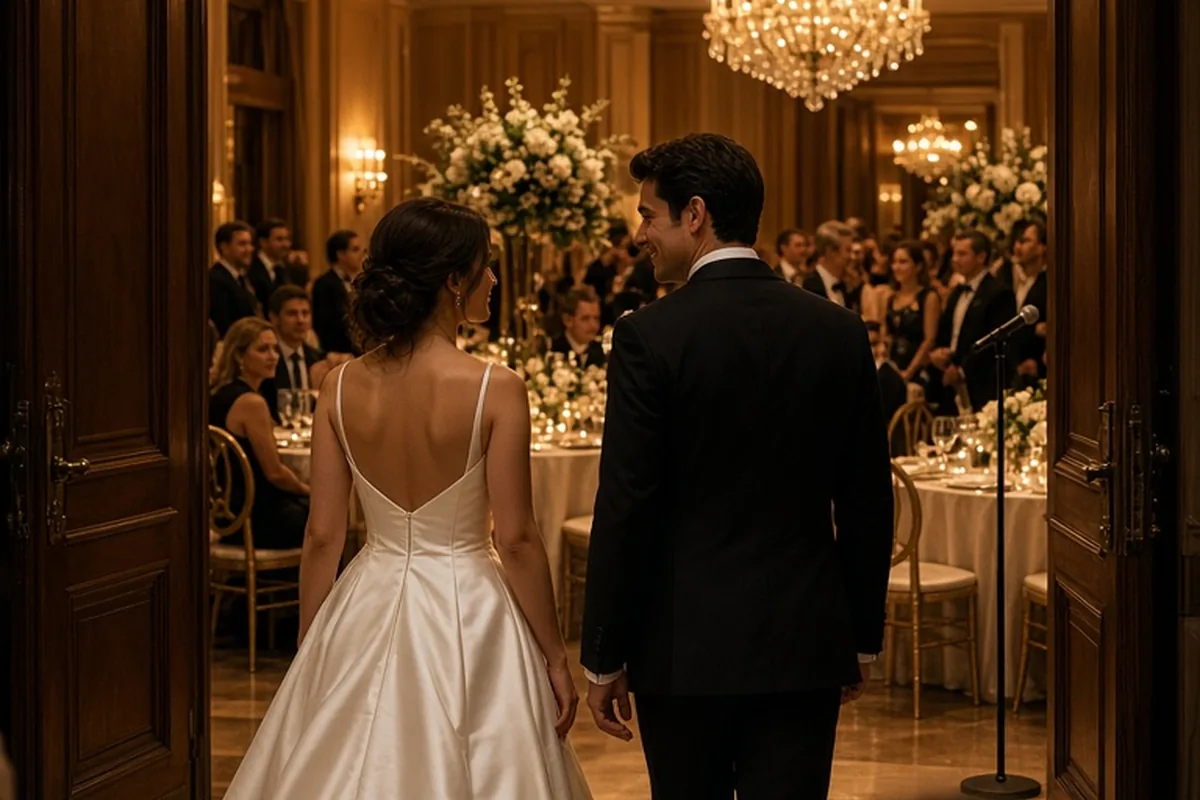
Wedding reception introductions announce the newly married couple and their wedding party into the dining room, setting the tone for the rest of the evening. The best approach matches the couple's true comfort level, whether that means a high-energy arena-style announcement, a classic formal introduction, or an understated greeting that leads straight into dinner. Success depends on clear phonetic guidance for your emcee, precise name and title preferences, and a planned transition into your next activity.
The grand entrance marks the boundary between the formal ceremony and the celebration, giving guests their first collective look at the newlyweds. Because this moment establishes the room's energy for the rest of the night, choosing an announcement format that reflects who you actually are prevents discomfort and keeps the schedule moving smoothly.
Aligning Your Entrance Style with Your Personal Energy
A reception entrance should feel like an authentic extension of your personalities, not an audition for a game show. Couples often feel pressured to stage a high-octane dance routine or sprint into the banquet hall because they have seen viral videos or assume guests expect a spectacle. If you are naturally reserved, forcing an energetic performance usually creates visible tension. Conversely, if you thrive on excitement, an understated entrance can feel anticlimactic after hours of formal anticipation. The first decision is agreeing on the ambient volume, physical pacing, and overall mood you want to bring through the door.
Consider four primary modes: understated elegance, relaxed casual, classic formal, and high-energy celebration. An understated entrance uses lower background music and straightforward phrasing, allowing you to walk directly to your seats without lingering in the center of the room. A relaxed casual approach leans into warm conversational announcements, often skipping individual introductions for the party and focusing simply on welcoming everyone to the feast. Classic formal entrances rely on timeless ceremonial language, structured processionals, and refined musical choices. High-energy entrances bring pulsating beats, dimmed room lights, dynamic spotlighting, and enthusiastic crowd engagement. Deciding this balance early gives your emcee clear guardrails on how to use their voice.
Handling Titles, Last Names, and Identity Accurately
Traditional introduction scripts historically relied on the phrase 'Mr. and Mrs. John Smith,' which effectively erases one partner's first name and presumes a shared surname. Modern couples have diverse marital naming arrangements, professional designations, and gender identities that standard templates do not accommodate. Your introduction script must reflect your actual names and preferred titles without leaving room for your emcee or DJ to improvise based on habit or assumptions.
If you are keeping your respective last names, combining them with a hyphen, creating a new shared name, or maintaining distinct professional titles like Doctor, Military Officer, or Reverend, write the exact phrasing down word for word. For same-sex couples, decide whose name is spoken first or whether you prefer alphabetical order, and specify whether you want titles like 'the newlyweds,' 'partners for life,' or 'husbands/wives.' For non-binary or gender-expansive individuals, clarify whether titles like 'Mr.' or 'Mrs.' should be replaced with gender-neutral alternatives like 'Mx.' or omitted entirely in favor of first and last names. Explicit written instructions prevent embarrassing announcements that force you to correct an emcee in front of two hundred guests.
Low-Key and Introverted Wedding Reception Introduction Scripts
If the idea of being announced under bright lights fills you with dread, you have complete permission to keep your entrance simple, brief, and low-pressure. You do not need an extended musical buildup, you do not need to pause for photos in the center of the floor, and you do not need your wedding party to perform choreographed handshakes. The goal for an introverted or private couple is to acknowledge the milestone, thank guests for their presence, and transition immediately into seated comfort.
A practical script for an understated couple might run: 'Please direct your attention toward the main entrance as we welcome our newlyweds, Alex Chen and Morgan Lee!' In this scenario, the couple walks at a normal walking pace straight to their head table or sweetheart table while guests offer applause. There is no requirement for the music to be jarringly loud; an instrumental acoustic song or mid-tempo indie track works well. Another low-key option is to bypass a separate entrance altogether by joining cocktail hour directly with guests and having the emcee simply invite everyone to find their seats for dinner while you walk over together.
Script Options for High-Energy Wedding Reception Entrances
For couples who want to kick off an all-night dance party immediately, a high-energy entrance turns the ballroom into a celebration venue from the very first minute. This format relies on rhythmic music with a distinct beat drop, coordinated lighting adjustments, and an emcee who knows how to build vocal momentum without shouting incoherently into the microphone. The pacing must remain crisp; letting a hype track loop for four minutes before the couple actually steps through the doorway drains room energy rather than building it.
An effective high-energy script reads: 'Ladies and gentlemen, it is the moment we have all been waiting for! Stand up on your feet, make some noise, and give an incredible welcome to our newlyweds, Jordan and Taylor Rivera!' The DJ queues the drop precisely as the double doors open, and the couple can enter with a jog, a quick spin, or an impromptu dance. When using this format, instruct your wedding party to clear the floor quickly so guests have an unobstructed view of your arrival. It is also wise to decide in advance whether this energy will lead straight into a packed-floor dance set or drop down smoothly into an opening welcome toast.
Introducing Blended Families, Children, and Non-Traditional Parties
Weddings involving second marriages, blended families, or older children require thoughtful introduction structures that emphasize unity without creating awkward social dynamics. When children are part of the union, inviting them into the introduction honors their role in the new household and produces memorable family moments. You can have the children enter alongside their parents or give them their own dedicated introduction immediately preceding the couple.
A blended family script could be phrased: 'Before our newlyweds enter, let us give a wonderful round of applause to the kids who make this new family whole: Mason, Chloe, and Noah!' Following their walk to the family table, the emcee introduces the couple: 'And now, put your hands together for the newly married partners, David Miller and Sarah Jenkins!' If you are working with complex family situations involving divorced parents who have remarried or estranged relatives, consider skipping parental reception introductions altogether. Emphasizing the wedding party and the couple alone avoids tensions over who walks with whom, whose name is read first, or who sits at adjacent tables.
Logistics and Coordination with Your Emcee and Venue Staff
Smooth introductions rarely happen by accident; they require precise coordination between the banquet captain, catering staff, DJ or emcee, and photographer. Before the doors open, the entire processional must be physically lined up in the correct sequence outside the reception space. If one attendant leaves to use the restroom or grab a drink, the entire script falls out of sync, which leads to the wrong names being announced over the sound system. Designate your wedding coordinator or an organized attendant to verify the line five minutes prior to the scheduled door opening.
Always provide your emcee with a printed sheet containing phonetic spellings alongside every name. Never assume a name is intuitive to pronounce; common surnames can have regional variations, and unfamiliar first names can cause unexpected stumbles. Write difficult pronunciations phonetically in brackets, such as 'Nguyen [WIN]' or 'Kowalski [ko-VAHL-skee].' Additionally, confirm that catering staff have cleared the central walkways of bread baskets, beverage trays, and mobile carts before the entrance begins so no one trips or collides while making their way inside.
Deciding What Happens Immediately After You Walk In
The final structural consideration is your immediate destination once you clear the doorway. Stopping the processional without an explicit next action creates an awkward pause where guests are left standing and unsure whether to sit, clap, or watch. You have three standard pathways: stepping straight into your formal first dance, walking to your table for a seated welcome toast, or moving directly to your seats to allow dinner service to begin.
Going straight into your first dance capitalizes on the standing crowd and guarantees full guest attention while everyone is already focused on the dance floor. It also checks off a major ceremonial obligation early, letting you relax for the rest of the meal. If you prefer to settle your nerves, walking straight to your sweetheart table lets everyone sit down immediately; you can then take the microphone for a quick sixty-second thank-you toast before salads arrive. If you choose this route, tell your emcee to instruct the room: 'Please take your seats as we prepare to serve dinner,' giving guests a clear behavioral cue.
Frequently asked questions
Do we have to introduce our bridesmaids, groomsmen, or wedding party individually?
No, individual introductions for the wedding party are entirely optional. If you want to streamline the schedule, you can have the party walk in as one unified group while the emcee offers a single collective cheer, or you can have the party seat themselves during cocktail hour and announce only the couple.
How can we ensure our DJ does not mispronounce our names during the entrance?
Provide a typed name sheet with clear phonetic breakdowns at least two weeks before the event, and review the pronunciations aloud during your final planning meeting. On the wedding day, ask your coordinator or a designated attendant to do a verbal check with the emcee fifteen minutes before the lineup begins.
Can we skip the reception introduction completely if we are nervous?
Yes, you can omit the grand entrance entirely without damaging the flow of your wedding. Many couples simply mingle throughout cocktail hour and walk into the dining room alongside their guests, allowing the emcee to announce dinner without a staged walk-in.
How much time should the entire reception introduction take?
A standard introduction of the wedding party and the couple typically takes two to four minutes from the opening music cue to everyone reaching their seats. Introducing large parties individually can stretch the process past six minutes, which often leads to guest disinterest and delayed dinner service.
Your next step
Sit down with your partner to draft your exact preferred announcement script and phonetic names, then send the written document to your emcee and coordinator for confirmation.