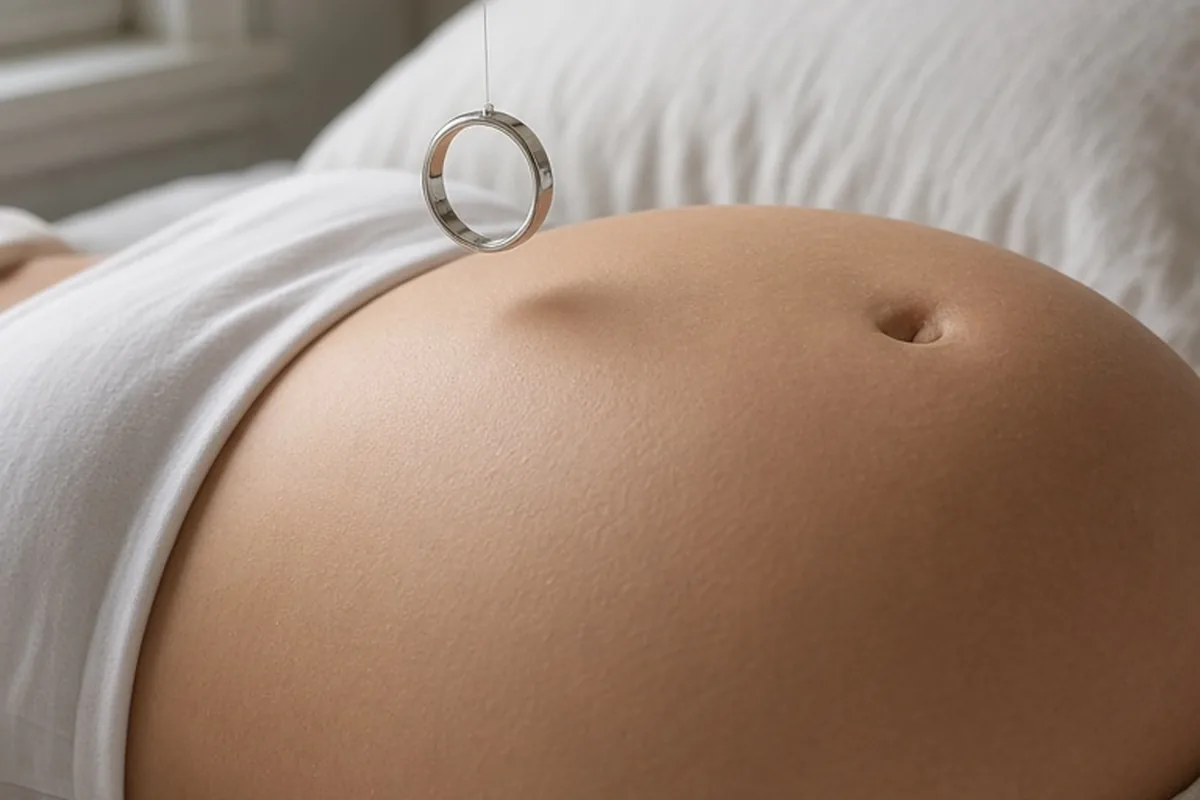
The wedding ring gender test is a traditional folk divination practice where a pregnant woman's wedding ring is suspended by a strand of thread or hair over her belly or palm. Believers interpret a back-and-forth swing as signaling a boy and a circular motion as signaling a girl, though some regional traditions reverse these meanings. Scientifically, the test relies on the ideomotor effect rather than biological signals, making it an entertaining parlor game rather than an accurate medical predictor.
Expectant parents often look for lighthearted ways to bond, celebrate, and pass the weeks while waiting to discover their baby's biological sex. Among the dozens of generational folklore methods shared by relatives, dangling a wedding band as an intuitive pendulum remains one of the most enduring traditions at baby showers and family gatherings.
How to Perform the Traditional Ring Over Belly Test
The traditional procedure for the wedding ring gender test requires only a few household items: the expectant mother's personal wedding band and a length of sewing thread or a long strand of her own hair. In folklore traditions, using the mother's wedding ring is thought to carry personal sentimental resonance, though any smooth metal ring or sentimental pendant is frequently substituted if a wedding band is unavailable or tight on swelling fingers. The thread is looped through the center of the ring so that the band hangs evenly without tilting to one side.
To begin, the pregnant person typically lies flat on her back on a comfortable bed or sofa, exposing or lightly covering her abdomen. The person holding the pendulum—often a partner, mother, or close friend—rests their elbow firmly on a stable table or knee to minimize voluntary arm fatigue. They hold the end of the thread between thumb and forefinger, suspending the ring approximately two to three inches directly above the center of the belly. The holder holds the ring completely still for several seconds to establish a baseline before letting go of any manual stabilizing tension.
An alternative variation adapts the test for early pregnancy or postpartum reflection by dangling the ring over the palm of the left hand or the inside of the wrist instead of the abdomen. The tester holds the ring over the open, upturned palm, gently taps the metal against the skin three times to calibrate the motion, and then lifts it back into the air. In both variations, the participants sit quietly and watch for the suspended metal to establish a distinct, rhythmic swinging trajectory on its own.
Interpreting Ring Swings: Circles, Lines, and Regional Reversals
The primary folklore interpretation of the ring test relies on distinguishing between a circular rotation and a straight, pendulum-like line. In the most common North American and Western European conventions, a ring that swings in a clear back-and-forth straight path indicates a baby boy. Conversely, if the ring begins tracing a circular or elliptical path around the center point, the folklore assigns that motion to a baby girl.
However, interpretive traditions are far from universal, which often creates lively debates among family members from different cultural backgrounds. In several Southern US folk traditions and parts of Eastern Europe, the assigned meanings are reversed: circular motion is thought to represent masculine energy, while linear motion is believed to represent feminine energy. Other local variations suggest that a side-to-side swing across the hips indicates one sex, while a head-to-toe linear swing indicates the opposite.
Some extended versions of the test claim to predict the total number and birth order of all future children. In these multi-child rituals, observers wait for the ring to complete its first pattern, watch it come to a natural pause, and observe whether it starts moving again. If the ring resumes swinging in an alternating pattern after a momentary standstill, believers interpret each subsequent movement cycle as an additional sibling. When the ring stops moving entirely and remains suspended in place, the ritual is considered complete.
The Science Behind the Swing: The Ideomotor Effect Explained
While it can feel as though an external magnetic, biological, or spiritual pull is commanding the ring, the motion is entirely explained by a well-documented psychological and neurological phenomenon known as the ideomotor effect. The ideomotor response occurs when a person makes tiny, involuntary muscular contractions in their fingers, wrist, or arm based on an unconscious expectation or subtle suggestion, completely without deliberate intent.
When an individual holds a thread suspended in midair, keeping their hand perfectly stationary over an extended period is physiologically impossible due to natural postural sway and micro-tremors. If the person holding the thread anticipates that the ring will swing in circles, their nervous system transmits microscopic muscular adjustments to the fingertips that gently encourage circular momentum. Because the pendulum amplifies even the most imperceptible micro-movements into visible swings, the observer genuinely feels that the ring is moving of its own accord.
Scientific demonstrations of pendulums and dowsing tools consistently confirm this mechanism. When the person holding the string is blindfolded or has no prior knowledge of the mother's hopes, or when the thread is suspended from a stationary mechanical tripod or ceiling hook rather than a human hand, the ring does not generate directional swinging patterns. Because the movement relies on human suggestion rather than fetal hormones or maternal physiology, the test operates with the same baseline odds as a random coin flip.
Setting Boundaries and Managing Expectations at Family Gatherings
The wedding ring gender test is frequently introduced at baby showers, holiday dinners, or casual weekend visits as an icebreaker. While many expectant parents welcome the nostalgia and warmth of participating in a shared family ritual, pregnancy can also bring physical exhaustion, heightened sensitivity, and boundary challenges. A pregnant person has every right to decide whether they want their belly examined or hovered over by relatives.
If you want to participate, establishing clear emotional framing beforehand keeps the activity fun and lighthearted. Treating the ritual strictly as an affectionate party game rather than an authoritative prediction prevents unwanted tension, especially for parents who are navigating gender disappointment, high-risk pregnancy stress, or strong preferences. Reminding well-meaning relatives that the swing is an entertaining curiosity prevents guests from treating the outcome as a settled fact.
For parents who prefer not to participate, simple, warm boundary-setting works best. You might say, 'We are saving all our predictions for the medical ultrasound, but thank you for thinking of us,' or 'I am keeping my belly touch-free today, though you are welcome to test the ring over your own wrist for fun.' A clear, gracious pivot allows friends and family to express their excitement without imposing uncomfortable physical intimacy or unsolicited folklore onto the parent.
Clinical Sex Determination Options for Reliable Medical Planning
While generational guessing games provide nostalgia, reliable nursery planning, baby registry purchases, and official announcements should rely on validated clinical screenings. Modern obstetrics provides several distinct methods for discovering fetal sex, each tailored to different stages of pregnancy, medical needs, and diagnostic precision.
The earliest routine clinical method is non-invasive prenatal testing, commonly referred to as an NIPT blood screen. Available starting around the tenth week of pregnancy, this maternal blood draw isolates cell-free fetal DNA circulating in the pregnant mother's bloodstream. While the primary medical purpose of NIPT is screening for common chromosomal conditions such as Down syndrome, trisomy 18, and trisomy 13, the analysis can also identify the presence of Y-chromosome material, providing accurate determination of fetal sex long before anatomical features are visible.
The most widespread anatomical method is the mid-pregnancy anatomy ultrasound, typically scheduled between the eighteenth and twenty-second weeks. During this comprehensive examination, an ultrasound technician systematically evaluates the baby's structural development, organ formation, amniotic fluid levels, and placental placement. If the fetus is positioned favorably and privacy settings permit, the technician can directly visualize external genitalia to determine sex. Parents who require diagnostic confirmation for medical reasons may also learn fetal sex through chorionic villus sampling or amniocentesis, though these invasive procedures are reserved strictly for clinical genetic evaluations rather than curiosity.
Creative Ways to Include the Ring Test in Modern Baby Showers
If you enjoy the charm of old wives' tales and want to incorporate the wedding ring test into a contemporary celebration, structuring it as an interactive game keeps guests engaged. Rather than relying on the ring test alone, hosts often set up an 'Old Wives' Tale Prediction Station' featuring a collection of classic folk tests. Guests can compare the ring test's motion against the expectant mother's sweet versus salty food cravings, morning sickness patterns, the shape of the baby bump, and ancient calendar charts.
To run the activity smoothly, display a small chalkboard or decorative card outlining the house rules for the swing direction so that all guests follow the same interpretation. Provide a tracking poster or tally board where attendees cast their votes for team boy or team girl based on the collective results of the folklore games. This turns an individual superstition into a collective group memory that sparks conversation between generations.
To maintain comfort and autonomy, consider pairing the ring test with the mother's palm or wrist rather than her bare abdomen if the event is held in a large public venue or mixed company. Testing over the hand preserves personal space, protects clothing, and allows multiple guests or partners to try the pendulum technique on themselves, keeping the focus entirely on laughter, community, and celebration.
Frequently asked questions
Can the wedding ring gender test be done on someone who is not pregnant?
Yes, many folk traditions perform the ring test over the palm or wrist of individuals who are not pregnant to supposedly divine the total number and gender of children they will have throughout their lifetime. Scientifically, the ring will still swing because involuntary micro-movements of the holder's hand occur regardless of pregnancy status.
Does it matter whose wedding ring is used for the test?
Folklore tradition often emphasizes using the pregnant mother's wedding band or a close relative's sentimental ring to maintain personal connection. Mechanically, any lightweight, symmetrically balanced ring or small metal pendant suspended on a thread produces the same pendulum effect.
Why did the ring test correctly predict my baby's gender?
Because fetal biological sex is binary, any random prediction has an inherent fifty-percent probability of being right purely by chance. When thousands of parents try the test, half will naturally see a swing that aligns with their eventual ultrasound or birth results.
Can the wedding ring test detect twins or multiple pregnancies?
Some folk accounts suggest that a ring switching between circular and linear patterns signifies twins, but there is no scientific basis for this claim. Multiple gestations can only be diagnosed accurately through clinical medical imaging such as an obstetrical ultrasound.
Your next step
Decide whether you want to enjoy the wedding ring test as a playful family keepsake, and schedule a clinical NIPT screen or mid-pregnancy ultrasound for reliable planning.