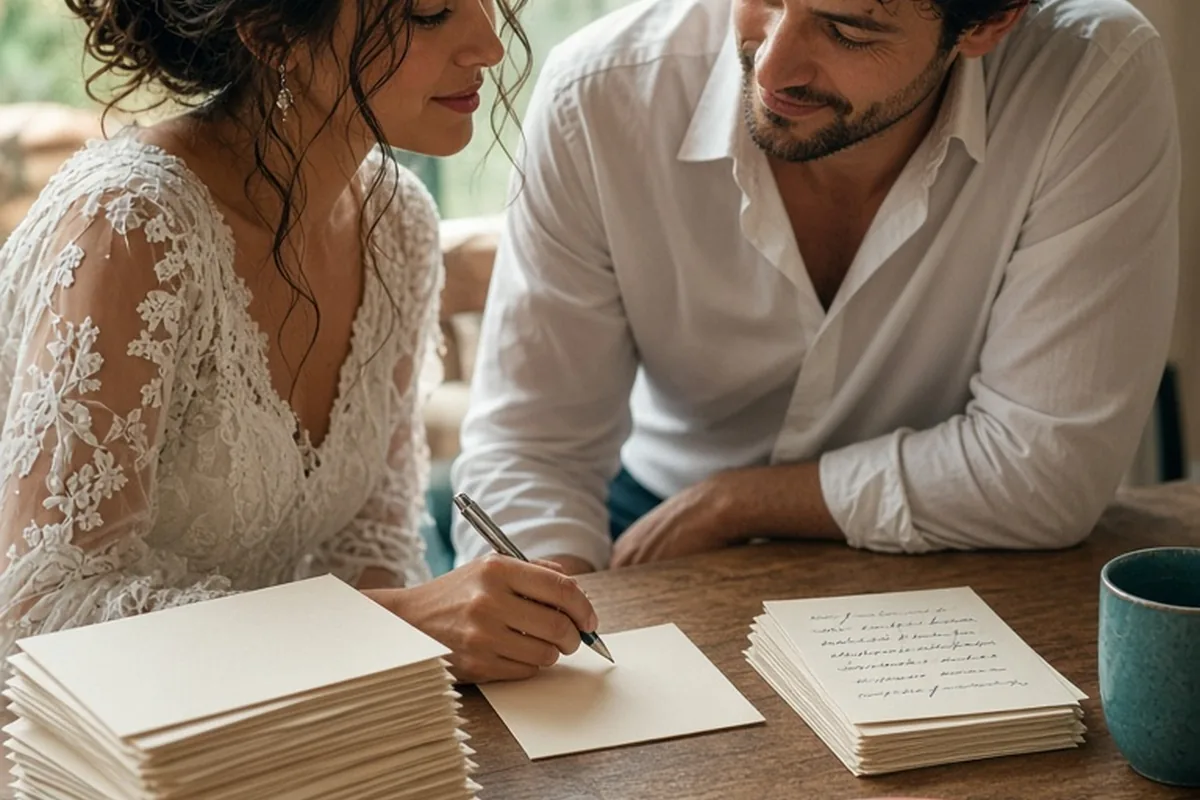
Writing thank you notes for 200 guests requires a modular four-part formula: name the specific gift, mention how you plan to use it, reference a shared wedding memory or future connection, and reaffirm your gratitude. To manage the volume without burnout, split the list evenly between partners and write 10 to 15 personalized cards per day over three to four weeks rather than attempting marathon writing sessions.
A wedding with 200 guests typically generates between 80 and 130 individual thank you cards, accounting for couples, families, and group gifts. While expressing genuine appreciation is essential, staring at a massive stack of blank stationery can quickly trigger decision fatigue and hand strain. By adopting reliable wording structures and a sustainable assembly routine, you can produce warm, personalized notes efficiently without sounding repetitive or mechanical.
The Core Four-Sentence Formula for High-Volume Cards
When handling a large volume of correspondence, having a standardized structural blueprint protects you from staring at blank cards wondering how to begin. A successful wedding thank you note does not need to be a long essay; in fact, concise messages of three to five sentences are often warmer and easier to read. The structure begins with an immediate expression of thanks that names the exact item or gesture, followed by a sentence explaining how the gift will be enjoyed in your daily routine. The third sentence connects back to the guest, whether referencing a moment from the reception, acknowledging their travel distance, or expressing a desire to see them soon. The final sentence closes with a warm restatement of appreciation.
To illustrate how this framework operates in practice, consider a standard registry item like a Dutch oven. A complete note using this formula reads: 'Dear Aunt Claire and Uncle Mark, Thank you so much for the beautiful enameled Dutch oven from our registry. We are already planning our Sunday dinner menu and cannot wait to make our family beef stew recipe in it. It meant so much to celebrate with you on our wedding day, especially seeing you out on the dance floor during the last song. Thank you again for your generous gift and your continuous love and support.' This structure keeps the message distinct and personal while taking less than two minutes to write.
Wording Templates for Registry Items, Physical Gifts, and Heirlooms
Physical presents generally fall into three categories: items you specifically selected on a registry, off-registry household goods, and sentimental keepsakes or handmade heirlooms. For standard registry goods, focus on the practical utility of the item and your excitement to integrate it into your shared home. If the gift is an off-registry item that you love, highlight the personal thoughtfulness of the selection. For example: 'Dear Sarah, Thank you so much for the hand-thrown ceramic vase. The blue glaze matches our living room perfectly, and it is already holding fresh eucalyptus on our entryway table. Having you by our side at the ceremony made the day complete, and we hope you will come over soon for dinner to see the new place.'
Handmade gifts, family heirlooms, and vintage items require an extra touch of emotional reverence because the giver invested significant time or sentimental value into the gesture. When thanking someone for a handmade quilt, embroidered linen, or passed-down piece of china, emphasize the heirloom quality and the care behind it. You might write: 'Dear Grandma Helen, Thank you from the bottom of our hearts for the gorgeous hand-knitted blanket. Knowing how many hours you spent crafting this for us makes it one of the most meaningful treasures in our home. Having you witness our vows meant the world to us both. Thank you for your endless love and for giving us a piece of family history we will cherish forever.'
Nuanced Phrasing for Cash Gifts, Honeymoon Funds, and Group Contributions
Traditional wedding etiquette dictates that you should never state the exact dollar amount of a monetary gift in writing. Instead, refer to the contribution as a 'generous gift,' 'kind financial contribution,' or 'thoughtful support.' The key to writing a sincere note for cash or checks is to explicitly state the goal or experience that the funds will support, such as a home renovation project, a down payment, or a specific honeymoon outing. For example: 'Dear Mr. and Mrs. Davis, Thank you so much for your generous gift. We are putting your kind contribution directly toward our honeymoon scuba diving excursion in Belize. We loved chatting with you during cocktail hour and are so grateful for your friendship and support as we begin married life.'
When dealing with online honeymoon registries, cash funds, or group gifts from coworkers, the same rule applies, with adjustments for the collaborative nature of the gesture. For group gifts, send individual handwritten notes to every contributor rather than one shared card whenever possible, as this acknowledges each person's individual generosity. For an office collection, a suitable template is: 'Dear Michael, Thank you so much for contributing to the espresso machine that the marketing team gifted us. It has already upgraded our morning routine tremendously. Thank you for your warm wishes and for making our return to work after the wedding so joyful.'
Tailoring Notes for Guests Who Traveled, Sent Regrets, or Provided Services
A 200-guest wedding inevitably includes guests with unique circumstances, such as attendees who traveled long distances, friends who could not attend but sent gifts, and loved ones who provided hands-on help or professional services. When acknowledging guests who spent significant money on flights and accommodations, prioritize acknowledging their physical presence over any material gift. A gracious note reads: 'Dear Jessica, Thank you so much for making the long trip from Chicago to celebrate our wedding. Having your energy in the room and catching up over brunch the next morning made our weekend unforgettable. Thank you as well for the lovely set of wine glasses; we will toast to you every time we use them.'
For guests who sent a card or gift but were unable to attend in person, explicitly mention that their presence was missed while thanking them for their kindness. For example: 'Dear Robert and Linda, Thank you so much for the beautiful serving platter and your warm wishes. We missed having you with us on our wedding day, but we felt your love and support from afar. We hope to catch up in person the next time we visit Ohio.' When thanking friends or family members who contributed services—such as baking desserts, managing the guest book, or arranging flowers—highlight their talent and labor as their primary gift: 'Dear Megan, Thank you so much for coordinating our ceremony music. Your talent brought so much calm and beauty to our day, and we could not have done it without you.'
Managing the Logistics of 200 Handwritten Wedding Thank You Notes
Successfully completing approximately 100 or more handwritten cards requires an organized system before writing a single word. Maintain a centralized digital spreadsheet that tracks guest names, mailing addresses, the exact gift received, whether the gift arrived before or during the wedding, and the date the card was mailed. Using columns to assign who is writing which note prevents duplicate efforts between partners. Dividing the total count equally ensures that neither person carries the entire cognitive or physical load of the task.
Pacing and workspace ergonomics are critical when working through a large stationery order. Attempting to write dozens of notes in a single weekend often leads to rushed handwriting, repetitive phrasing, and wrist fatigue. Instead, establish a daily rhythm of writing five to seven cards each morning over coffee or ten cards each evening. Ensure you have high-quality pens that do not smear, pre-printed return address labels or a custom stamp to save wrist strain, and a complete set of postage stamps on hand before you begin.
Timeline Expectations, Etiquette Rules, and Handling Delayed Cards
There is a persistent myth that couples have an entire year to send wedding thank you notes. In modern social etiquette, the standard expectation is to send all cards within three months of returning from your honeymoon, or within three months of the wedding date. If gifts arrive prior to the wedding date, it is acceptable and often helpful to write and send thank you notes immediately upon arrival, which reduces your post-wedding workload considerably. For large weddings of 200 guests, completing the project within eight to twelve weeks is a realistic and respectable target.
If unexpected circumstances, relocations, or work demands delay your cards beyond the three-month mark, do not let embarrassment stop you from sending them. A late thank you note is always vastly better than no note at all. When writing delayed cards, avoid lengthy explanations, defensive excuses, or over-the-top apologies that take up the entire message. Simply include a brief, gracious opening such as, 'We have been thinking about how wonderful it was to celebrate with you, and we apologize for our delay in sending this note,' and then proceed with your standard four-sentence appreciation formula.
Frequently asked questions
Can I type my wedding thank you notes to save time for 200 guests?
Traditional wedding etiquette strongly favors handwritten notes because the tactile effort reflects personal gratitude. However, if you or your partner have a physical disability or condition that makes handwriting painful, typing your letters and adding a brief handwritten signature and greeting is completely acceptable.
Do I need to send a thank you note to someone who attended but did not bring a gift?
Yes, it is gracious practice to send a thank you card to non-gifting guests simply acknowledging their attendance and companionship. Express gratitude for their time, travel, and presence in celebrating your marriage.
How should we split writing thank you notes between partners?
The most balanced approach is to assign each partner their respective side of the family and mutual friends, while splitting neutral shared acquaintances down the middle. Both partners should sign each card, regardless of who physically writes the message.
What should I write if I received a gift I genuinely dislike or plan to return?
Focus entirely on the giver's kindness, generosity, and thoughtfulness rather than the specific item itself. Thank them warmly for their warm wishes and support without mentioning returns, exchanges, or your personal aesthetic preferences.
Your next step
Open your guest list spreadsheet today, verify all return addresses, and commit to writing your first batch of ten cards together this evening.